
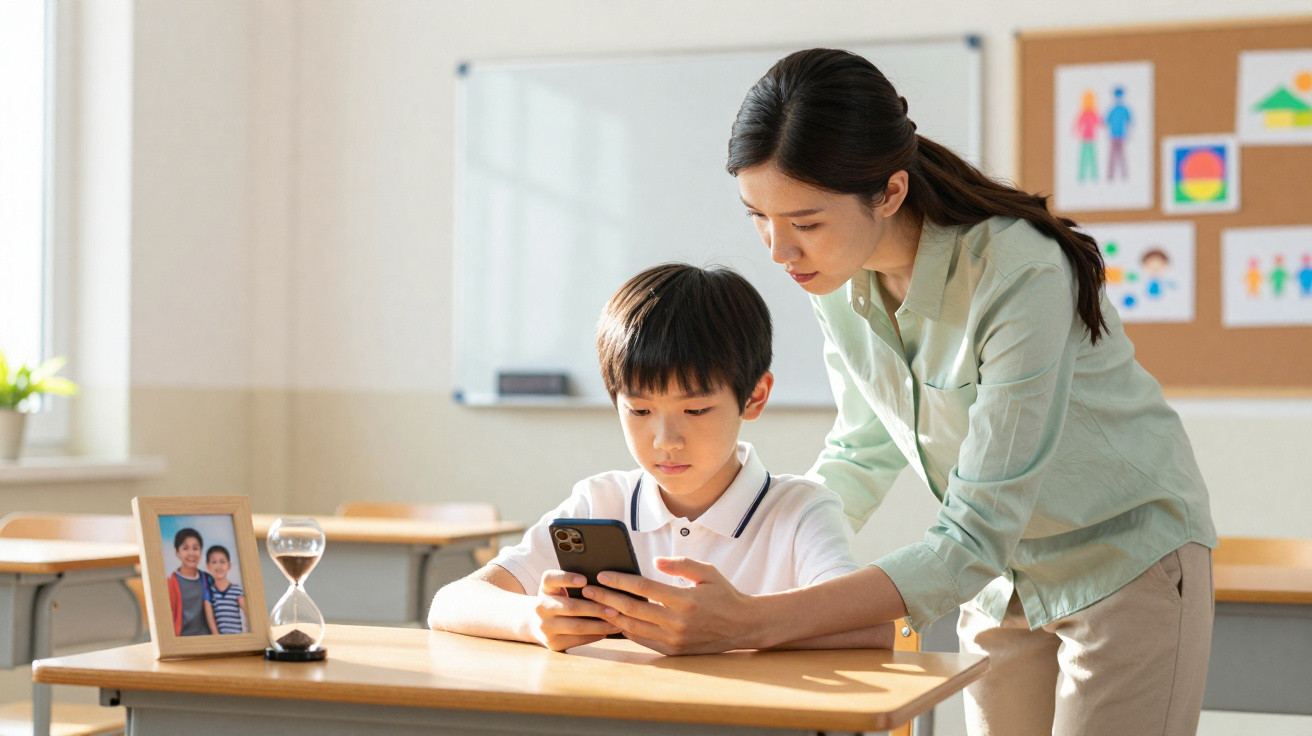
Early access to social media has effects on children’s cognitive and socio-emotional development that are difficult to reverse. Teachers and psychologists observe them in classrooms and consulting rooms, and are calling for stronger regulation. World Social Media Day is marked this Tuesday.
Social media and children’s attention in the classroom
"One of the first things I notice is their ability to sustain attention for a consistent period - long enough to learn something and retain knowledge," says Rita Mendes.
A music teacher, Rita Mendes is herself active on social media, where she has tens of thousands of followers. However, she takes a critical view of minors being on these platforms: they should not be there.
In February, Portugal’s Parliament gave initial approval to a PSD bill proposing to regulate social-media access for under-16s. A number of countries have recently debated this approach, recognising the risks faced by children and young people.
Two weeks ago, British Prime Minister Keir Starmer announced that the United Kingdom would join Australia in banning under-16s from accessing the main social-media apps. At the time, Rita Mendes welcomed the decision in a video posted on TikTok.
For World Social Media Day, marked this Tuesday, Lusa spoke to the teacher and the Portuguese Psychologists’ Association about how the risks of early access can be seen in classrooms and consulting rooms.
Working with pupils from pre-school through to the third cycle of basic education, Rita Mendes says it is easy to tell which pupils have access to social media and which do not.
Alongside difficulty concentrating, she identifies gaps in vocabulary among the more "digital" children, as well as greater difficulty expressing their feelings or, for instance, describing a conflict that took place during break time.
"On social media, there is a constant absorption of content, but nothing is truly taken in because the brain has no time to retain it," she explains, contrasting this with reading, where "the brain has time to absorb the text and process it".
Language, emotions and screen exposure
Psychologist Júlio França also points to the effect of early access on language development. He says this is particularly linked to the absence of a suitable setting in which such skills can develop.
"Whether it is through spending time with parents, friends or at nursery, there is a whole range of behaviours that act as models and support language development," he says, adding that in an unsuitable setting, "language can develop, but with errors".
For younger children, Júlio França, a member of the Educational Psychology Specialist Council of the Portuguese Psychologists’ Association, also identifies effects on emotional regulation and motor development. Older children are likewise at risk from screen exposure, particularly when it is excessive.
"When we are talking about older children, social media can bring other kinds of consequences, linked to exposure to content that is not suitable for that stage of development," he stressed, citing violent, hate-inciting or sexual content as examples.
On the other hand, placing social interaction in a secondary role undermines the development of socio-emotional skills. In this regard, the psychologist recalls the effects of Covid-19 pandemic lockdowns, while also highlighting the addictive potential of digital platforms.
"I see this too in some of the children I work with. It seems that time is never enough; they always need more," he says.
Júlio França and Rita Mendes acknowledge that "not everything is bad" on social media, but agree that, when weighed against each other, the negative aspects significantly outweigh any potential benefits.
Regulation of social media access for under-16s
Regarding the option of banning minors from social media, the teacher believes this would be the ideal scenario. She accepts, however, that it is a challenging goal, as children often show greater knowledge of new technologies than adults.
"Some parents allow their children to use social media, but monitor very actively what they consume and the time their children spend on their phones," she says as a positive example, while noting that "most parents do not have that availability".
"Without regulation, there are various dangers," Júlia França stresses, warning that many of these consequences "can then be very difficult to resolve".






Comments
No comments yet. Be the first to comment!
Leave a Comment