
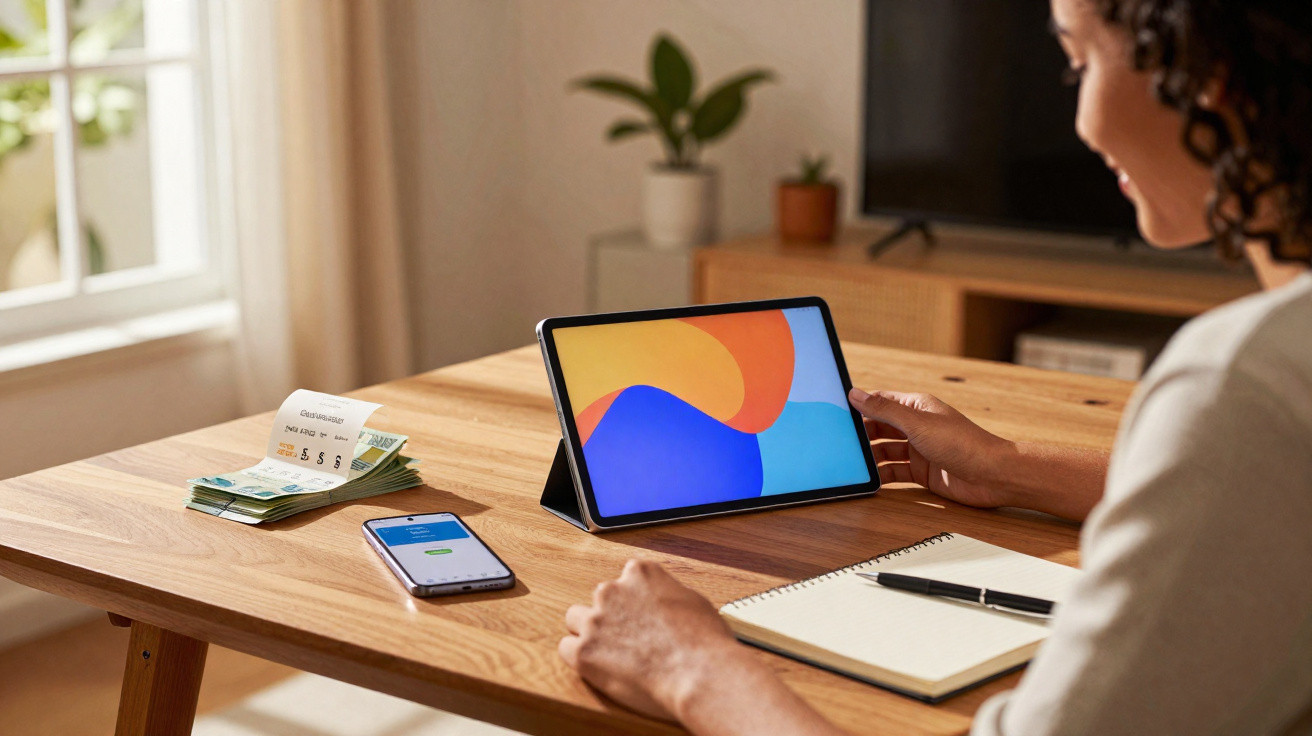
“Galaxy Tab S8 mega sale – premium spec, budget price.” At first glance, it seemed like one more loud advert, the sort you dismiss before it has properly registered. But the figures felt different. A tablet that once seemed like an out-of-reach indulgence was suddenly beginning to look “actually possible”.
The following day, I saw a young couple in an electronics shop, phones in hand, silently working out the sums while comparing price labels, trade-in deals and screenshots of their bank balances. When they arrived at the Tab S8 display, their expressions changed. You could almost see the instant it shifted from “luxury” to “perhaps, just perhaps, now”.
That small change reveals plenty about the direction of technology – and household budgets. It also explains why this Samsung sale is attracting so much attention.
When the Galaxy Tab S8 goes from “too expensive” to attainable
The Galaxy Tab S8 arrived as a premium-tier device. It offered a speedy Snapdragon 8 Gen 1 processor, a 120 Hz display, an included S Pen and a refined aluminium chassis – the full serious-kit package. For a long while, it sat in the category of technology people admire, try briefly, regretfully admire again, then leave on the shop display.
The price labels in this mega sale are now subtly changing that narrative. A tablet once associated with productivity-focused YouTube channels and designers’ desks is entering the same bracket as discounted mid-range laptops and mid-tier phones. Rather than thinking, “I’ll buy a basic tablet for Netflix”, shoppers may now wonder, “hang on, can I move up to premium for only a little more?”.
The divide between a compromise purchase and a genuine work-and-play machine has seldom been so narrow. That is why this offer feels like more than a promotion; it feels like a turning point.
A student in Lyon told me she had intended to purchase an inexpensive Android tablet purely for lecture PDFs. She entered a chain retailer with a firm budget, prepared to choose whichever entry-level model matched the figure in her notes app. Then she spotted the Tab S8 sale label, priced perhaps €80 above her target.
She did what most people would: paused, left the shop, checked online prices in the car park, rang a friend and returned fifteen minutes later. “I realised that if I bought the cheap one, I’d also end up buying a laptop next year,” she said. “With the discount, this felt more like a small laptop in tablet form.”
Search behaviour suggests a similar trend: searches for “Galaxy Tab S8 sale” and “Tab S8 vs cheap tablet” rise at the same time. When premium technology reaches sale-price territory, shoppers do more than browse – they compare, calculate and raise their expectations.
On the surface, this mega sale concerns pricing. In practice, it is about value over time and buying at the right moment. Hardware quickly becomes old news in technology headlines, but the Tab S8 remains surprisingly capable. Its Snapdragon processor still handles multitasking briskly. DeX mode can still make it function like a laptop when paired with a keyboard. And the S Pen remains well ahead of the generic styluses supplied with budget devices.
Price reductions make the greatest impact when hardware has reached the stage of being “good enough for years”. That is exactly where the Tab S8 sits today. The launch excitement has passed, yet for most people’s day-to-day needs – streaming, note-taking, light editing and evening gaming – the performance difference between it and newer, more expensive models is limited. Every euro removed from the price therefore moves it closer to the point where the question changes from “Is it the latest?” to “Is it smart?”.
This is the point at which the deal becomes as psychological as it is financial.
How to make the Galaxy Tab S8 sale a genuinely smart purchase
The first useful step is to decide what you want the Tab S8 to do before the discount wins you over. It sounds straightforward, but sales can distort our judgement. Will it replace a laptop for studying or remote work? Is it mainly for streaming series and gaming? Or will you use it for drawing, writing or managing a small business from the sofa?
After identifying that main purpose, examine the sale configurations: storage capacity, Wi-Fi or 5G, and whether a keyboard bundle is included. A cheaper price for the wrong model may cost more later if you reach its limits and have to buy accessories or pay for extra cloud storage. If you expect to manage large files, edit photographs or download content for travel, the higher storage option in the sale may be more valuable than it initially appears.
Then consider the ecosystem rather than rushing past it. If you already use a Samsung phone or Galaxy Buds, the Tab S8 integrates into your routine in a way that a random Android tablet may not. Notes synchronise automatically, hotspot access is straightforward, copying and pasting between devices is easy, and Quick Share is available. Those small moments when everything simply connects add an unseen kind of value. That is where a discount can multiply its benefit rather than merely reduce a price.
Many shoppers make the same mistake during major electronics sales: they pursue the largest percentage reduction, only to feel disappointed after the novelty has worn off. A useful reminder is that a tablet is not merely an enlarged phone. If your use extends only to Instagram browsing and TikTok scrolling, even a discounted premium tablet could end up gathering dust beside the sofa.
A second common oversight is ergonomics. The Tab S8 is thin, but the right keyboard or cover can transform the experience. Without one, you may find yourself bent over a coffee table, telling yourself you will “set it up properly later”. Let’s be honest: nobody really does that every day. Choosing a suitable stand or case from the start may determine whether it becomes a tool you use or an object you admire from a distance.
There is also an emotional element that people rarely acknowledge. During a major sale, it is easy to purchase the aspiration rather than the device. If your aspiration is “I’ll finally be organised, creative, productive”, stop and consider which small habit you are realistically prepared to change once you have opened the box.
“I bought the Tab S8 on sale thinking it would magically turn me into a note-taking machine,” a young architect told me. “What helped wasn’t the tablet. It was blocking 20 minutes every morning to sit with the S Pen and my tasks. The tablet just made that moment nicer.”
To keep the purchase practical rather than purely emotional, it can help to base it on a few specific benefits:
- One frustrating daily task the Tab S8 will make easier, such as invoices, class notes or sorting emails.
- One modest pleasure it will improve, such as reading comics, watching sport or sketching ideas.
- One future situation in which a capable tablet prevents you from needing to buy additional equipment.
This does not take away the enjoyment of finding a good deal. It simply gives that enjoyment a form that fits your actual life.
Why the Galaxy Tab S8 mega sale reflects a wider tech and budget story
The Tab S8 mega sale is not taking place in isolation. Inflation has quietly encouraged many people to keep devices for longer, repair rather than replace them, and wait for meaningful discounts. Premium tablets were once impulse purchases for enthusiasts. They have become considered investments for students, freelancers and families seeking one screen that can cover education, work and entertainment.
When a company such as Samsung heavily discounts a still-capable flagship, it communicates something important: the key battleground is not simply the newest specifications, but whether a purchase feels fair. People favour products that seem able to last four or five years without becoming embarrassingly outdated. With its understated design and powerful internal hardware, the Tab S8 performs well over the long term. It is no longer the gleaming new gadget, which, oddly, makes it a more straightforward purchase.
A quieter cultural change sits behind this too. On a train from Paris to Marseille, I watched three forms of the same story: a child viewing cartoons on a cracked entry-level tablet; a freelancer switching between Gmail, Figma and Slack on a Tab S8 with a keyboard; and an older man reading the news on a mid-range iPad. The devices had the same rectangular form, but represented entirely different realities. The mega sale gives more people an opportunity to move from the first group to the second without having to leap straight to an ultra-high-end iPad budget.
We often discuss the digital divide between people who have devices and those who do not. Less attention is given to the gap between technology that barely copes and technology that is comfortably capable. Sales of this kind reduce that divide in a practical, everyday sense.
At a more personal level, the Galaxy Tab S8 deal poses a simple question: what does “premium” mean to you now? Is it the raw specifications, the logo on the back, the design of the camera bump, or the confidence that your device will not struggle when twenty browser tabs are open and a video call starts to stutter? For many people, premium is moving away from luxury and towards durability, away from showing off and towards remaining calm under pressure.
Most of us have experienced a device we only half trusted freezing at precisely the worst moment – while accessing boarding passes, giving live presentations or opening exam notes. A Tab S8 in discount territory does not magically remove technology-related stress, but it does put more people into a category where their tools are more likely to work quietly and reliably.
That may ultimately be the real headline beneath the flashing “MEGA SALE” banners.
| Key point | Detail | Why it matters to the reader |
|---|---|---|
| Premium hardware, lower price | Flagship chip, 120 Hz display, S Pen, discounted heavily | Access high-end performance without paying launch-day prices |
| Productivity and longevity | DeX mode, keyboard options, strong performance for years | Turn a “tablet” into a part-time laptop and long-term tool |
| Real-world value vs impulse | Align the deal with your habits, ecosystem and budget | Avoid buyer’s remorse and make the sale work for your life, not the other way around |
FAQ
- Is the Galaxy Tab S8 still worth buying in 2026? Yes, if the sale price is strong. Its processor, display and S Pen support still cover most everyday tasks, from study and remote work to media and casual gaming.
- Who benefits most from this mega sale? Students, freelancers, and anyone who was about to buy a cheaper tablet or basic laptop often gain the most, since they can step up to a more capable device for a similar budget.
- Should I get the keyboard cover with the Tab S8? If you type regularly – emails, reports, essays – the keyboard can turn the tablet into a light laptop. If you mostly stream and browse, a simpler stand case is usually enough.
- How does it compare to cheaper Android tablets? Performance, screen smoothness, S Pen integration and software support are on a different level. You feel it when multitasking, drawing, or holding video calls.
- What’s the main thing to check before buying during the sale? Storage and connectivity. Pick enough internal storage for your files and decide whether you truly need 5G, or if Wi-Fi is all you’ll realistically use.




Comments
No comments yet. Be the first to comment!
Leave a Comment