
Add us to your favourites on Google
Why add us? Get Zona Militar news on Google.
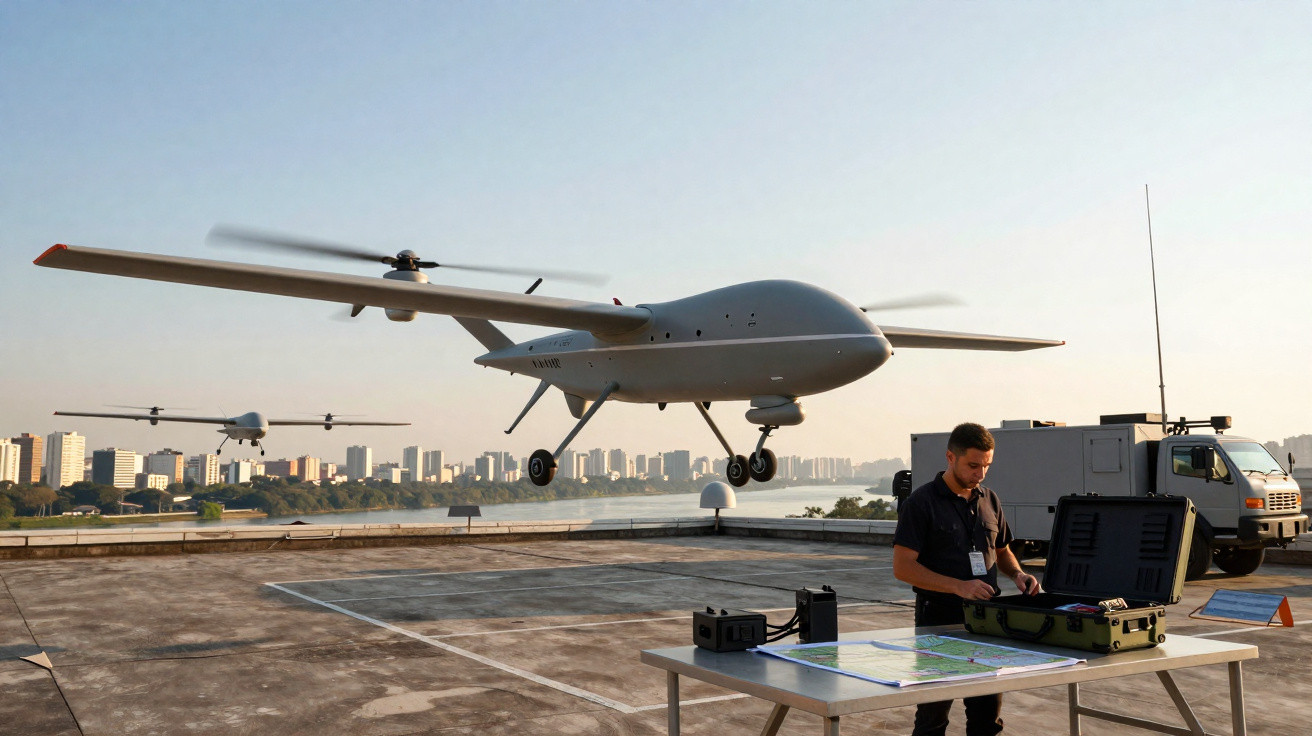
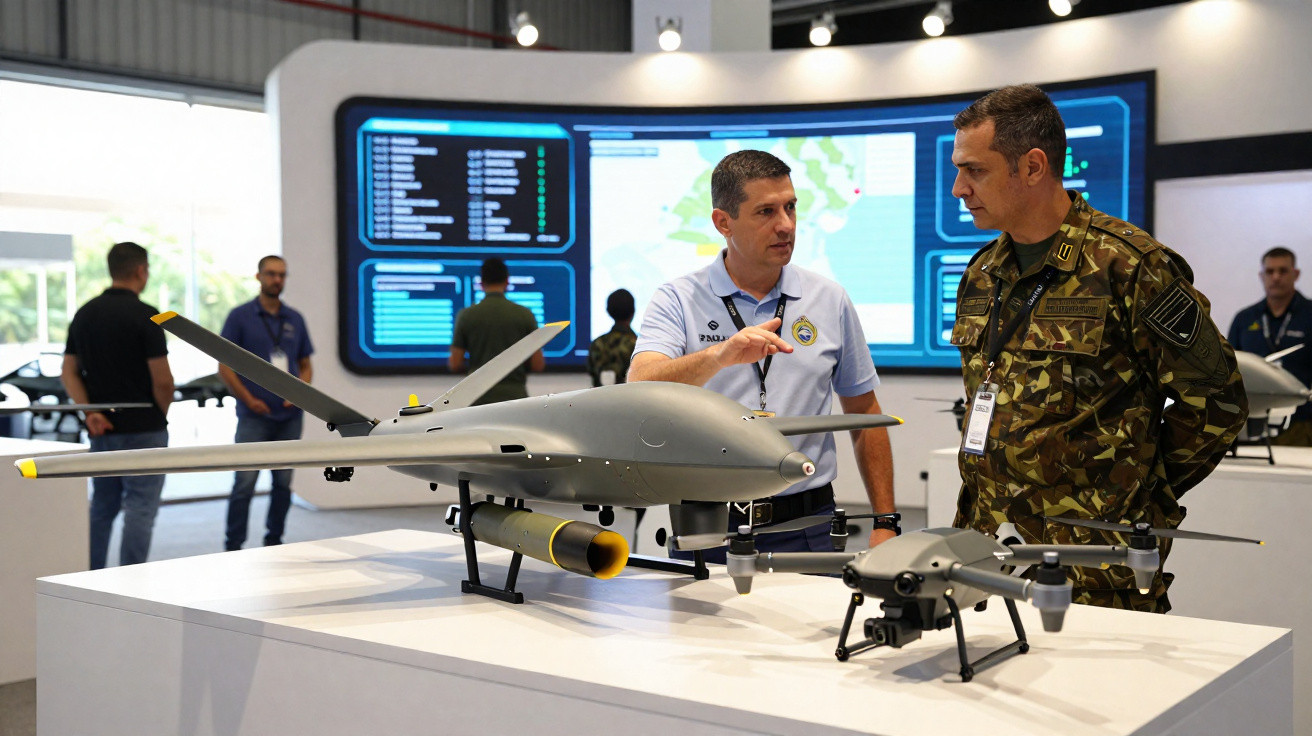
During DroneShow 2026 in São Paulo, Zona Militar’s Brazil correspondent, Angelo Nicolaci, visited the XMobots stand, where the company displayed its Nauru family of Remotely Piloted Aircraft Systems (RPAS). Created to meet the needs of the defence, public-security and strategic-monitoring sectors, the aircraft range highlights the progress made by Brazil’s industry in Intelligence, Surveillance, Target Acquisition and Reconnaissance (ISTAR). It brings together solutions ranging from short-range tactical missions to long-endurance, highly complex operations.
XMobots representatives outlined the philosophy behind the Nauru family during the presentation. It was designed to provide scalable, interoperable platforms that share a common operating, logistics, command-and-control architecture. This approach is intended to make operator training easier, lower support costs and increase operational flexibility across different scenarios, allowing users to select solutions suited to their requirements while retaining standardisation.
Nauru RPAS platforms for tactical and strategic missions
The smallest system displayed was the “Nauru 100D”, an eVTOL platform intended for tactical surveillance, reconnaissance and monitoring of areas of interest. The system can be carried by just two operators, assembled quickly in the field, and has an endurance of up to two hours, with an operational range of between 20 and 30 kilometres.
Its vertical take-off and landing capability removes the need for runways or prepared sites, greatly increasing its operational flexibility in urban environments, remote areas and difficult-to-reach regions. The company highlighted straightforward field assembly, the aircraft’s high degree of modularity-which enables rapid component replacement and simplified repairs even under operational conditions-and battery replacement in under one minute, reducing the time required to return to missions.
Another important point is that the Nauru 100D has recently completed its development and testing cycle, confirming its operational capabilities and demonstrating the platform’s maturity. According to XMobots, the system is already attracting interest from public-security agencies and armed forces considering its adoption for applications ranging from surveillance and monitoring missions to tactical reconnaissance operations.
In the intermediate segment, the company presented the Nauru 500C ISR, a hybrid platform using electric motors during vertical take-off and landing, while cruise flight is provided by an internal-combustion engine fuelled with standard petrol. Using this fuel lowers operating costs and simplifies refuelling logistics, an important consideration for operations far from major urban centres.
According to information supplied by the company, the system has an approximate endurance of four hours and an operational range of up to 60 kilometres. This allows persistent surveillance missions, border monitoring, critical-infrastructure protection and support for public-security operations. Alongside its ISTAR capabilities, the platform can also be fitted with systems for releasing explosive ordnance, adding an offensive capability to the aircraft and substantially broadening its potential employment in modern military scenarios. The combination of endurance, logistical flexibility and engagement capability makes the Nauru 500C ISR a versatile option for missions requiring not only the identification and tracking of targets, but also the ability to respond immediately when required.
Nauru 1000: long-endurance ISTAR and precision-strike potential
The main highlight of the presentation was the Nauru 1000, a system developed for more complex, long-duration strategic missions. The platform combines electric motors for vertical take-off and landing operations with an internal-combustion engine running on aviation gasoline (AvGas) in cruise flight.
Based on data presented at DroneShow 2026, the Nauru 1000 can remain operational for approximately 12 hours and operate at distances exceeding 100 kilometres. These characteristics position it as a solution for large-area surveillance, strategic reconnaissance, border monitoring and prolonged tracking of targets of interest.
In addition to its long-range ISTAR capabilities, the platform was designed to accept different payloads, including systems for releasing explosive ordnance. The company also disclosed that tests have already taken place involving the integration of anti-tank guided missiles (ATGMs), showing the aircraft’s potential for precision-strike missions and support to more complex military operations.
Command, control and electronic protection
XMobots also emphasised the robust command-and-control infrastructure associated with the Nauru family systems. The aircraft can be operated from mobile stations comprising dedicated consoles, computers and communications links, enabling real-time monitoring of both flight parameters and imagery generated by onboard sensors.
Depending on the mission profile, duties can be shared between different operators, with one responsible for flying the aircraft and another dedicated exclusively to operating the sensors and analysing the collected information. These stations can be installed in vehicles, vans, containers or mobile structures specially configured for extended operations.
In terms of electronic protection, the company highlighted several features incorporated into the Nauru family platforms. The systems continuously monitor navigation parameters, terrain profile and flight conditions, automatically carrying out safety procedures whenever necessary.
Among the features shown was an anti-jamming system able to detect electronic-interference attempts, alert operators and automatically change frequencies to preserve the command-and-control link. In critical situations, the systems can also initiate automatic return-to-base modes and emergency-recovery procedures intended to protect the aircraft.
Another significant aspect presented at DroneShow was the modular operational concept of the Nauru family. Beyond portable stations, XMobots offers systems installed in vehicles, vans and specialist containers, turning them into genuine mobile command-and-control centres. This capability significantly increases operator mobility and enables the systems to be deployed during extended operations and in remote environments.
The growing interest shown by military forces, public-security agencies and government institutions in the Nauru family platforms reflects the maturity achieved by Brazil’s unmanned-systems industry. In a context in which obtaining real-time information has become decisive to operational success, XMobots is seeking to establish its solutions as domestic alternatives capable of meeting the highest requirements of the defence and security sectors.
Completion of the Nauru 100D’s development and progress on the Nauru 500C ISR and Nauru 1000 programmes demonstrate the company’s commitment to creating national solutions that can reduce external dependencies and expand Brazil’s technological autonomy in a field that is increasingly strategic for defence and security.
Zona Militar will shortly visit XMobots’ facilities to examine the development and manufacturing process for its remotely piloted aircraft first-hand, as well as observe operational demonstrations of its solutions. This will allow an even more detailed assessment of the capabilities being developed by Brazil’s defence and technology industry.
You may also be interested in: Leopard: Brazil brings together platform operators and strengthens the sustainability of its armoured force





Comments
No comments yet. Be the first to comment!
Leave a Comment