
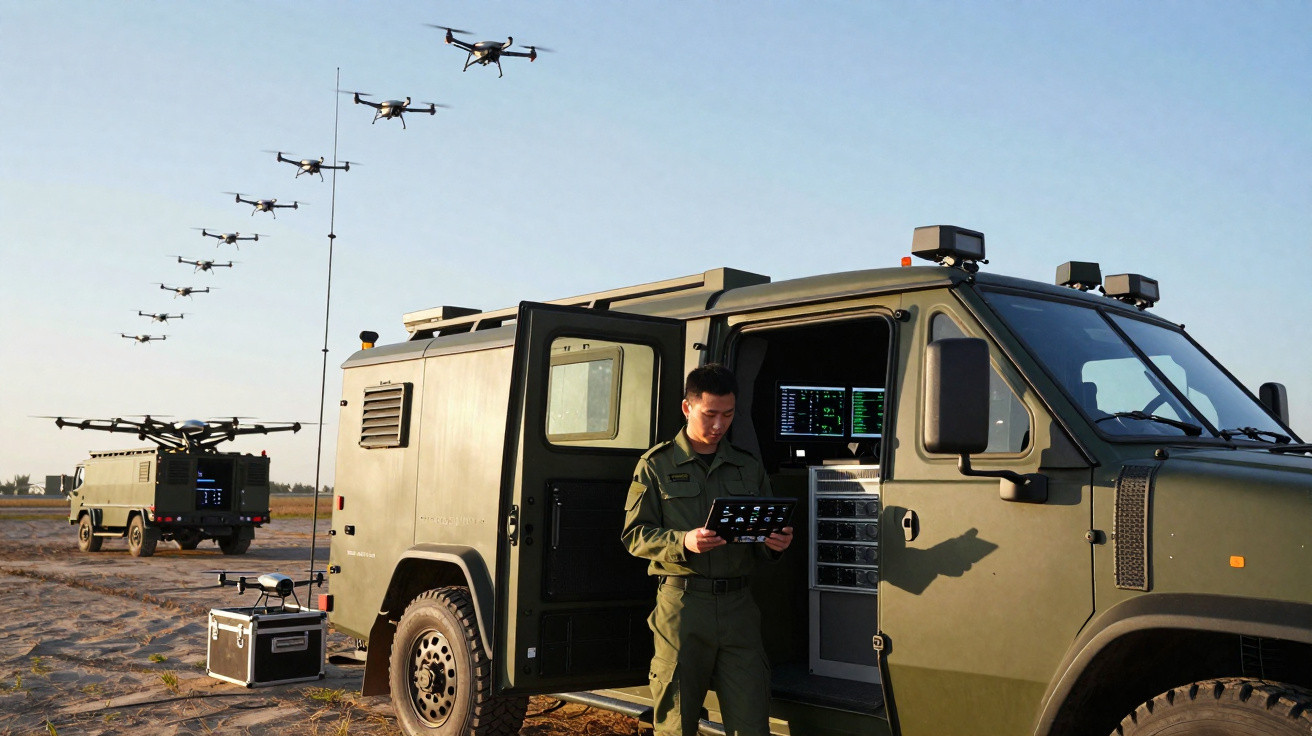
China has formally unveiled Atlas, a control-and-launch system for attack-drone swarms that combines autonomous capabilities with an end-to-end operational process. Its public presentation demonstrated the way it directs drones during coordinated missions, in a framework intended to broaden the use of such platforms across varied operational settings.
Atlas drone-swarm system and its vehicles
According to information released by China Central Television's (CCTV) military channel, Atlas consists of the Swarm-2 ground combat vehicle, a command vehicle and a support vehicle. Footage published by state media showed that the launcher vehicle bears the logo of China Electronics Technology Group Corp., the state-owned corporation responsible for developing electronic systems.
The Swarm-2 vehicle made its first appearance at Airshow China 2024 in Zhuhai, Guangdong province. Each unit can carry and launch 48 fixed-wing drones, while one command vehicle can direct as many as 96 drones at the same time. CCTV said that every drone can be fitted with different payloads, including electro-optical sensors, attack munitions and communications-relay equipment, enabling multifunctional swarms to be arranged in line with mission requirements.
Coordinated reconnaissance and drone launches
In a test-range demonstration, three similar targets were positioned within the area allocated for the exercise. According to the state-media report, Atlas carried out coordinated reconnaissance, autonomously determined which target was the command vehicle, opened its launcher and deployed drones that subsequently locked on to the target in flight and struck it accurately.
The report further stated that the Swarm-2 uses a mechanism that releases one drone every three seconds to ensure adequate separation between aircraft. This timing helps preserve safe flight paths and lowers the likelihood of interference among units, particularly in high-density aerial operations.
The order of deployment and the drone types can be set according to operational requirements. Reconnaissance drones may be sent ahead to gather information, while electronic-warfare units can be launched before attack drones to weaken enemy defences. Official information said this modular capability makes it possible to tailor swarm employment to a range of tactical scenarios.
CCTV said a swarm of close to 100 units can rapidly form dense, precise formations. The drones independently alter their flight paths in response to environmental factors, including airflow disturbances, using algorithms that support internal communications, real-time position updates and coordinated collision avoidance while manoeuvring.
State media also highlighted that a single operator can manage up to 96 drones during large-scale operations, in a process likened to “one person flying nearly 100 kites with a single line”. The system can integrate drones of varying sizes into the same swarm, allowing complementary roles in different operations.
Modular roles for Atlas attack-drone swarms
A Chinese military expert said the system expands battlefield employment options through modular configurations. He stated that swarms can be used to saturate air defences, conduct precision strikes through persistent surveillance, or carry out deep penetration at low altitude with small radar signatures. He added that these advances are underpinned by China's development of artificial-intelligence models intended to improve target recognition, task allocation and route planning in complex combat environments.
Image credits to the relevant parties.





Comments
No comments yet. Be the first to comment!
Leave a Comment