
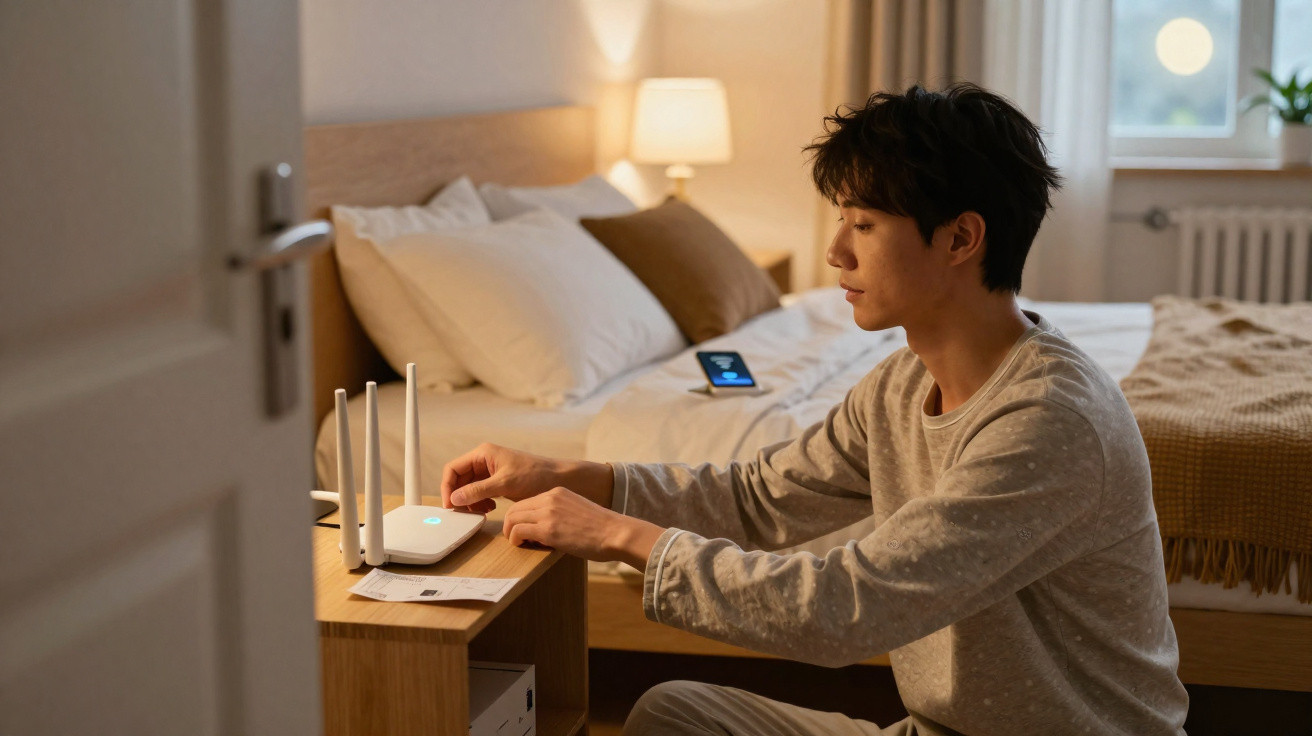
After a quick episode in the evening and one final glance at the phone, the lights go out – but the Wi-Fi stays on. For millions of households, this constant operation seems entirely normal. Yet a growing number of experts recommend deliberately switching off the router overnight. The aim is not only to save electricity, but also to support sleep and wellbeing.
Why Wi-Fi should take a break at night
In recent years, we have become used to being connected at all times. Smartphones, smart TVs, voice assistants and connected heating systems all rely on Wi-Fi. Our bodies, however, follow a very different pattern: they need distinct periods of activity and rest.
"Anyone who turns off their Wi-Fi at night sends a clear signal: it is now offline time – for the mind, the body and the following morning."
Wi-Fi routers emit radio waves around the clock. Their output is well below legal exposure limits, and their effects on the body are considered moderate. Even so, early research suggests that continual exposure to radio waves may affect sleep, particularly for people who are already sensitive or struggle to fall asleep.
How sleep relates to the “internal clock”
Our circadian rhythm determines when we feel sleepy and when we are alert. Light is its most important cue, although routines, sounds and digital stimulation also have an influence. Radio waves themselves are not the main concern; rather, they form part of a wider pattern of permanent availability.
Many people keep their phone beside the pillow because the Wi-Fi remains active. Messages, social-media alerts or push notifications can then arrive during the night. This fragments sleep, even if we do not remember waking up the next morning.
Consciously turning off the Wi-Fi in the evening creates a barrier. The temptation to scroll “just for a moment” is reduced. This behavioural change often has a greater effect on sleep than any new mattress.
What researchers say about radio waves and sleep
The evidence is not yet conclusive, but many research teams call for greater caution rather than complacency. Individual studies have reported:
- altered times for falling asleep with long-term exposure to radio waves;
- slight restlessness during certain sleep stages;
- differences in hormone balance, including the sleep hormone melatonin.
These findings do not justify dramatic warnings. However, they support reducing exposure where this can be done without any loss of convenience – and overnight is usually the easiest time to do so. Nobody streams while in deep sleep.
"Night-time is the simplest period in which to reduce radio-wave exposure, screen time and digital stimulation at once – a combination that can make sleep noticeably more stable."
The small energy user on the shelf
A router may seem insignificant: there is no motor or fan, only a few LEDs. Nevertheless, it consumes energy continuously. Many devices draw between 5 and 10 watts of constant power. That may sound minimal, but it runs 24 hours a day, 365 days a year.
Switching off the router for eight hours every night saves an average of around 2.4 kilowatt-hours per month. Over a year, that means several euros less on the electricity bill. It is not a major financial windfall, but it makes a point: not every device needs to run permanently.
Phantom power: the hidden electricity bill
Experts use the term “phantom power” for energy consumed by devices when nobody is using them. This includes:
- routers and modems running continuously;
- televisions and consoles on standby;
- power supplies left in the socket when no device is charging;
- smart speakers that are constantly listening.
In some households, this silent consumption accounts for a double-digit percentage of the annual electricity bill. Addressing it requires hardly any lifestyle sacrifice, while still noticeably reducing a household’s CO₂ footprint.
| Device | Typical standby power | Potential annual saving when switched off overnight |
|---|---|---|
| Wi-Fi router | 5–10 W | approx. 8–12 € |
| Television | 1–3 W | 2–5 € |
| Games console | 4–6 W | 5–9 € |
How to make switching off Wi-Fi part of an evening routine
The greatest benefit lies not in the technology, but in the habit. People who have to find the router manually each night, unplug it and reconnect it in the morning are unlikely to maintain that routine for long. A fixed automatic process works better.
Practical ways to switch off the router reliably
- Use a timer plug: A basic plug-in timer disconnects the router from the power supply at set times.
- Set a Wi-Fi schedule on the router: Many models include a menu setting that can disable the Wi-Fi function overnight.
- Use a switchable power strip: The router, television and console can be connected to one strip and switched off with a single click.
- Set an evening reminder on the smartphone: For many people, a brief 23:00 alarm labelled “Wi-Fi off” is enough of a prompt.
"The aim is not to be perfect, but to create a straightforward, dependable rhythm that works without having to think about it."
Households with children or teenagers benefit twice over. Once the Wi-Fi is off, it automatically sets a limit on screen use without laborious arguments about “just five more minutes”.
What if smart devices need to be online overnight?
Some homes rely on internet-connected alarm systems, heating controls or health devices. In these cases, it is worth examining the settings closely. Sometimes it is enough to deactivate only the Wi-Fi radio module while systems connected by LAN continue to operate. In other cases, individual devices can run via mobile data or their own wireless networks.
Anyone unsure should check which functions are genuinely required overnight. Does the robot vacuum need an app connection at three in the morning? Does the television need to download updates while everyone is asleep? The more consistently unnecessary functions are turned off, the more stable the home network remains – and the lower the security risk.
Health, the environment and money: the combination matters
Turning off Wi-Fi will not cure a sleep disorder overnight. It is better viewed as one element of a broader approach: less blue light in the evening, a consistent bedtime, a quiet bedroom and limited digital stimulation.
At the same time, every kilowatt-hour saved reduces demand on the electricity grid. A few kilowatt-hours may seem insignificant for an individual household. But if hundreds of thousands of routers pause every night, the combined load falls substantially. This effect matters more at a time of rising energy prices and strained grids.
"Turning off Wi-Fi at night is a small, very practical decision that neatly combines sleep hygiene, energy saving and a sense of responsibility."
A realistic everyday scenario
Consider a family of four that decides the network will be quiet from 22:30 onwards. Their router is connected to a timer plug that cuts the power at that time. After a few days, the parents notice they scroll less in the evening because there is a limit on the time available. The children know that, once the Wi-Fi ends, the gaming session must end too.
After several weeks, they begin sleeping slightly earlier and feel less tired in the morning. The annual saving appears as a small but visible item on the electricity bill. Nobody feels restricted; on the contrary, the clearer structure brings more calm to the evening.
Risks and limits of the trend
There are also circumstances in which Wi-Fi should remain active continuously. Anyone who depends on telemedicine, care-assistance systems or important remote-monitoring equipment at night should prioritise function over convenience. In such cases, it is better to optimise the set-up, for example through separate networks or by selectively switching off devices that are not needed.
It is equally unrealistic to expect switching off Wi-Fi to resolve every health issue. Its effect comes in combination with other habits: regular sleep times, physical activity, daylight and intentional offline periods in the evening. That is precisely where its appeal lies: many small adjustments can together make a noticeable difference – without radical changes, simply by clicking the router off.






Comments
No comments yet. Be the first to comment!
Leave a Comment