
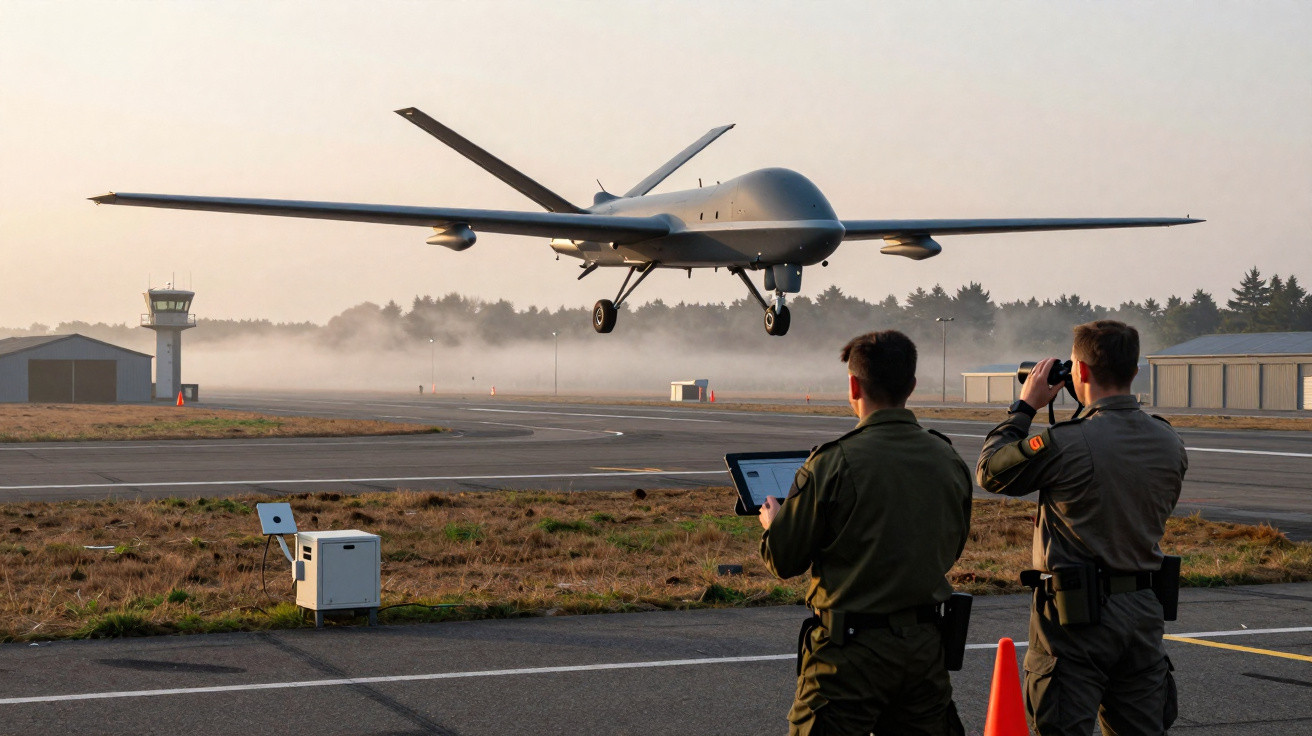
At Breuil aerodrome in central France, a new European military drone has entered its initial flight-test phase, representing another move in the continent’s effort to achieve greater strategic autonomy in the air.
A dawn take-off observed by the defence establishment
On Thursday 17 September 2025, the Aarok medium-altitude long-endurance (MALE) drone completed its first airborne trials from the small Breuil airfield in the Loir-et-Cher département. The aircraft was created by the French firm Turgis & Gaillard, a comparatively young yet ambitious defence supplier seeking to compete with bigger industrial groups.
A representative of France’s Direction Générale de l’Armement (DGA), the influential defence procurement body responsible for assessing and certifying new military equipment, observed the tests. This attendance suggests the flights were more than demonstrations: they formed the first stages of a formal qualification procedure.
The Aarok’s first takeoff at Breuil shows that France’s domestic drone industry is moving from drawings and prototypes to real flight campaigns.
The early-morning timing provided still air and limited traffic, creating suitable conditions for an initial set of tightly managed tests involving a new military platform.
What type of drone is Aarok?
Aarok belongs to the MALE category, meaning it is intended to remain airborne for extended periods at medium altitude, generally between 5,000 and 10,000 metres. Drones of this kind have become an important asset for modern armed forces, undertaking surveillance and intelligence collection and, in certain cases, precision-strike operations.
Turgis & Gaillard intends its project to offer an alternative to the US and Israeli systems that currently dominate European inventories. The aircraft is expected to carry a mix of sensors and communications equipment, and it could be armed should defence authorities select that configuration.
- Role: surveillance, reconnaissance, potential strike missions
- Endurance: intended for lengthy missions without landing
- Operation: remotely piloted from a ground control station
- User: chiefly intended for French and European armed forces
Using a modest regional aerodrome for the trials allows the company to expand the drone’s flight envelope progressively while retaining close control of safety and security.
Why Breuil aerodrome is important
Breuil aerodrome usually accommodates light aircraft and glider operations. However, on this September morning it temporarily became a trial site for an advanced military aircraft. Selecting the location reflects a broader defence-testing pattern: conducting controlled experiments at smaller airfields, away from major commercial airports.
The Loir-et-Cher site has several benefits:
- Less congested airspace that is simpler to control and secure
- Sufficient runway length for large drones, without the complications of a major airport
- Access to other defence and aerospace locations across central and western France
The DGA observer’s presence shows that the flight profile, telemetry and safety measures were subject to close scrutiny. Every take-off, landing and manoeuvre produces data needed before a drone may proceed to more advanced operational trials.
Regional airfields like Breuil are quietly becoming key nodes in Europe’s push to field home-grown unmanned aircraft.
Strategic implications for France and Europe
This individual flight sits within a wider political and industrial context. For many years, European governments have relied on imported drones during overseas operations, from the Sahel to the Middle East. Developing a nationally designed aircraft such as Aarok is part of the push for greater independence in surveillance and strike capability.
The French Ministry of Armed Forces is seeking options that can be incorporated into French and European networks without export restrictions set by third countries. A successful Aarok programme could also advance export prospects among allied countries that favour European equipment.
A new contender in a crowded market
Turgis & Gaillard is smaller than major companies such as Airbus and Dassault Aviation, but it is attempting to establish a place in the market through a flexible, modular drone. The company describes Aarok as a platform that can be rapidly adapted for varied roles, ranging from maritime patrol to border surveillance.
For local economies, programmes of this kind create skilled employment and supplier contracts. Within the French defence ecosystem, they introduce competition that may lower costs and encourage innovation.
From first trials to future missions
The Breuil test campaign is merely the first stage. A new drone would typically follow this route:
- Ground inspections and taxi trials
- Brief low-altitude flights involving straightforward manoeuvres
- Gradual increases in altitude, range and flight endurance
- Assessment of sensors, communications links and data processing
- Integration with command systems and, ultimately, military training units
Aarok could only enter operational squadrons after completing these stages and obtaining DGA approval. That process may take several years and will be affected by budget choices and export opportunities.
Every uneventful test flight is a small victory: it proves that the aircraft behaves as predicted and that the engineers’ calculations hold up in real air.
What MALE means in operational terms
The expression MALE - medium-altitude long-endurance - may seem technical. In practical terms, it means aircraft such as Aarok can remain aloft for many hours, monitoring a convoy, border or shipping route without pause. Human pilots require relief rotations and rest, whereas a drone can stay on task for as long as its fuel and maintenance requirements permit.
Typical operational roles include:
- Maintaining continuous surveillance over a crisis area
- Delivering live video feeds to commanders on the ground
- Relaying communications for units operating in remote locations
- Assisting search-and-rescue missions by increasing visual coverage
Armed variants provide the additional ability to engage time-sensitive targets, subject to strict rules of engagement and legal oversight. Unarmed versions nevertheless offer significant benefits for intelligence gathering and deterrence.
Risks, limitations and public concerns
The growing use of large military drones prompts issues extending beyond the technology itself. Residents near test locations often have concerns about noise, the consequences of a crash, or military activity taking place above their homes. Regulators must also manage shared airspace to ensure crewed aircraft and drones can operate alongside one another.
In defence terms, drones can be exposed to electronic warfare, hacking attempts and GPS interference. Programmes including Aarok require strong cyber security and resilient communications links to limit these threats. They also depend on clear political rules governing where, when and how armed drones may be deployed.
Conversely, MALE drones can lower the danger faced by military crews by keeping pilots on the ground during hazardous operations. They can collect evidence in conflict areas, helping investigations into battlefield events. When used within strict legal frameworks, they alter how governments observe crises without necessarily deploying large fleets of crewed aircraft.
The calm morning at Breuil, when a new drone departed from a small regional runway, illustrates these broader changes. Every test flight is both a technical undertaking and an indication that unmanned aircraft are becoming a standard part of European airspace, from local airfields to distant theatres of operation.






Comments
No comments yet. Be the first to comment!
Leave a Comment