
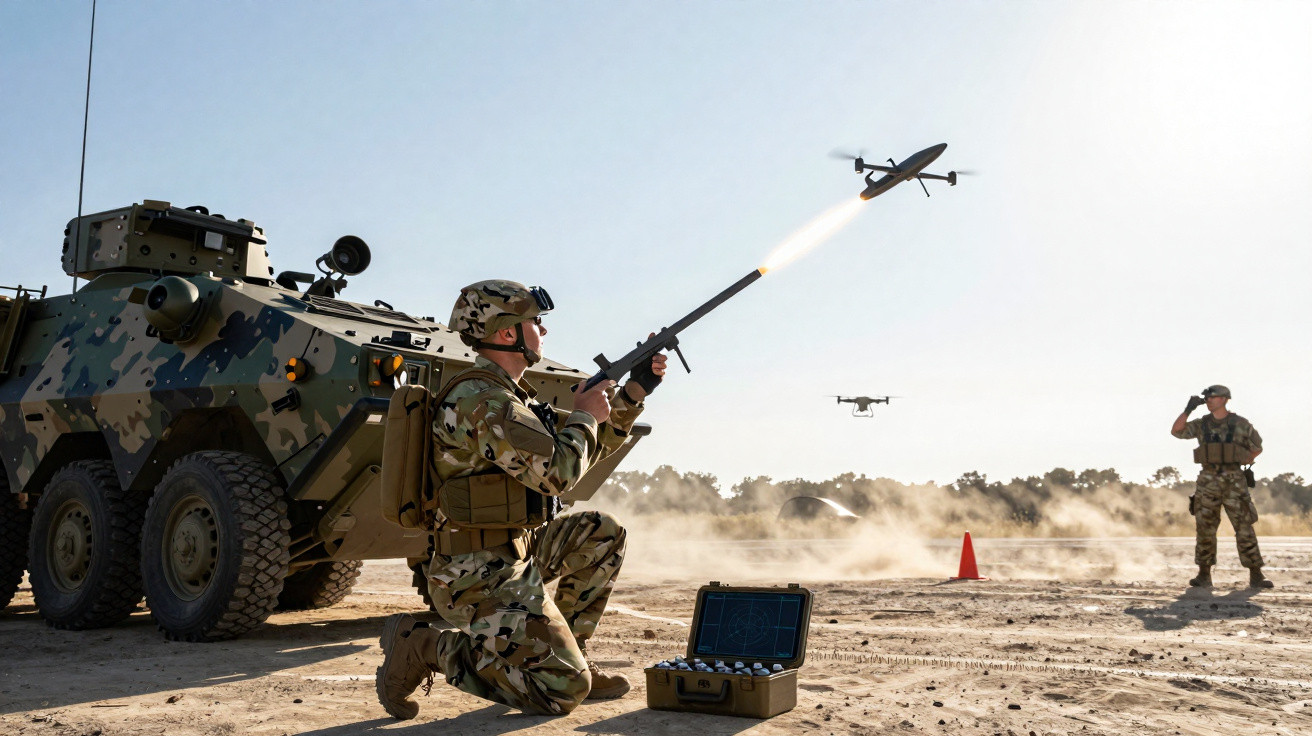
It is not a jet fighter; it is a drone hunter.
With inexpensive quadcopters increasingly filling the airspace above battlefields, airports and critical infrastructure, British engineers are working to deploy systems able to pursue them physically and stop them before they cause serious harm.
High-speed response to low-cost drone threats
UK company Drone Defence has introduced AeroStrike, a small interceptor developed to counter so-called Class 1 drones – lightweight aircraft increasingly deployed for surveillance, smuggling and improvised attacks.
Speed is the principle behind AeroStrike. Reaching speeds of up to 270 km/h (around 168 mph), the interceptor is quick enough to catch most commercial quadcopters and many low-flying fixed-wing drones.
AeroStrike is pitched as a “last line of defence” when other counter-drone tools are too slow, too blunt, or already overwhelmed.
Instead of concentrating on long-distance detection or wide-area electronic jamming, the system is intended for close-range use. It is designed to provide point defence for assets where even one penetrating drone would be unacceptable, including fuel depots, radar installations, forward artillery positions, VIP convoys and temporary command posts.
How AeroStrike is designed to work
Drone Defence calls AeroStrike an “effector” – the element within a broader counter-UAS (uncrewed aircraft system) network that physically addresses a threat after detection.
Its key performance specifications include:
- Top speed: up to 270 km/h (168 mph)
- Flight endurance: up to 10 minutes
- Operating radius: around 13 km (8 miles)
- Mission type: point defence and short-range interception
These figures indicate a platform that sacrifices endurance in favour of outright acceleration and manoeuvrability. Although 10 minutes in the air may appear limited, it could be sufficient at close distances to intercept several drones approaching from similar directions.
A 13-kilometre engagement bubble gives security teams a short but crucial window to detect, track, and physically intercept a threat before it reaches a protected site.
The system is anticipated to function within a layered defence architecture. Long-range radar and sensors identify an approaching drone, then send tracking information to an operator or automated control system. AeroStrike can then be launched to engage the target over the final few kilometres.
Point defence for convoys and forward units
Although many counter-drone systems are intended for fixed locations, including airports and stadiums, AeroStrike is also presented as a mobile capability. Drone Defence points to applications around convoys and forward-deployed units that regularly move between locations.
One potential scenario involves a military logistics convoy travelling on a contested route and being observed by hostile forces using a small commercial drone. Detection equipment fitted to an escort vehicle identifies the suspicious aircraft. Rather than depending solely on jamming – which could be ineffective if the drone is operating autonomously – personnel could launch AeroStrike from a nearby vehicle to pursue and neutralise it in flight.
At forward operating bases, the interceptor could remain ready near a helipad or ammunition store. Should radar detect a loitering munition or a hobby drone adapted to release explosives, AeroStrike could be launched in much the same way that a fighter jet intercepts an unidentified aircraft, though on a smaller scale with a far faster response.
Why Class 1 drones keep commanders awake at night
Class 1 drones generally weigh under 150 kg, but current battlefield concerns focus largely on much smaller backpack-sized quadcopters. They are inexpensive, readily obtainable and simple to operate with little training.
Armed groups have employed them to find troops, correct artillery fire and deliver grenades or small explosive charges. Criminal organisations have used drones to smuggle contraband into prisons and survey secure sites. Even an ordinary camera drone can collect sensitive imagery when flown sufficiently close.
Conventional air-defence systems – built to engage jets, cruise missiles and helicopters – find these small, low-flying targets difficult to counter. Their radar signatures are faint, their flight paths unpredictable, and launching a traditional missile at a £1,000 quadcopter is highly unattractive.
High-speed interceptors try to flip that cost equation by using relatively inexpensive drones to counter other drones, rather than high-end missiles.
How AeroStrike compares with other counter-drone tools
No individual technology can solve the drone threat. AeroStrike appears intended to complement established approaches rather than displace them. The comparison below helps define its role:
| Method | Strength | Weakness | Best use case |
|---|---|---|---|
| Radio jamming | Can disrupt many drones at once | Less effective against pre-programmed or hardened drones | Protecting wide areas such as bases |
| Directed energy (lasers) | Low cost per shot once installed | Complex, sensitive to weather and line-of-sight | Static, high-value sites |
| Net or kinetic guns | Simple, relatively cheap | Short range, needs clear aim | Crowded urban sites, stadium security |
| High-speed interceptor (AeroStrike) | Can chase and manoeuvre with target | Limited endurance, requires launch and control | Point defence, mobile units, time-critical threats |
By introducing a rapid and agile interceptor, commanders gain another option when a drone evades jamming or suddenly appears above a sensitive asset.
Operational challenges behind the speed
Speed by itself cannot ensure a successful interception. Striking a small drone travelling at 80 km/h while repeatedly changing direction is challenging. AeroStrike is likely to depend on sophisticated guidance algorithms, highly accurate sensors and potentially semi-autonomous modes to cover the last few metres.
Rules of engagement create a further complication. In a battlefield environment, operators may have greater latitude to destroy a suspicious drone. In built-up areas, however, they must consider where debris could land, who controls the airspace and whether the aircraft is genuinely hostile rather than a hobbyist drone flying too near.
The closer such interceptors operate to civilian areas, the more pressure governments face to clearly define legal authority and safety procedures.
Scale is another concern. An interceptor capable of neutralising one or two drones in rapid succession has value, yet recent conflicts have demonstrated that swarms involving tens or hundreds of aircraft can overwhelm defences. Systems such as AeroStrike will probably need to operate as part of teams, with multiple interceptors and automated launch systems positioned in advance around important assets.
What “last line of defence” really means
Describing AeroStrike as a last line of defence has particular consequences. It suggests that, when the interceptor launches, other measures have either been used already or cannot be used: jammers might be switched off to avoid interrupting friendly communications, radar may have detected the target late, or the threat may have arrived unexpectedly at extremely low altitude.
Under those circumstances, response times fall to seconds. A fast-climbing interceptor able to reach 270 km/h offers an opportunity – rather than a guarantee – to stop a drone before it reaches an ammunition dump, fuel tank or VIP convoy vehicle.
Key terms worth unpacking
Some of the terminology surrounding systems such as AeroStrike obscures important differences:
- Class 1 drone: Usually small, short-range and comparatively light. It is often battery-powered, with a limited payload but considerable tactical value.
- Point defence: Protecting one particular object or a confined area, rather than an entire city or region.
- Effector: The part that physically responds to the threat – here, by intercepting or destroying the drone – rather than the sensors or command systems.
These definitions show why a high-speed aircraft with a 10-minute endurance can still be useful. It is not intended to patrol for hours; it is built to launch at short notice, race towards an identified threat, neutralise it and return.
Future scenarios and potential risks
In future, systems such as AeroStrike are likely to encounter more capable adversaries. Hostile groups may deploy drones following pre-programmed routes, using encrypted control links, rapidly altering altitude or exploiting terrain and buildings to conceal their approach. High-speed interceptors will require dependable navigation and perhaps a level of onboard autonomy to react quickly enough.
Civilian deployment brings different risks. Security teams responsible for prisons, events and power plants may be tempted to depend heavily on interceptor drones. Without clear regulation, this could result in mid-air collisions, damage caused by falling wreckage or disruption to legitimate air traffic, including medical helicopters.
Balancing rapid, decisive defence with air safety and civil liberties will shape how far and how fast systems like AeroStrike spread beyond the battlefield.
For now, the UK's high-speed interceptor illustrates a broader shift: as small drones become more common and capable, the response is moving away from static sensors and jamming towers towards agile systems able to chase, outmanoeuvre and defeat them in a literal 270 km/h pursuit.






Comments
No comments yet. Be the first to comment!
Leave a Comment