
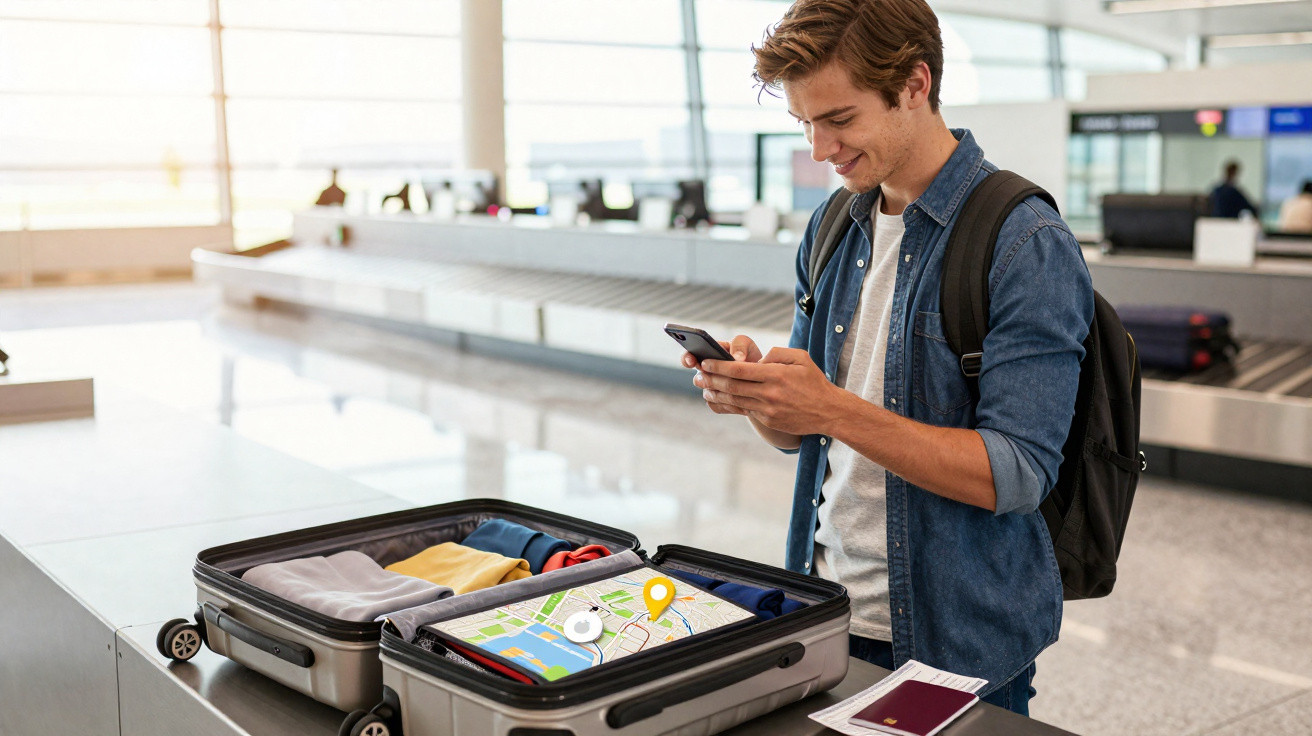
Tiny Bluetooth trackers offer reassurance, but airport regulations can seem unclear to passengers.
Travellers want to see their suitcase arrive on the baggage carousel-or, if it fails to appear, understand where it has gone. Apple’s AirTag now increasingly occupies the space between airline baggage operations and personal reassurance.
What airlines currently say about AirTags
Most airlines allow AirTags in hand luggage as well as checked baggage. They rely on a coin-cell battery and ultra-low-power Bluetooth rather than mobile data or Wi-Fi. This configuration fits comfortably within today’s passenger-flight safety rules.
AirTags run on a CR2032 coin cell with roughly 0.1 g of lithium. That falls within baggage-tracker thresholds used by aviation regulators.
A number of leading airlines have publicly stated that these tags are not banned from checked luggage. Their minimal transmission output and very small lithium quantity mean they are considered “personal electronic device” items, not dangerous goods.
- EasyJet: has no rule preventing Apple AirTags from being carried on board.
- United Airlines: places no restriction on AirTags in checked baggage.
- American Airlines: currently has no ban on these devices.
The source of the 2022 confusion
In October 2022, Lufthansa briefly stated that AirTags should not travel in the aircraft hold, referring to broader dangerous-goods regulations. Passengers challenged the position, technology firms contributed to the discussion, and regulators clarified the specifics. Days later, the carrier changed its stance, confirming that AirTags present no safety risk.
Lufthansa rescinded its short-lived restriction after aviation authorities and industry groups clarified the rules for low-power baggage trackers.
The incident continues to circulate online, helping explain why travellers revisit the question during every busy travel season.
What airline rules permit
Rules used by airlines internationally account for baggage trackers with extremely small batteries. Industry guidance sets a lithium-metal limit of 0.3 g for this type of device, while the limit for lithium-ion batteries is 2.7 Wh. AirTags contain a lithium-metal coin cell and sit well under the relevant threshold. Regulators in the United States and Europe have also said that these trackers may stay switched on in checked luggage, as they use negligible power and cannot access mobile networks.
Here is a brief comparison of common trackers and their batteries:
| Tracker | Battery type | Approx. lithium content/energy | Checked-bag status |
|---|---|---|---|
| Apple AirTag | CR2032 lithium metal | ~0.1 g lithium | Permitted by most airlines |
| Tile Mate | CR2032 lithium metal | ~0.1 g lithium | Permitted by most airlines |
| Samsung SmartTag2 | CR2032 lithium metal | ~0.1 g lithium | Permitted by most airlines |
The key exception involves older GPS or cellular trackers, alongside smart suitcases containing power banks. These have larger rechargeable batteries and are governed by separate requirements: spare batteries must remain in the cabin, while power banks frequently need to be taken out before check-in.
Why travellers adopted AirTags
Following the airport disruption of summer 2022, mishandled luggage became a familiar topic of conversation. Apple’s Find My network is made up of millions of iPhones, allowing AirTags to report their position anonymously whenever a nearby device passes them. This crowd-sourced system was especially helpful during operational breakdowns, when airline platforms were overwhelmed and call centres were congested.
When bags missed connections, AirTags gave travelers a map dot and a timeline-information that sped up claims and lowered stress.
United Airlines went further by adding “Share Item Location” to its app. Passengers can provide customer support with the tag’s live position, enabling agents to route a bag more quickly. Other airlines are likely to introduce comparable processes.
Flying with an AirTag without unnecessary hassle
Pack and configure it carefully
- Put the tag somewhere it will not be crushed by screening equipment or baggage handlers, such as a side pocket or beneath the lining.
- Give the item a precise name in the Find My app: “Blue Rimowa Check-in” is more useful than “Suitcase.”
- Turn on Lost Mode before submitting a claim, and include both a telephone number and email address.
- Never put spare coin-cell batteries in checked luggage; carry spares in your hand luggage.
- Do not use tape or alterations that obstruct the speaker or vent, as this can retain heat and create problems.
Be aware of airline staff and security
Security officers encounter trackers every day. Should you be asked about one, explain that it is a low-power Bluetooth tag powered by a coin cell. There is no need to disable its radio: AirTags have no mobile radios and do not connect directly to aircraft systems. If the tag makes a sound, mute it through the Find My app or ensure the battery cap has been fitted correctly.
Privacy and courtesy remain important
Do not put a tracker in another person’s bag without their permission. Apple’s protection measures issue “unknown AirTag” notifications to nearby iPhones and, through dedicated apps, to Android devices. These notifications guard against unwanted tracking, and may draw attention at an airport when a tag is in the incorrect bag. Mark your luggage with your name and airline reference so that both the bag and its tag identify the same owner.
The details travellers often ask about
Can an AirTag interfere with aircraft systems?
No. Its transmission power is extremely limited and falls within the normal standards for consumer electronics already accepted on flights. Aircraft routinely accommodate cabins full of phones, headphones and watches; a coin-cell tracker contributes negligible radio interference.
What battery life can you expect in everyday use?
Apple estimates around one year from a CR2032 under normal pinging conditions. Rough baggage handling makes little difference to that estimate. Very cold conditions can reduce capacity, so flights in winter to exceptionally low temperatures may result in a marginally shorter lifespan. Frequent travellers should keep a spare coin cell in their hand luggage.
Alternatives and special cases
For aviation purposes, Tile and Samsung trackers function in much the same way. The deciding factor is often network coverage: iPhone users benefit from broader reach via the Find My network, whereas Galaxy users may favour SmartThings Find. When checking professional equipment or sports kit, using two tags-one in the primary case and another in a pouch-can provide extra redundancy. If your suitcase has a removable power bank, remove it before check-in and take it into the cabin.
Extra steps that help when luggage goes missing
Take a photograph of your bag and its contents before leaving home. When making a report, give the airline representative the AirTag’s live location and most recent timestamp. Store your baggage receipt and claim reference in the Find My item notes for easy access. If the tracker shows that your suitcase is at the arrival airport but staff believe it remains in transit, politely request that they inspect the local baggage room; this discrepancy is more common than you might expect.
Low-power baggage trackers are allowed, useful, and increasingly part of airline workflows. The winning move is simple: tag your bag, label it, and keep your spare battery in the cabin.



Comments
No comments yet. Be the first to comment!
Leave a Comment