
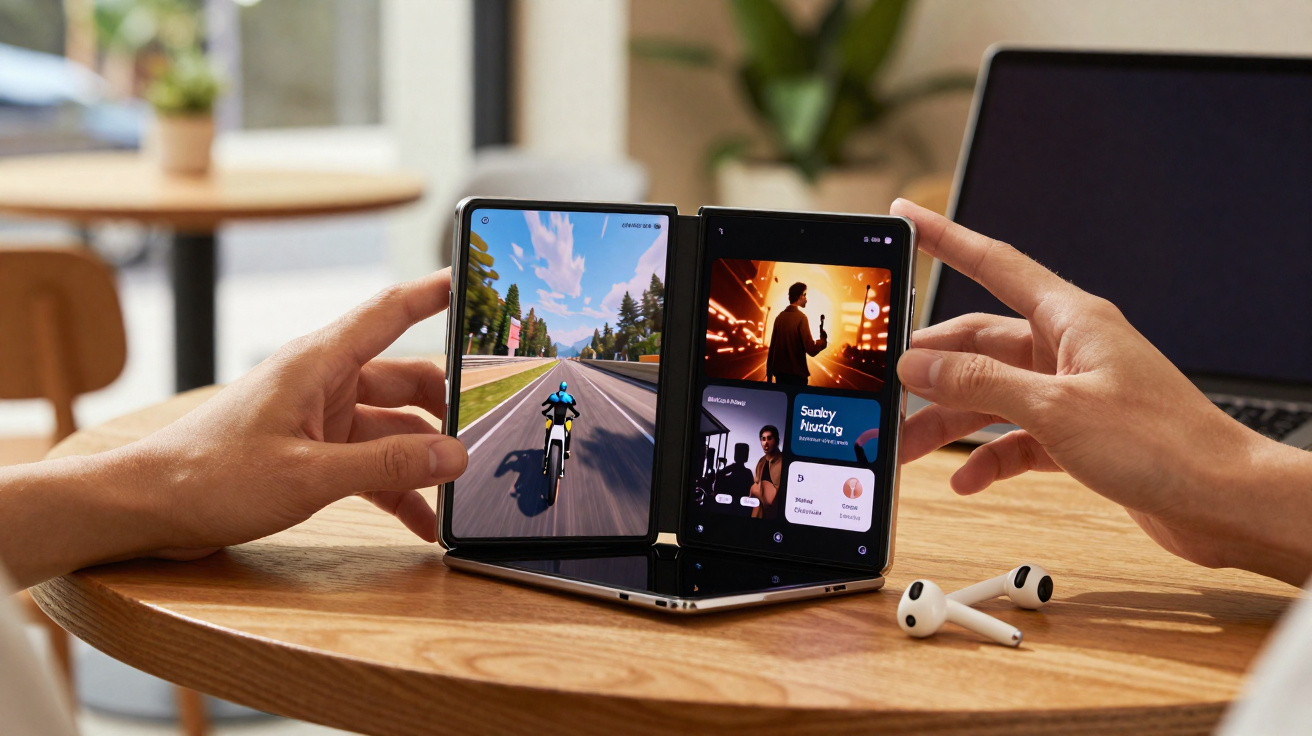
Samsung is taking foldables a step further with the Galaxy Z TriFold. Rather than folding in half, this smartphone folds into three sections. It combines the functions of a conventional phone and a tablet - and offers more besides. It is a remarkable product in several respects. Here are our hands-on impressions.
Since launching the first Galaxy Fold in 2019, Samsung has refined its formula year after year. In 2025, the manufacturer made a major statement with the high-end Galaxy Z Fold 7. So how can it keep advancing a format that has already been polished to the limit? By rethinking it entirely. That is precisely the role of the Galaxy Z TriFold.
Samsung officially unveiled the Galaxy Z TriFold a few weeks ago. This is a smartphone that folds not twice, but three times. How does it work, and what is the point? We spent considerable time handling it, and these are our first - very positive - impressions.
Subscribe to Presse-citron
How does the Galaxy Z TriFold work?
The Galaxy Z TriFold introduces a new form factor. Yet, the first time you hold it, the basic idea is immediately apparent: it is essentially a Galaxy Z Fold 7 with a third panel added.
When closed, it looks like a conventional smartphone, complete with a large 6.5-inch AMOLED display. Unfold it and it becomes an enormous 10-inch AMOLED screen - the size of a tablet. The purpose is obvious: instead of buying both a smartphone and a Galaxy Tab S11, the TriFold brings those two roles together. The format is undeniably striking from the outset. We were surprised by how slim the device feels, measuring only 4.2 mm thick when opened, as well as by its apparent sturdiness. Naturally, it has two hinges, doubling the potential points of failure, but they feel reassuringly robust. Hopefully, that impression will hold up over time. While the Z Fold could be opened in a single quick movement, the process takes slightly longer here; it is less instinctive and more involved. It simply takes some getting used to.
The Galaxy Z TriFold closes like a wrapped present. There is only one way to do it, however: the left panel must be folded first, followed by the right. If the user tries the reverse order, whether through curiosity or habit, the phone vibrates repeatedly and displays a warning message. If just one panel is folded over, the internal screen cannot be used and becomes blurred until the device has been fully closed.
Once shut, the Galaxy Z TriFold is almost like a normal phone. Almost, because it is undeniably thick at 12.2 mm. That is thicker than a standard smartphone, and even thicker than the Galaxy Z Fold 6, which had already been criticised on that front. It is a necessary trade-off, though for now it is difficult to see how the panels could be stacked without this drawback. At 239 grams, it is also somewhat heavy, but still manageable. Among its other flaws, the two creases in the internal screen remain clearly visible. You eventually stop noticing them, but they are still there.
The Galaxy Z TriFold is an astonishing technical achievement. Yes, it is effectively a Z Fold 7 on steroids, but we love the format: folding it, unfolding it, using it to watch videos or play games. Better still, the 4:3 aspect ratio of the inner display reduces the black bars seen on the Z Fold 7. With the Galaxy Z TriFold, the promise of fitting a smartphone and a tablet into one product is fulfilled. By comparison, the Z Fold 7's inner display simply looks like… a large phone.
| Galaxy Z TriFold | |
|---|---|
| Dimensions | Unfolded: 153.5 x 132.6 x 5.6 mm Folded: 153.5 x 68.1 x 12.1 mm |
| Weight | 239 grams |
| Displays | Internal: 10 inches, AMOLED 2X LTPO 120 Hz, 1600 nits 1584 x 2160 pixels External: 6.5 inches AMOLED 2X LTPO 120 Hz 2600 nits 2520 x 1080 pixels |
| Processor | Qualcomm Snapdragon 8 Elite Gen 5 |
| RAM | 16 GB |
| Storage | 512 GB 1 TB |
| OS | Android 16/OneUI 8 |
| Camera sensors | 200-megapixel wide-angle sensor (f/1.7) 12-megapixel ultra-wide-angle sensor (f/2.2) 10-megapixel telephoto sensor (f/2.4) X3 optical zoom |
| Selfie camera | 2X 10 megapixels |
| Biometrics | Side-mounted fingerprint sensor |
| Battery | 5600 mAh, 45 W fast charging |
| IP certification | IP 48 |
| Colours | Black |
What can you do with the Galaxy Z TriFold?
The Z TriFold is technically impressive, but what can it actually be used for? Samsung has spent years refining use cases for the Z Fold, and that accumulated experience carries over to this new device.
There are, of course, entertainment-focused uses. Watching a video, playing a game or making a video call with the 10 MP selfie camera is enjoyable on a display this large, but that alone does not truly justify the form factor. Samsung is instead betting on productivity, with several OneUI features tailored to this 10-inch screen.
Multitasking has therefore been enhanced. Three separate vertical windows can be positioned across the individual panels. You could, for instance, have a website in one, a video in another and a note-taking app in the third, using the keyboard because S-Pen support is unfortunately absent. Galaxy AI also makes productivity as straightforward as possible, allowing users to copy and paste text, images, and even an object within an image that is automatically cut out. It is easy to use as well as effective. This is not entirely new, as all of these capabilities are available on the Z Fold, but Samsung has adapted them extremely well to the 10-inch format by accounting for all three panels. Clever.
Our favourite feature, though, remains DeX. The Z TriFold can be connected to any Bluetooth display and used with DeX, Samsung's “Windows desktop” interface. The smartphone is projected onto the external display while continuing to serve as a second screen. With a mouse, it is possible to move naturally between the two. DeX can also run directly on the TriFold, with a keyboard and mouse connected to it. Office work is entirely feasible on a 10-inch screen.
The TriFold's flexibility suggests countless possible uses. We can imagine using it as a normal smartphone in the street or on the Underground, then unfolding it on arriving at work to connect it to a second display, or at home to watch a video comfortably from the sofa. The possibilities are broad, but the device still needs to prove that it can deliver on its promise. Battery life is the main concern. With a 5600 mAh battery, there is reason to wonder whether it can last a full day. Everything will depend on software optimisation and the processor's power consumption.
But how much does all this cost?
Using the Galaxy Z TriFold is an enjoyable experience. But would we buy one? There is no denying that it is a technical feat. It includes the latest cutting-edge components, including the Qualcomm Snapdragon 8 Elite Gen 5 processor and a 200-megapixel wide-angle sensor, the same one found in the Z Fold 7. The price is consequently painful: almost €2,200 when converted. One could argue that this represents the combined cost of a premium smartphone and tablet - as well as a Z Fold 7 - but it remains an exceptionally expensive phone. This is the Korean price converted into euros. Should it go on sale here, the various taxes would need to be added.
In any case, buying one is not currently an option. The Galaxy Z TriFold is exclusive to the Korean market. Samsung intends to release it in other countries, including China and the United States, but not in Europe. At least, that is not currently planned, according to Samsung France. Perhaps we should wait for version 2?
Either way, the Galaxy Z TriFold is an intriguing smartphone, the kind of “wow” product that makes you want to keep using it. It is Samsung's new technical showcase, and could be only the first step towards adapting the foldable format in every conceivable way. As with any technical showcase, though, it comes at a high price…


Comments
No comments yet. Be the first to comment!
Leave a Comment