
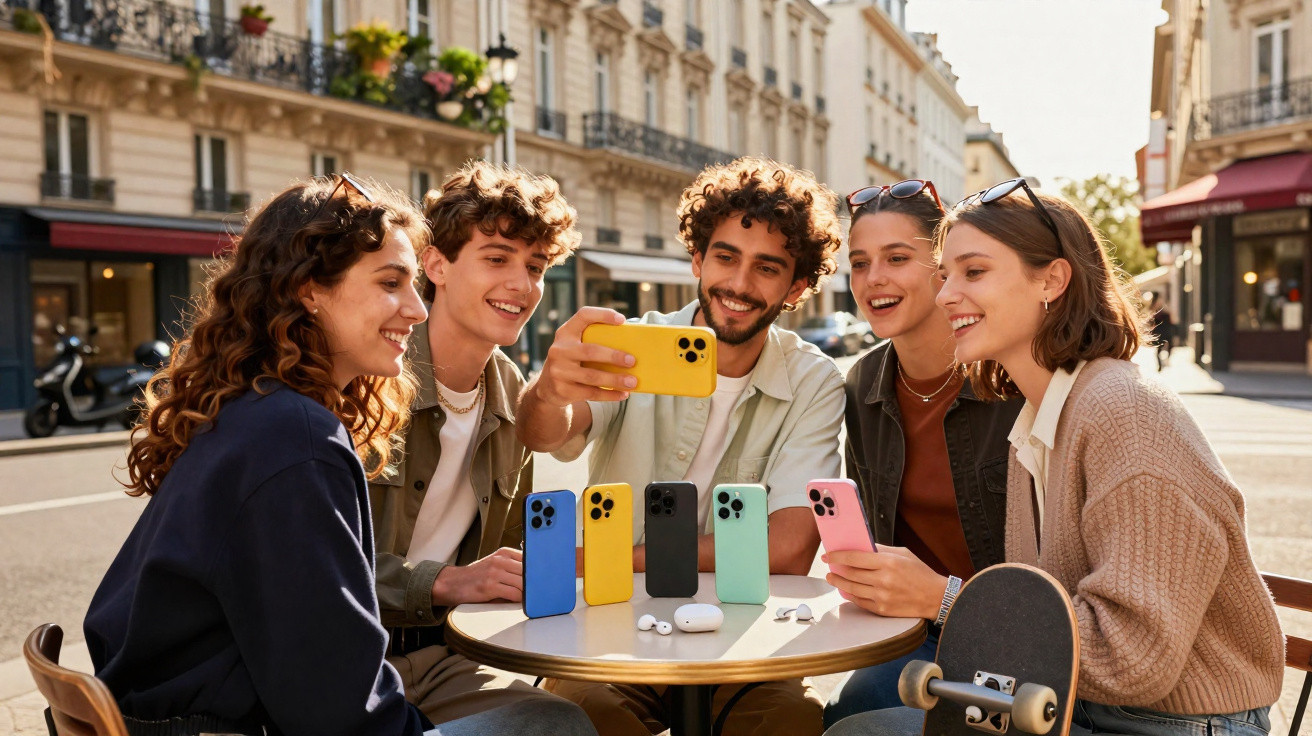
Realme is a brand that is becoming increasingly significant in the mobile phone market. It has just launched its GT8 Pro, an excellent premium smartphone. But who is this manufacturer determined to do things differently? Julien Lidoine, the brand’s sales director in France, explains.
We recently reviewed the Realme GT8 Pro, an excellent premium smartphone that stands out for its striking design and carefully developed camera system. After using it for several weeks, one question kept coming up from people around us: “What kind of brand is Realme?”.
To the general public, Realme may look like yet another manufacturer trying its luck in France. In one sense, that is true, but the company wants to move beyond that stage and establish a lasting presence in the country. How does Realme intend to make an impression, and what is its strategy? How does this young brand plan to set itself apart in an extremely competitive market? We asked Julien Lidoine, Realme France’s sales director.
A brand focused on young people
Let us start at the beginning. Realme is a Chinese manufacturer headquartered in Shenzhen. It was originally created by Oppo in 2010 under the name Oppo Real. The division became independent in 2018 as Realme, before arriving in France in 2019. Although it is no longer an Oppo subsidiary, it remains part of the same corporate group, as we will discuss later. To stand out in a fiercely contested market, the company chose to target young people above all else.
This is not merely an image-led positioning, but a strategy that is delivering results: “77% of our consumers are between 18 and 34 years old,” says Julien Lidoine. “We are a young brand speaking to young people; the founders and most employees fall within that age group. The average age is 28. It was not necessarily a deliberate decision, but it naturally became part of the brand’s DNA.”
That youthful profile shapes its internal operation, which is “like a start-up”. In France, the company has sixteen employees, a small number for the local arm of a multinational. This approach gives it considerable flexibility. To appeal to customers, Realme concentrates particularly on two areas: unconventional communication and distinctive products.
Quality Realme products across every segment, with a difference
Realme has a reputation for producing inexpensive smartphones. Yet this perception does not fully reflect reality: the manufacturer operates across every price bracket, from entry-level devices to premium models.
“The best communication is getting phones into people’s hands,” Julien Lidoine states. If a customer is happy with a €200 phone, they will stay with the brand when they want to upgrade to a €400 product, or something more expensive. This is why Realme places such importance on lower-priced products, both in terms of design and day-to-day use. That is central to its approach, though it is not its only way of standing out in the market:
“For a product with equivalent value, such as a premium model, our offering will be the one best suited in terms of use, ergonomics and aesthetics for the generation we call blue-collar workers,” meaning sixth-formers, students and young professionals. With the Realme GT8 Pro, the brand is therefore focusing on photography through a partnership with Ricoh, a specialist in “street photography” that appeals to a young, urban audience. While we do not see this as a particularly compelling selling point, especially on a €1000 device, it does at least make the image Realme wants to project very clear.
Realme also wants to distinguish itself from rival manufacturers through a straightforward mantra: make every smartphone unique. For instance, the GT8 Pro’s silicone finish, with its crumpled-paper effect that we liked so much, differs from one handset to another. “Every product will be different. You could take a thousand of them and not find two identical ones.” The same principle applies to the removable camera module, which can be swapped for another: each user can fit the one that suits them. Another notable example is the Realme 14 Pro Plus, a ridged mid-range phone that changes from white to blue when the temperature drops. Here too, the pattern varies from one device to the next. However, the brand cannot apply this idea to all of its phones, as the production costs would be too high.
In any event, the strategy appears to be working: between 2023 and 2024, Realme quadrupled its sales in France. Unfortunately, the company did not share its figures with us.
Communication beyond the usual playbook
To win over younger customers, Realme is pursuing a strategy reminiscent of Honor’s early approach in the mid-2010s: campaigning almost entirely through social media. Rather than conventional marketing through posters or television adverts, it relies on regular TikTok and Facebook posts, competitions and engagement. It costs less, while helping to reduce the final price of its products.
However, this communication strategy has its limitations: “Europe is difficult to break into because the operator market has regained control; it accounts for between 50% and 60% of the market.” Realme does not currently work with any French network operator-a strategy that helped certain brands, including Nothing, take off-but we are told that this remains an objective. In France, it is simply the best route to visibility. Realme does, however, already work with retailers such as Fnac and Boulanger, giving it a physical presence in shops. As a result, consumers see the brand and, in some cases, discover that it exists at all.
Also read – I tested the Realme GT 8 Pro, and it is the excellent surprise of the end of the year
Realme left France in 2022 before returning in 2024 with a new team. Julien Lidoine tells us that the brand is now firmly on track to stay, currently moving between seventh and fifth place among France’s biggest sellers.
An independent brand within a wider conglomerate
As we explained earlier, Realme began as an Oppo sub-brand before becoming independent in 2018, while remaining under the umbrella of BBK Electronics. BBK ceased to exist in 2023 and was replaced by a corporation centred on OpPlus, comprising Oppo and OnePlus, alongside satellite brands such as Vivo and Realme. Yet Realme is indeed independent. So how can the GT8 Pro be so close to the OnePlus 15 and the Oppo Find X9 Pro, sharing the same chassis and specifications?
“This is because production and component purchasing are shared, which is the key. But everything else-product strategy, design and AI-is completely independent.”
Realme does not intend to radically alter its overall strategy in the short or medium term. Its stated objective will remain unchanged: producing good smartphones that appeal to young people while cutting costs as much as possible. That is why the manufacturer has no intention, for example, of entering the foldable market, which it sees as guaranteeing commercial failure. In any case, Realme-branded products have become increasingly convincing over the years, but the company must now confront its biggest challenge: overcoming its lack of brand awareness.




Comments
No comments yet. Be the first to comment!
Leave a Comment