
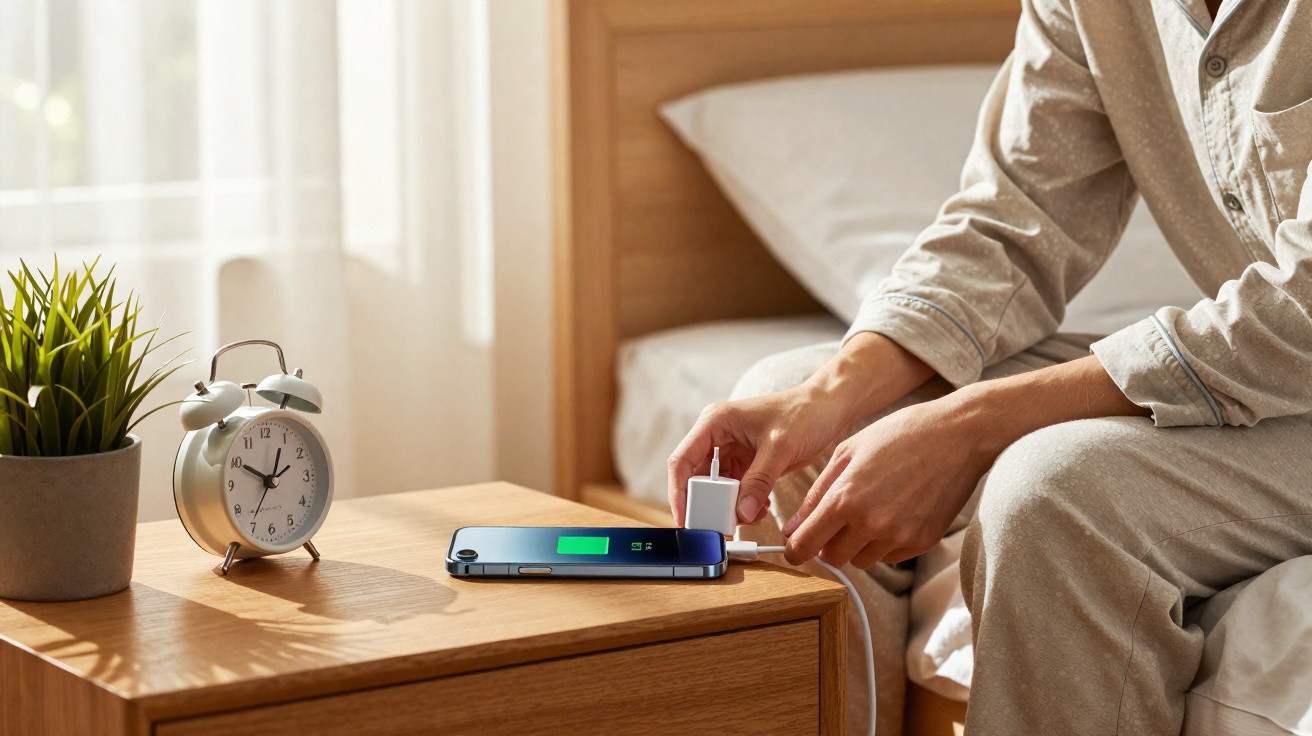
You barely give it a thought. You set your phone on the bedside table, connect the cable by touch, and see the display flicker on briefly: 23%… charging. Then you drift off, confident that by morning it will be sitting at a flawless 100%, like a small digital sunrise ready for the day.
The following day brings the same routine, and so does the next month. The battery symbol turns fully green well before the alarm sounds, yet it remains there for hours: quiet, warm and gradually degrading as you sleep.
You wake up to a phone that appears “fresh”, while beneath the surface it is ageing more quickly than you might realise.
That seemingly harmless 100% is not quite as innocent as it looks.
Why 100% is quietly bad news for your battery
Lithium-ion batteries dislike either extreme. They do not respond well to being fully drained, nor to spending hours held at 100%. That pleasing full bar on the screen each morning means your phone has actually spent part of the night under chemical strain.
Within the battery, minute reactions become faster when voltage is high and the temperature rises even slightly. Nothing dramatic happens overnight: there will be no smoke or alarming notifications. However, that subtle strain builds over time, day after day and night after night.
The outcome is a battery that starts losing capacity sooner than it ought to.
Think of the last time you found yourself saying, “This phone was great at the beginning, now it dies at 40%.” Initially, you may blame your apps, the most recent update or some unexplained glitch. You might even suspect the manufacturer intended it that way.
But this gradual decline is often linked to one straightforward habit: keeping the phone plugged in at 100% every night. Your device may reach a full charge at around 2 or 3 a.m., then remain connected until 6, 7 or 8. That is hours at maximum voltage, sometimes while the battery is a little warm beneath a pillow or on a soft mattress.
We have all experienced the moment when the “low battery” alert arrives slightly earlier than expected.
From a technical perspective, lithium-ion cells perform most comfortably in their middle range. Their ideal zone is roughly 30% to 80%. At 100%, internal voltage reaches its highest point, which speeds up the long-term deterioration of materials within the cell.
Some manufacturers use “trickle charging” and intelligent charging modes to reduce the impact, but the underlying physics remain unchanged. A fully charged battery left on its charger resembles a runner made to hold a sprinting stance for hours. It may look strong on paper, but it is tiring in practice.
This is why people who avoid leaving their phones at 100% often retain healthier batteries for years longer.
How to charge smarter without disrupting your routine
You do not need a science degree to look after your battery more effectively. The easiest approach is to think in terms of ranges rather than perfection. Try to keep your phone somewhere between approximately 20% and 80% throughout the day.
Rather than charging fully overnight, use shorter charging sessions. Give it a quick boost in the morning while you shower, then another in the late afternoon while you are at your desk. These small “snacks” are much kinder to the battery than one huge overnight feast.
If your phone includes an “optimized charging” or “protect battery” setting, switch it on and leave it to do its job.
Of course, nobody manages this perfectly every day. You are exhausted, fall asleep on the sofa, plug the phone in and leave it at that. There is no elaborate timetable or flawless habit tracking.
The aim is not to become obsessive; it is to alter your default behaviour. Perhaps you no longer plug it in automatically every night. On weekdays, you could charge before bed and disconnect it before sleeping. At weekends, you might depend more on brief daytime top-ups. Every minor adjustment cuts the overall time your battery remains stuck at 100%.
Across a year, these small actions can save your phone from dozens of hours of unnecessary strain.
Sometimes the smartest way to “boost” your phone is not by chasing 100%, but by giving the battery room to breathe.
- Use partial charges: Top up between 30% and 80% whenever possible. This keeps the battery within its comfort zone for most of the time.
- Activate battery protection modes: Features such as “Optimized Charging”, “Adaptive Battery” or “Protect Battery” slow charging and prevent extended periods at 100%.
- Avoid charging under your pillow: Heat accelerates battery ageing. At night, place the phone on a hard surface with fresh air around it.
- Unplug in the morning: Do not keep your phone charging at 100% on your desk throughout the day. Once it is full and you are working, unplug it.
- Accept 80–90% as “good enough”: The final 10% can feel satisfying, but it causes the most stress to the battery over the long term.
Rethinking what a “full” phone really means
There is something almost symbolic about reaching 100%. It can feel like control: you are prepared for the day and nothing can catch you out. But the urge to maximise the charge every morning is quietly shortening your phone’s future.
Once you view your battery as a living component instead of an unlimited fuel tank, your habits may shift. You may be happy to leave home with 83% and a cable in your bag. You may stop worrying at 25%, knowing that a 20-minute top-up can carry you through the evening. Rather than pursuing a full bar at any cost, you let go of the chase, and your battery repays you by ageing more gracefully.
In a year or two, when friends complain that their phones struggle to last half a day, you may still complete your normal routine on one charge. Not because you purchased the newest model, but because you gave this one a little more respect - and a little less 100%.
| Key point | Detail | Value for the reader |
|---|---|---|
| Avoid long periods at 100% | Overnight charging holds the battery at high voltage for hours | Extends battery lifespan and postpones an expensive phone replacement |
| Prefer partial charges | Remaining roughly between 20% and 80% lowers chemical strain | Preserves stronger day-to-day battery performance over the years |
| Watch out for heat | Charging on soft surfaces or beneath pillows raises the temperature | Reduces hidden damage and helps keep the phone safer and more reliable |
FAQ:
- Is it really bad to leave my phone charging all night? Modern phones will not explode, but a battery wears out more quickly when it remains at 100% for hours, particularly if it gets slightly warm. The occasional night is fine; constant charging is the issue.
- What’s the ideal charge percentage for daily use? Most experts suggest keeping it roughly between 20% and 80%. There is no need to fixate on precise figures; simply avoid spending all your time at either extreme.
- Do fast chargers damage the battery more? Fast charging creates additional heat and strain, especially beyond 80%. Using it when you are in a rush is fine, but a slower charger is gentler for overnight or desk charging.
- Should I always wait until my battery is almost dead before charging? No, that advice relates to older battery types. With lithium-ion batteries, frequent small top-ups are healthier than deep discharges to 0%.
- Does activating “optimized charging” really change anything? Yes. These modes postpone the final part of charging, so your phone does not remain at 100% for hours. It is a straightforward, almost invisible method of reducing long-term battery wear.






Comments
No comments yet. Be the first to comment!
Leave a Comment