
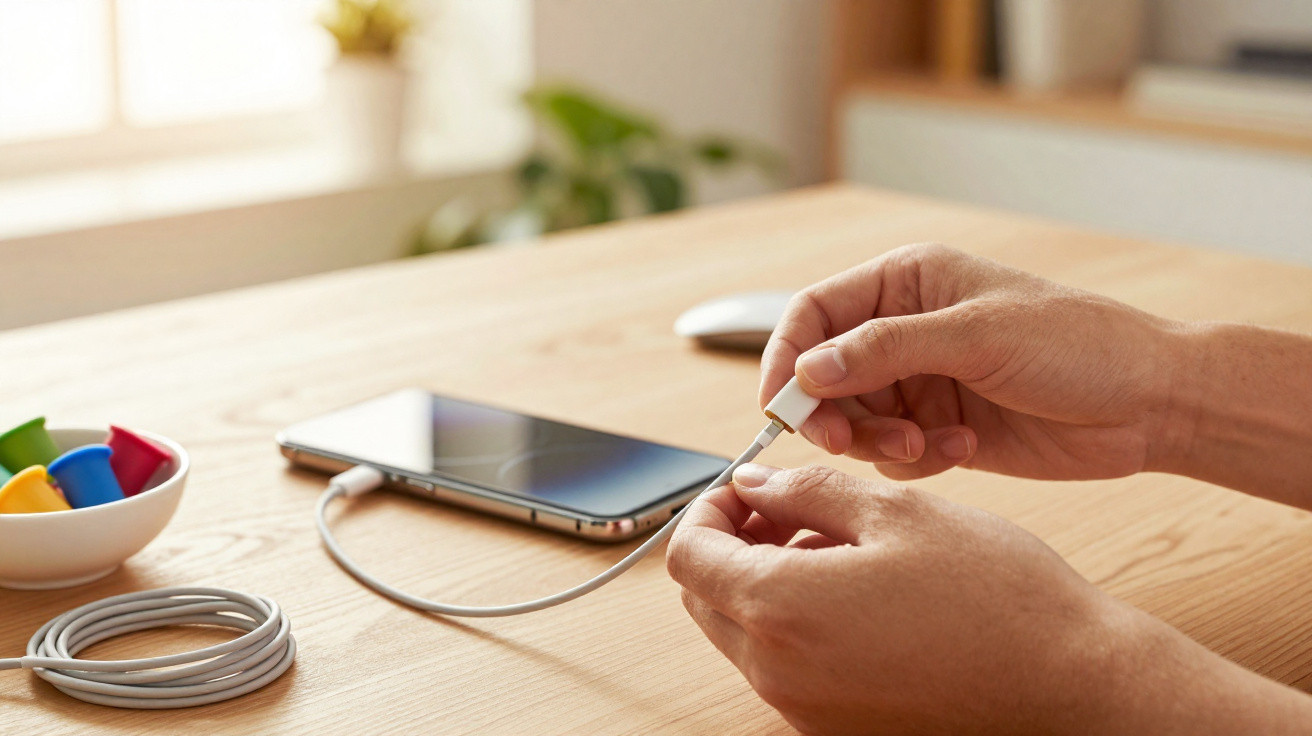
Your phone charger nearly always gives out in the very same place: the soft rubber section beside the plug, often at the exact moment replacing it feels least affordable. You are not unlucky; the cable is simply enduring the same small pressures repeatedly until it fails.
You twist it, hold it at a certain angle, locate the one position that works and stay perfectly still, praying the charging icon will not disappear. Everyone knows the point at which a charger turns into a delicate compromise rather than something dependable. Eventually, the outer sheath develops a tiny split and, with a frustrated sigh, the cable loses its battle. That damage is not accidental.
Why that same spot keeps failing
Charging cables usually fail beside the connector because stress accumulates there. A firm plug joins a flexible lead, causing every bend to concentrate at the seam, much like a garden hose folding at one point. Whether you are on the sofa, in bed or at your desk, the phone pulls at the cable end while the strain relief absorbs the impact. It may appear to be a mild curve, but it is far from one.
Picture Emma on the 07:42, doomscrolling with her phone on her lap and its cable hanging from a socket beside her seat. Each jolt shifts that neck by a few millimetres, and every jolt adds to the damage. Brands may advertise “10,000 bend lifespans”, but everyday bends are not smooth laboratory curves: they involve tight corners, twisting and sudden tugs from kitchen doors or commuter bags. The tidy rubber collar around the plug is, in reality, a concealed stress concentrator.
A cable breaking is a matter of fatigue rather than fate. Repeated tiny bends cause copper strands to work-harden and eventually snap; heat and age make plasticisers migrate, leaving the outer jacket cracked; and the short strain relief on low-cost leads behaves like a hinge. Fast-charging heat, fluff in the port and a weighty phone drooping from a bedside table all add to the problem, creating an ideal weak point. This is cable fatigue, not luck.
Stop the break for good: habits and hardware that work
Make a “stress loop” to shield the cable neck. Leave a small, smooth amount of slack immediately after the plug, roughly the width of your thumb, then secure the lead so your phone is not tugging the connector. A stick-on clip on the bedside table, a basic Velcro tie around a monitor stand or routing the cable through a desk grommet removes strain from the soft collar. Combine this with a phone stand or right-angle adapter, allowing the lead to run sideways instead of dropping sharply downwards. Stop yanking; pinch the plug, not the cable.
Adjust the way you store and carry it. Wind it loosely in a figure-of-eight around your hand and fasten it with a soft tie, rather than making tight loops or kinking it around the charging brick. Avoid leaving a phone connected to a cable dangling from a wall socket, as it becomes a small pendulum constantly striking the neck. Put a separate travel lead in a pouch, and discard any cable with visible metal or a rigid, bleached-looking bend. Realistically, few people will do this every day, but a minute of attention can prevent months of irritation.
Buy equipment designed to withstand this vulnerable area rather than merely to look attractive. Leads with extended, pliable strain reliefs, silicone or braided outer jackets, and right-angle or magnetic tips shift the bend away from the high-risk section. Use a right-angle connector or magnetic tip to remove bend stress.
“Most dead cables I see fail in the first two centimetres,” says Dan, a phone repair tech in Leeds. “Move the bend away from there and your cable suddenly lives a quiet, long life.”
- Choose longer boots or strain reliefs that bend flexibly instead of short ornamental collars.
- Silicone and textile-braided jackets withstand everyday rough treatment better than thin, shiny PVC.
- Right-angle and magnetic tips lower the torque placed on the phone’s port.
- If necessary, fit heat-shrink tubing or a pen spring as a DIY sleeve before any damage appears.
- Use a small clip or weight to secure the lead, leaving a thumb-sized loop beside the plug.
Make peace with cables: lifespan, design and when to let go
Certain leads genuinely start life more robust than others; that is not simply marketing. A well-made cable distributes stress along a longer boot, contains finer multi-strand conductors that can flex without work-hardening, and has a jacket that will not become brittle after a hot summer behind the sofa. Your charging arrangement matters too: when the socket is behind the bed and the phone sits on a moving duvet, the cable neck faces a nightly tug-of-war. Reposition the plug and fit a clip, and the wear pattern can disappear overnight.
Your routine determines the outcome. Set aside a small dish or stand for the phone while it charges, give the connector an unstrained path out, and do not wind the lead tightly around the charging brick as though it were string on a yo-yo. Never leave a cable hanging from a wall socket. Throw away a lead that is already split or becomes hot: exposed copper and arcing at the plug are not only frustrating but potentially hazardous. Whether you pay £9 or £29, a bend that repeatedly sits at the neck will still cause failure at the neck.
There is a subtle satisfaction in creating an effortless charging routine that works reliably. Secure the cable, fit a right-angle or magnetic tip, retain that relaxed loop, and let your charger return to the background where it should be. Tiny changes can bring major rewards. Share the arrangement that put an end to your 2% panic; somebody else needs that calm battery icon this evening.
| Key point | Detail | Benefit for the reader |
|---|---|---|
| Move the bend away from the neck | Make a slack loop and secure the cable; use right-angle or magnetic tips | Immediately reduces stress at the point where cables commonly fail |
| Wrap and store without kinks | Use a loose figure-of-eight and soft tie; do not make tight coils around the brick | Avoids hidden damage that becomes apparent weeks later |
| Select better materials and design | Long strain reliefs, silicone or braided jackets, reputable brands | Longer lifespan, fewer urgent cable replacements and improved safety |
FAQ:
- Why do my cables always break near the plug? This is the stress point where a rigid connector joins a flexible cable, concentrating bends there and tiring both the copper and outer jacket.
- Are braided cables actually stronger? Frequently, yes. A quality braid combined with a long, flexible boot distributes stress more effectively and resists cuts, although internal construction remains important.
- Should I get a right-angle or magnetic connector? They can help considerably by redirecting the bend and reducing torque on the port; magnetic tips also shield the phone socket if the cable snags.
- What’s the best way to pack a cable? Make a loose figure-of-eight and secure it with a soft strap; avoid tight loops and sharp bends, and store it in a pouch away from keys.
- Is a frayed cable dangerous or just annoying? Fraying may expose conductors, create heat and cause sparking at the plug; stop using any lead with cracks, a burnt smell or intermittent charging.






Comments
No comments yet. Be the first to comment!
Leave a Comment