
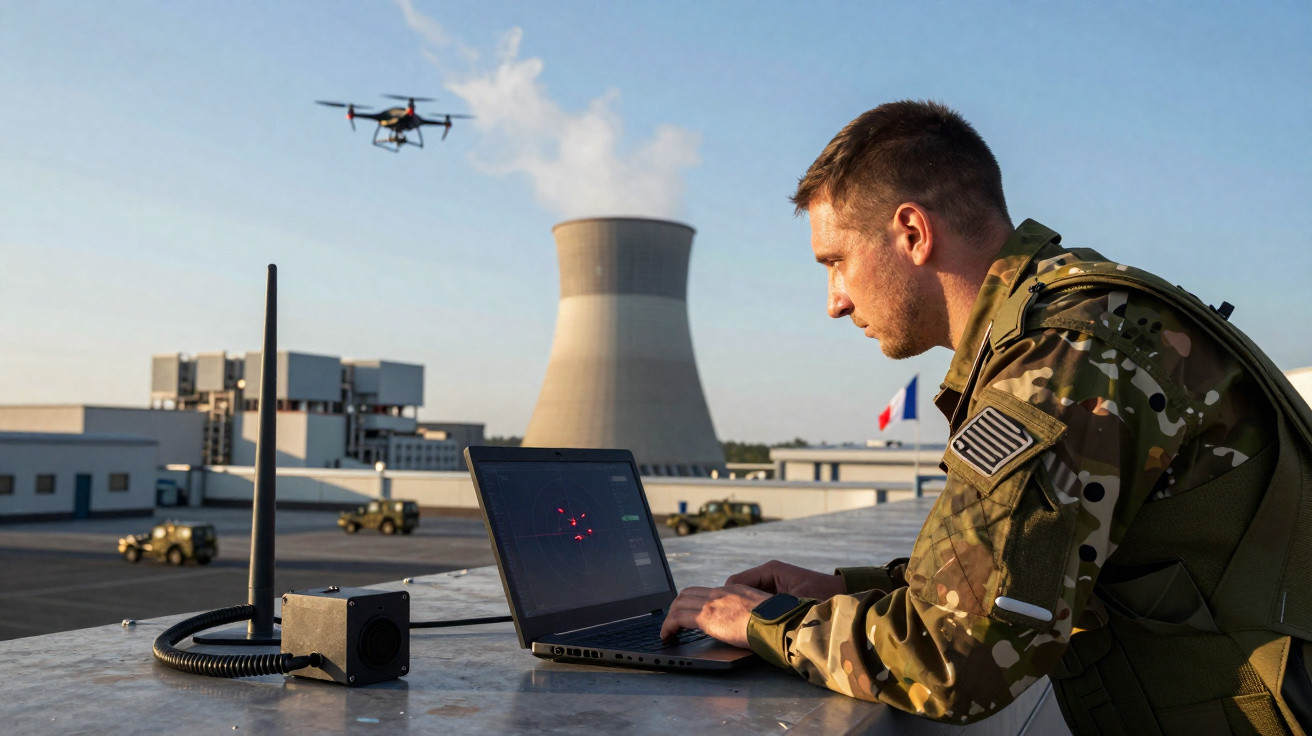
In recent weeks, small unidentified aircraft have been spotted over some of France’s most sensitive sites, including nuclear facilities and military bases. Paris is now racing to address a long-neglected weakness in its defences: the few hundred metres of airspace in which recreational drones, commercial quadcopters and improvised devices can inflict disproportionate harm.
Low-flying drones over nuclear and military sites
France’s newest warning has not involved high-altitude bombers or hypersonic missiles. Instead, it concerns consumer-type drones flying at low level, frequently unheard until they are nearly directly above their target.
Defence sources say these aircraft have passed over:
- Mourmelon, a major French Army training camp
- A rail convoy carrying Leclerc battle tanks near Mulhouse Nord
- The Eurenco facility in Bergerac, which manufactures propellants and explosives
- L’Île Longue, home base of France’s nuclear-armed ballistic missile submarines
- Logistics and intelligence centres, including the Creil-Senlis joint services site
Every flight has been brief, and none has yet produced physical damage. Yet collectively, they resemble somebody testing door handles in a darkened street.
French security officials see a pattern of probing flights, as if an unknown actor was “testing locks” on critical sites rather than striking them.
Ground-level responses have at times appeared makeshift, relying on handheld jamming rifles, shotguns and improvised patrols. Such measures are emergency options rather than a lasting protective shield for high-value facilities requiring round-the-clock security.
The French defence establishment has reached a stark assessment: low-level airspace has become a strategic blind spot.
Emergency order: two TRUSTCOMS systems to plug the gap
On 26 December 2025, the Directorate of Aeronautical Maintenance activated an “operational emergency” process, ordering two counter-drone systems from the French company TRUSTCOMS. This accelerated procedure is seldom used, showing that the military considered the situation too pressing for a prolonged tender process.
Infodrone: spotting the intruder
The first system, Infodrone, is designed for detection and identification. It uses the “remote ID” signal that most civilian drones in Europe are now required to transmit. Functioning like a digital number plate, the signal carries basic identity and location information.
TRUSTCOMS states that Infodrone can detect and locate roughly 95% of commercial drones equipped with this capability. Compact and rapidly deployable, the equipment is suited to:
- Protecting permanent locations including factories, depots and bases
- Securing temporary high-profile events
- Delivering a quick initial check of “is this friend, legal user or unknown?”
Infodrone gives commanders something they often lack in drone incidents: near-instant clarity about what is flying, and where it is coming from.
The system neither fires a weapon nor independently transmits disruptive signals. Its principal benefit is reducing the delay between “we see something on radar” and “we know whose drone this is and whether it should be here”.
DroneBlocker: shutting down hostile aircraft
DroneBlocker, the second TRUSTCOMS system, provides the forceful element. It employs jamming to sever the radio connections and satellite-navigation signals (GNSS) on which drones rely.
After acquiring a target, DroneBlocker can interfere with:
- The control connection between the operator and the drone
- Telemetry used for command and data transmission
- GPS, Galileo and other positioning signals directing autonomous flights
The manufacturer says it can neutralise up to 99% of drones within its engagement envelope. Real-world conditions will affect that figure, but the intended outcome is clear: compel an aircraft to land, hover without control, or activate a fail-safe return that authorities can observe.
A significant capability is its capacity to tell “friendly” drones apart from hostile ones. French forces are making increasing use of their own UAVs for reconnaissance, convoy overwatch and base security. A counter-drone zone that brought down every aircraft would be impractical. Differentiating blue drones from red drones is therefore now an essential requirement.
DroneBlocker is designed to blind and mute hostile drones while letting authorised military UAVs continue their mission inside the same airspace.
A patch, not a full cure
Officials emphasise that Infodrone and DroneBlocker do not replace France’s principal long-term counter-UAV programmes. Rather, they provide an interim measure for what one officer called “an immediate, uncomfortable void”.
The objective is to equip commanders with additional capabilities as France builds a more far-reaching national architecture to counter drones, both domestically and during overseas operations.
French planners have also had to adjust their thinking. Technological advantage is no longer determined solely in high-altitude airspace by sophisticated fighters and long-range sensors. It is equally contested in the cluttered layer between forests and rooftops, where a £1,000 quadcopter can prompt a security alert at a nuclear base.
A crowded anti-drone toolbox
France is not beginning from nothing. Each of the three services already operates or tests several counter-drone systems at different stages of deployment.
| Service | System | Main role | Typical use |
|---|---|---|---|
| Air and Space Force | MILAD | Detection, tracking and jamming | Protection of air bases and sensitive sites |
| Air and Space Force | BASSALT | Detection and neutralisation using radar and optics | Major events, base protection |
| Joint / DGA | HELMA‑P | Laser “hard kill” against drones | Physical destruction at short range |
| Army | PROTEUS | 20 mm cannon with smart fire control | Close protection for units and fixed locations |
| Army | NEROD jammers | Portable neutralisation of commercial drones | Patrols, convoy security |
| Joint | Infodrone & DroneBlocker | Identification and jamming | Rapid reinforcement at critical locations |
Helicopters equipped with electronic-warfare pods may also be assigned to form temporary “no-drone bubbles” above designated areas.
The issue is now less about creating new equipment than ensuring coverage, response speed and coordination. Drones can emerge with virtually no warning, follow pre-programmed flight paths or operate in swarms intended to overload sensors.
Generals warned of swarm scenarios
French MPs had been alerted to this risk months before the latest incidents. At parliamentary hearings during the autumn, Air and Space Force chief General Jérôme Bellanger outlined recent exercises in which the military evaluated its defences against drone swarms.
His conclusion was carefully phrased but troubling: the results were “perfectible”. Put simply, a substantial number of low-cost, coordinated UAVs can strain or evade existing systems.
Senior officers now speak openly about a future where saturation attacks by expendable drones become as common as artillery barrages once were.
These attacks need not destroy runways or hangars to generate disorder. A concentrated drone wave can leave radar operators sorting through hundreds of tracks, while security personnel pursue several false alarms around a base. Just one aircraft getting through could record footage, interfere with communications or release a small payload.
What “remote ID” and jamming really mean
For those outside the field, much of the terminology surrounding counter-drone warfare can seem unclear. “Remote ID” and “jamming” are two of the most important concepts in this French initiative.
Remote ID is effectively a form of digital drone identification. European rules require most commercial UAVs to broadcast information including their serial number, position, altitude and the operator’s location. Systems such as Infodrone listen for these transmissions. When they identify a drone lacking remote ID, or one broadcasting suspicious parameters, they can flag it as a possible threat well before it reaches a perimeter fence.
Jamming, deployed by DroneBlocker and similar systems, floods radio frequencies or navigation bands with powerful noise. When performed properly, a drone’s receiver is unable to interpret commands or satellite data. Military planners must tune this with care: excessive power or an incorrect frequency could disrupt nearby civilian communications or friendly systems.
How a real incident could unfold
Defence officials regularly run paper-based scenarios. One plausible example could unfold in early evening at a nuclear facility, when security sensors detect a small, slow-moving object approaching at low altitude. Radar displays a weak track, while cameras see flashing lights but cannot determine the model.
An Infodrone unit would immediately search for remote ID transmissions. If it detects a lawful, registered drone operated by a maintenance contractor on a pre-authorised route, the alert can be closed quickly. If it finds no valid signal, or the data identifies an unauthorised operator beyond the perimeter, the threat level increases.
A DroneBlocker station would then be directed at the track. Operators would jam the intruder’s control link and GNSS, making it drift, land or return home along a route that can be monitored. Teams at the site could subsequently recover the hardware and, if fortunate, trace it to the person who launched it.
This layered approach - detect, identify and then neutralise - is precisely the response France seeks to standardise before an opportunistic flight develops into a genuine crisis.


Comments
No comments yet. Be the first to comment!
Leave a Comment