
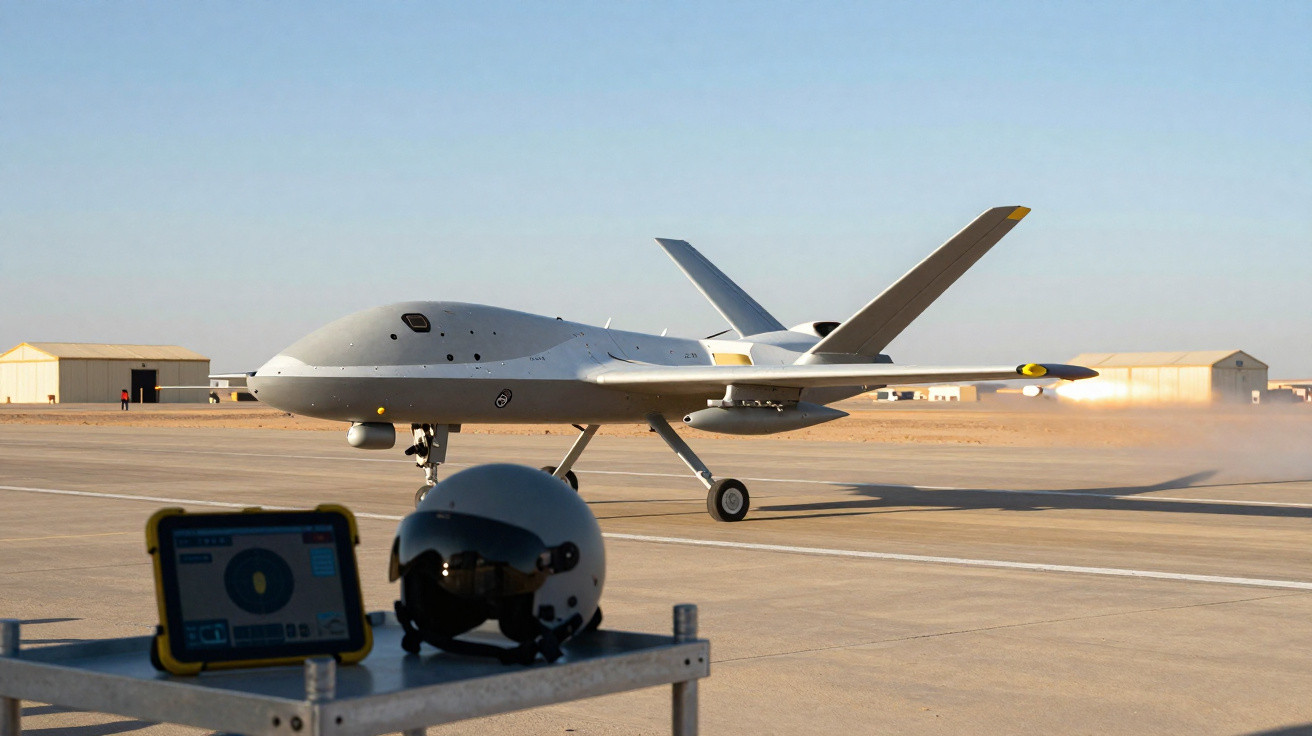
The United States Air Force (USAF) has begun weapons-integration trials involving its Collaborative Combat Aircraft (CCA) combat drones, following a flight by the YFQ-44A carrying an inert AIM-120 AMRAAM air-to-air missile. This latest test phase forms part of the development effort intended to demonstrate that these uncrewed aircraft can operate alongside crewed platforms within the USAF’s future force architecture.
CCA weapons-integration testing
According to the USAF, the CCA programme has moved into a testing stage that includes captive-carry assessments with inert weapons. The purpose is to confirm airworthiness, safety and system performance. These tests assess the aircraft’s ability to carry external stores, verify structural integrity and aerodynamic behaviour, and establish compatibility between the weapon system and the platform before any consideration is given to using live munitions.
“We are following the same detailed approach used across all other aircraft developmental test programmes to validate structural performance, flight characteristics and safe separation,” said Air Force Chief of Staff General Ken Wilsbach. The officer added that this process “ensures that the CCA can safely integrate inert weapons ahead of future employment”, stressing that this is a phase focused strictly on technical validation.
USAF Collaborative Combat Aircraft programme
The CCA programme is designed to develop relatively low-cost, risk-tolerant aircraft that operate as part of a human-machine team, increasing the range, survivability and effectiveness of crewed aircraft in contested environments. Programme officials have emphasised that this stage remains under development and is focused on the safe integration of systems rather than operational employment. Throughout the process, a human operator retains authority over any decision concerning weapons release.
For the programme’s first increment, two designs have been selected for development and flight testing: General Atomics’ YFQ-42A, named Dark Merlin, and Anduril’s YFQ-44A, known as Fury. The concept is intended to provide crewed fighters with an uncrewed “loyal wingman” companion able to expand detection, strike and protection capabilities in high-threat scenarios.
YFQ-42A, YFQ-44A and future CCA designs
Meanwhile, other companies continue to promote their proposals in the autonomous combat drone sector. Northrop Grumman unveiled its YFQ-48A design, called Talon Blue and previously known as Project Talon, which the USAF described as a strong contender for future phases of the CCA programme. Although the YFQ-42A and YFQ-44A are currently the designs formally under development in Increment 1, the possible inclusion of other designs in later increments has not yet been officially confirmed.
“CCA is a critical part of a larger integrated system that will give our warfighters a decisive advantage,” Wilsbach stated. The general added that the programme is intended to provide a network of effects able to “sense, strike and protect our forces in contested environments”, as the Air Force advances the modernisation of its capabilities through a progressive approach and within already established command and legal frameworks.
Images for illustrative purposes.






Comments
No comments yet. Be the first to comment!
Leave a Comment