
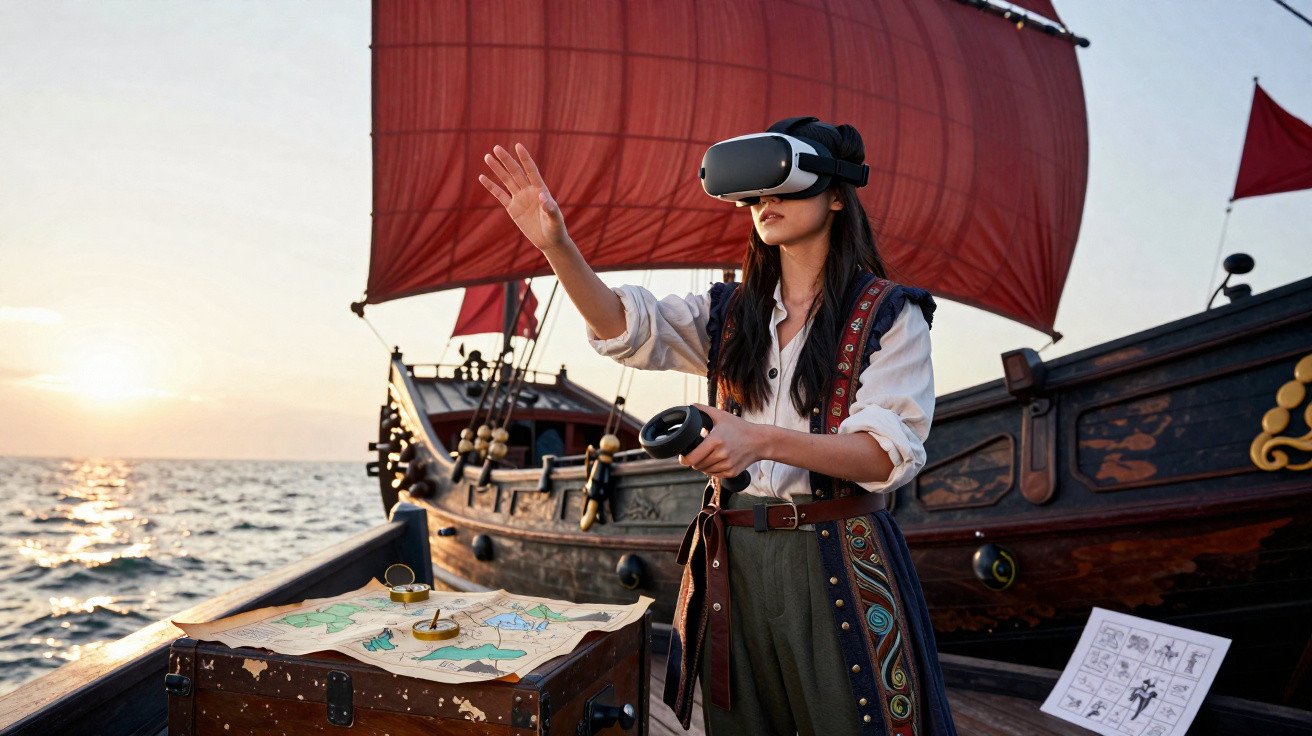
When pirates come to mind, historical figures such as Blackbeard may sit alongside the fictional Jack Sparrow. Yet one significant name is frequently overlooked: Cheng Shih. She was not only one of history's most successful pirates, but also the woman who assumed command of her late husband Cheng Yat's pirate armada after he died. This left her indirectly commanding more than 40,000 pirates for a period of almost ten years in Chinese waters during the early 19th Century. Cheng Shih's story exists in books and other sources, but Singer Studios wants to make it tangible in VR.
The Pirate Queen brings Cheng Shih's story to VR
Set over one night - the night Cheng Shih took power and began the journey towards establishing laws that treated men and women equally on her ships - The Pirate Queen: A Forgotten Legend casts players as Cheng Shih, or rather, places them in her boots. Due next year for PC VR devices and Meta Quest 2, the game takes an escape-room-style approach to VR rather than relying on gunfire and spectacle-heavy set pieces. During a private demonstration, I see a glimpse of the VR experience. Its restrained, deliberate gameplay is appealing, even though I am not wearing a headset myself. I am particularly drawn to the team's focus on Cheng Shih's life, and its decision to frame the VR game around a single night. I am told not to anticipate vast battles full of pirates, but instead the emotional pressure Cheng Shih may have felt that evening.
"We come from film, so VR is a nice stepping stone for us," Singer Studios CEO and creative director Eloise Singer tells me. "Each level has an escape room aspect; we wanted to lean away from being a shooter or combat game, challenging you to be as smart as she was, using her intellect to outsmart everyone."
It was that intelligence, along with the fact that Cheng Shih's account is largely unknown within the wider world of piracy, that drew Singer and Singer Studios towards The Pirate Queen. Singer has been considering this story for six years.
Singer Studios released The Last Rifleman, starring Pierce Brosnan (007 Tomorrow Never Dies, Mamma Mia), only last month, while 2021 saw the release of Rare Beasts, starring Billie Piper (Doctor Who, Penny Dreadful) and Lily James (Cinderella, Baby Driver). The studio has also worked with companies including Amazon on projects. The Pirate Queen began at Singer Studios as an idea for a film, but that shifted after Singer met David Ranyard, the now-former head of PlayStation London Studio.
"He was like, 'This would make an amazing game,'" Singer says. PlayStation London Studio created PlayStation's VR Worlds and Blood & Truth for VR, so it is not hard to understand how The Pirate Queen became a VR title. Still, Singer says she had never envisaged attempting to make a game, and put the idea aside for a while. When the pandemic arrived and film productions across the world stopped, however, Singer rang Ranyard to say she wanted to turn The Pirate Queen into a game. The team secured funding for a prototype, expanded with further staff, and earned awards including "Best Debut" at the Raindance Film Festival.
Singer Studios then presented the prototype to Meta. I am told it was a one-room experience featuring light puzzle mechanics. Meta loved it and, during the first call, told the studio it wanted to develop it into a full project. More than four years after development started, The Pirate Queen will launch next year on Meta Quest 2 and other PC VR devices.
Creative director Eloise Singer and lead actress Lucy Liu
When I ask Singer why The Pirate Queen had to be a VR experience, she gives a straightforward response: "I've always wanted to be a pirate."
"So selfishly, I'm just like, 'I want to make a pirate game because I get to be a pirate,' and it feels like our whole team is like that," she adds. "But I think at the same time, when I first heard her story, it was one of those, 'I'm so shocked that I didn’t know about this piece of history,' and I just felt really compelled that everyone should know more about this period of history and how important this woman was. And it's not even just the fact that she was a pirate, but she was the most powerful pirate of all time actually, and quite literally paved the way for equality.
"The more I looked into it, the more I was interested in this story, and I just felt it could make an amazing game. I really wanted to tell it, and I think when you feel there's a fundamental belief for you wanting to tell the story, that's kind of your driving force for wanting to create anything."
Cultural care and puzzle-led gameplay
Singer says The Pirate Queen was originally intended for women, perhaps those between 16 and 35 years old. As more people played and tested the game, though, the audience broadened to include young children and older people, while gender stopped being a consideration. "It's for everyone," she says. "It's a really beautiful project because it feels very inclusive in that sense."
In the same vein, Singer says the team has spent considerable time making the game as culturally sensitive and accurate as possible. That has involved studying Chinese culture and 19th-century China, as well as consulting and collaborating with people of Chinese heritage, among other measures. Its work with Chinese experts is why The Pirate Queen includes correctly presented red lacquered wood on ships, art appropriate to the period, historically accurate calligraphy, and properly woven mats on vessel floors.
Lead artist Will Brosch calls The Pirate Queen an experience that favours brains over brawn. "You are outmaneuvering your opponents in a diplomatic sense, but that doesn't mean you don't get your hands dirty in other ways," he says.
That is evident in the 20-minute demonstration I watch. Instead of clashing swords or gunpowder explosions lighting up the horizon, the game presents smaller puzzles to solve. Brosch says there is no hand-to-hand combat, although he does hint at cannons. In one example, a locked door in the captain's cabin on the ship that once belonged to Sao is marked with several symbols. After throwing rocks at pottery above a cabinet, the player uncovers additional symbols on the wall. Matching the lock's symbols with those on the wall opens it, allowing them to pass through the door.
"There's a lot of cognitive puzzle stuff," Brosch explains. "The script is quite narrative, linking back to our film background, and it's about finding gameplay that fits within the script."
This demonstrates Singer Studios' narrative-first approach to The Pirate Queen, an essential one given the importance of telling Cheng Shih's story in a medium saturated with male-led piracy across games, films, television programmes and books. Singer tells me this approach also helped the studio bring actress Lucy Liu (Kill Bill: Volume 1, Charlie's Angels) aboard as executive producer and the voice of the pirate queen herself.
"After we got accepted into [the Tribeca Film Festival], we reached out to her team and said, "We're developing this project, and it's really exciting. Is it something that she would be interested in coming on board with?'" Singer says. "And her team responded really warmly to the project and said, 'This story is incredible.'"
According to Singer, Liu had not known this story and could not believe it was real. She now voices Cheng Shih and has joined the project, presumably helping the team develop this universe further. The The Pirate Queen VR game is only the beginning: plans include a biopic-style film, a graphic novel, a podcast and a television series with Beijing, China-based studio Seesaw Films, which made 2019's The Farewell, starring Awkwafina (Crazy Rich Asians, Shang-Chi).
Lucy Liu recording VO for the game
"I think it reflects the studio and our values and foundations, which is that we are transmedia," Singer says. "The whole idea is that we want to tell stories to different audiences on different platforms."
Guiding players through the VR world
Immersive producer Siobhan McDonnell says autonomy is the greatest difference between VR production and filmmaking. "Where do you want your constraints?" she asks. "The autonomy of the player is about the illusion that you can go wherever you want in this story world, but actually, in terms of design, you do want the player to do certain objectives. It's this beautiful fusion of, 'Go explore and be free, but we kind of want you to do this part of the game.' And I think mixing those two things can be challenging because you need it to be covert."
McDonnell and Brosch point to breadcrumbs as one means of achieving this. Shimmering highlights on necessary objects, lighting signals, audio, and in-world narration from Cheng Shih can all steer players towards the golden path. Brosch adds that VR players are more likely to become overwhelmed than they are in other games, and that VR development must find ways to avoid this or risk losing the player. Singer says testing has been particularly helpful in this respect, and it is an element of game development she is keen to bring into the studio's film work.
Testing has also allowed the team to address the motion sickness that can accompany any VR project. Programmer Hankun Yu says he never experiences motion sickness in VR, yet he reached "6-out-of-10" sickness in a sequence that has since been removed, where players swung on a rope between ships. With motion sickness in The Pirate Queen now resolved - though I will need to take the team's word for that until I play it myself - Yu looks forward to people eventually connecting this historical tale with something he worked on in a tangible way.
With the release set for early next year, the team is eager to put the game into players' hands.
"As an artist, I always hope that the player, especially in VR, takes the headset off and realizes that they forgot where they were, and that they were totally immersed in the world," Brosch says. McDonnell tells me she simply wants players to feel like badasses.
I enjoy the demonstration of The Pirate Queen that I am shown, and I enjoy talking with the people creating it just as much. Singer, Brosch and the others I speak with are passionate about Cheng Shih's account and about recreating it through VR in a respectful, exciting way. Without hands-on time, it is difficult to judge exactly how enjoyable the experience will be, but what I have seen and heard makes me eager to do so when it arrives next year.
Creative director Eloise Singer and lead actress Lucy Liu
"For people to say, 'I had no idea about that story, that was amazing, that was so much fun,' that's all I want," Singer tells me. "We're creating something to shed light on the history and a woman people don't know about."
**Editor's Note: This story has been updated to reflect that Cheng Shih's husband's name was Cheng Yat.



Comments
No comments yet. Be the first to comment!
Leave a Comment