
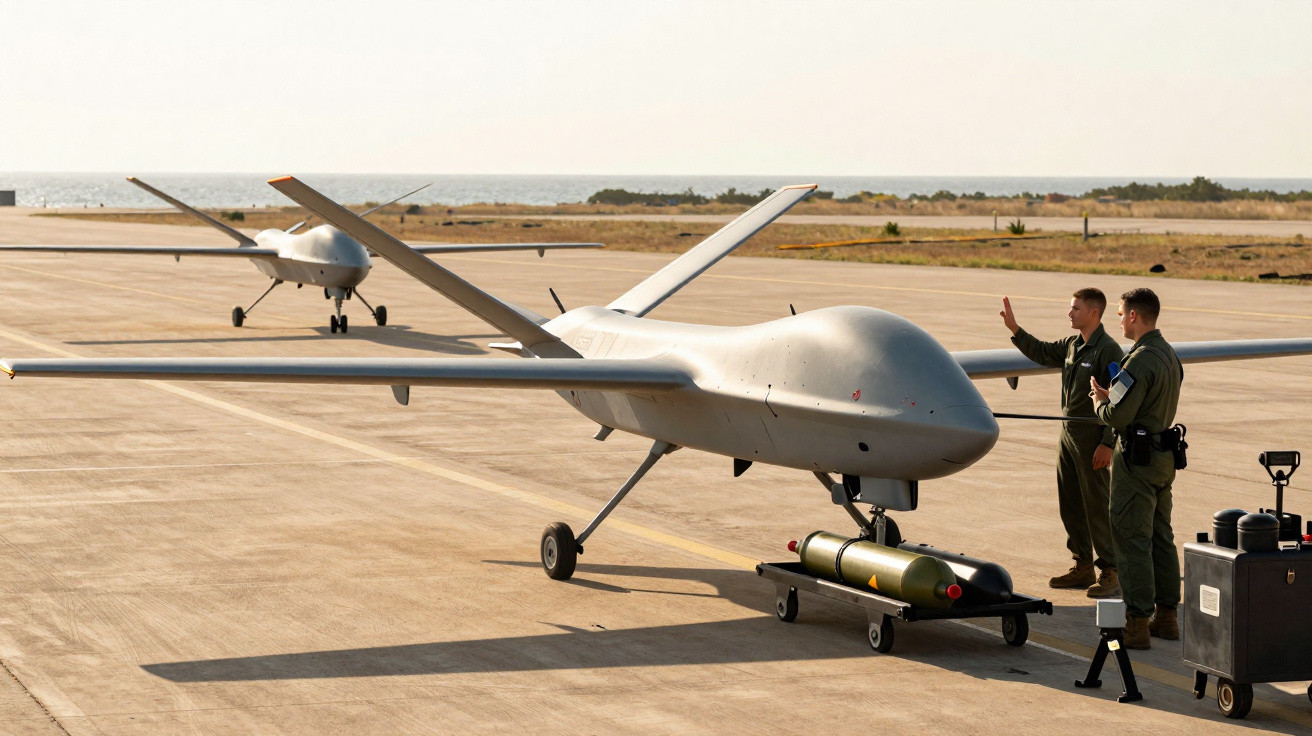
The US Marine Corps’ next-generation XQ-58 Valkyrie drones are developing into a versatile hybrid platform: they can be rocket-launched from rough, improvised locations, while also recovering and flying again from runways using conventional landing gear.
A stealth drone that can operate without a runway - unless the Marines choose one
Kratos, the manufacturer of the XQ-58 Valkyrie, has confirmed that the landing-gear-equipped model ordered by the Marines will retain the drone’s distinctive rocket-assisted launch arrangement from fixed ground launchers.
The same Valkyrie airframe the Marines are getting will be able to launch via boosters or take off conventionally, then land on a runway.
This CTOL - conventional take-off and landing - Valkyrie preserves one of the programme’s key original advantages: independence from runways. At the same time, it can return to earth like a conventional aircraft rather than descending beneath a parachute.
As part of the Marine Corps’ MUX TACAIR Collaborative Combat Aircraft (CCA) programme, Kratos is targeting the first flight of this version in early 2026.
From rocket sled to retractable landing gear
The original Valkyrie concept
The standard XQ-58, which made its maiden flight in 2019, was intentionally designed without landing gear. It launches on a disposable rocket booster fitted to a static launcher, before recovering by parachute with airbags used to soften the landing.
This method brings important advantages: there is no need to defend a lengthy runway or rely on heavy-duty paving, while launches can take place from remote strips, open fields, or even containerised launchers concealed in shipping yards or on small islands.
Runway-free operations make the Valkyrie harder to target, easier to hide, and simpler to disperse across a wide battlespace.
Kratos subsequently demonstrated a wheeled launch trolley that lets gearless Valkyries roll along a runway before take-off, although recovery still depended on a parachute.
What changes with CTOL Valkyries
The CTOL model intended for the Marines gains retractable undercarriage, allowing it to both depart from and return to runways. However, this involves compromises. Space inside the airframe formerly available for fuel or mission systems must instead accommodate structural fittings, retraction equipment and wheels.
Kratos has previously stated that fitting landing gear reduces part of the drone’s internal payload capacity, although external hardpoints continue to be available for sensors and stores.
- Gain: runway landings, faster turnaround, easier maintenance
- Loss: some internal payload volume and, potentially, fuel capacity
- Retained: ability to use rocket-assisted launches from static sites
Questions remain over the aircraft’s dimensions and arrangement. The CTOL model could be marginally larger, but it needs to remain compatible with existing launchers if Kratos is to retain the same rocket-based system. That requirement constrains any increase in the airframe’s length, wingspan or weight.
Why the Marines want rockets and runways
Operating inside the “weapons engagement zone”
The Marine Corps is reshaping its aviation force around expeditionary, widely dispersed operations. Small units could work from austere temporary sites on remote islands or minimally equipped airstrips within an adversary’s missile-threat envelope.
Under such circumstances, a drone fleet dependent solely on large permanent runways would be exposed. The Valkyrie’s rocket-launch capability enables Marines to send aircraft on missions from camouflaged locations well away from principal air bases, making enemy targeting more difficult.
A rocket-launched Valkyrie can fly its first combat sortie from a hidden site, then land later at a prepared runway to keep flying follow-on missions.
This hybrid concept is a major attraction of the CTOL configuration. Analysts often describe a scenario resembling the following:
| Phase | How Valkyries operate |
|---|---|
| Opening strikes | Rocket-launched from dispersed static sites, no runways required |
| Follow-on operations | Land on tertiary or improvised runways, quickly refuel, rearm, and launch again |
| Later campaign | Operate more like conventional aircraft from selected airfields, mixed with manned jets |
Sortie generation and sustainment
Although parachute recovery avoids the need for a runway, it can be slow and occasionally harsh on the aircraft. Following a sortie, crews must inspect the airframe for recovery damage, repack the parachute and reset the airbags. An error during this process can seriously damage the drone.
Runway recoveries should enable ground teams to return Valkyries to flight more rapidly, particularly from semi-permanent expeditionary bases. That turnaround time is a significant benefit for a force seeking frequent, low-cost uncrewed sorties.
There is also a logistical cost. Rocket launches use expendable boosters that need to be stored and transported forwards along vulnerable supply routes. Conventional runway operations require fuel vehicles, power equipment and additional support staff. The CTOL Valkyrie gives commanders the option to select the logistical approach best suited to the mission and threat at that moment.
Performance compromises and payload decisions
Runway independence against payload and range
Aircraft designed to operate independently of runways are commonly restricted in maximum take-off weight, as the capacity of the rocket booster and the strength of the launch structure limit how heavy they can be. In practice, this generally means carrying less fuel or payload than a comparable aircraft taking off along a runway.
Kratos has previously said that gearless Valkyries gain “tens of percent” in fuel and payload when using the wheeled launch trolley rather than the static rocket-only arrangement. This indicates that the launch method itself can substantially affect range and endurance.
With CTOL aircraft, commanders must make more complex decisions:
- Launch by rocket from a concealed site, accepting weight restrictions in exchange for surprise and survivability.
- Take off conventionally from a longer runway, accepting greater exposure while carrying more fuel and weapons.
Landing gear also changes how internal volume is allocated. Payloads that once fitted within the bay could need to be mounted externally or redesigned. This may affect stealth characteristics and sensors that require internal carriage or particular installation positions.
Where the XQ-58 Valkyrie sits in Marine aviation
Part of the MUX TACAIR “minimum viable product” drive
The CTOL Valkyrie is one of the candidate airframes in the Marines’ MUX TACAIR CCA initiative. The programme is intended to field a “minimum viable product” rapidly before adding further capability progressively through a spiral-development approach.
The Marines want an uncrewed aircraft that can handle air-to-ground strike, intelligence gathering, and electronic warfare from dispersed bases.
Its open-architecture systems and modular construction mean the Valkyrie can receive different payload packages over time, including jamming pods, targeting sensors, weapons and networking nodes that connect manned and uncrewed aircraft.
Not every future Marine drone is expected to fly regularly. Some could serve as “war reserve” assets, held in storage and used lightly for training before being surged during a crisis. For such aircraft, runway compatibility is relevant to peacetime integration with manned squadrons, while rocket-launch capability is important for survival in the opening stages of war.
Beyond the Marines: further users and variants
The US Air Force, which managed the Valkyrie’s first flight and still employs the type for experimental work, is the only publicly identified operator apart from the Marines. Kratos has indicated that further US sales opportunities may exist and is also collaborating with Airbus on a German Air Force version.
Future versions could divide into two broad categories: entirely runway-independent aircraft tailored for austere operations, and CTOL variants centred on integration with established air bases and allied air forces. The modular architecture of the core airframe should allow versions to be adapted for each customer.
Key terms and what they mean in operational use
For non-specialists, several acronyms determine how these drones may be employed in practice:
- CCA (Collaborative Combat Aircraft): Uncrewed aircraft intended to work alongside manned fighters as scouts, decoys or additional weapons carriers.
- Stand-in Force: Marine units operating within enemy missile range from small outposts, aiming to survive through agility and concealment.
- MUX TACAIR: The Marine Corps programme to introduce uncrewed tactical aircraft able to support ground forces through strike, reconnaissance and electronic effects.
During a real Pacific crisis, for instance, a small Marine unit could deploy containerised Valkyrie launchers to a remote island, launch rocket-assisted drones equipped with radar jammers and anti-ship missiles, and then recover them at a rough airstrip hundreds of miles away for rapid rearming. Some aircraft could avoid a formal air base altogether for weeks.
Such a scenario demonstrates both the opportunity and the danger. Flexible launch methods make the Valkyrie less predictable and even more difficult to strike. However, dependence on expendable rockets and vulnerable island runways creates separate weaknesses. A precisely placed missile barrage or interrupted booster supply chain could severely reduce sortie rates.
For planners, the CTOL Valkyrie’s appeal is its flexibility. On any given day, commanders can balance concealed, dispersed rocket launches against heavier runway-based sorties while using the same underlying drone. That mix-and-match capability is likely to shape how the Marines - and potentially other air arms - operate Valkyries in the years ahead.





Comments
No comments yet. Be the first to comment!
Leave a Comment