
We have all known a classmate who, the day before an exam, asked for everyone’s notes, copied them and then achieved the better mark. That is, more or less, what Xiaomi appears to be trying to do.
After being accused of copying the broad outlines and technological solutions of the Porsche Taycan, the Chinese brand best known for making smartphones now wants to beat the German manufacturer on its own turf: the Nürburgring-Nordschleife. It is the school where numerous brands take their performance cars to learn good manners, and Porsche has long been the star pupil.
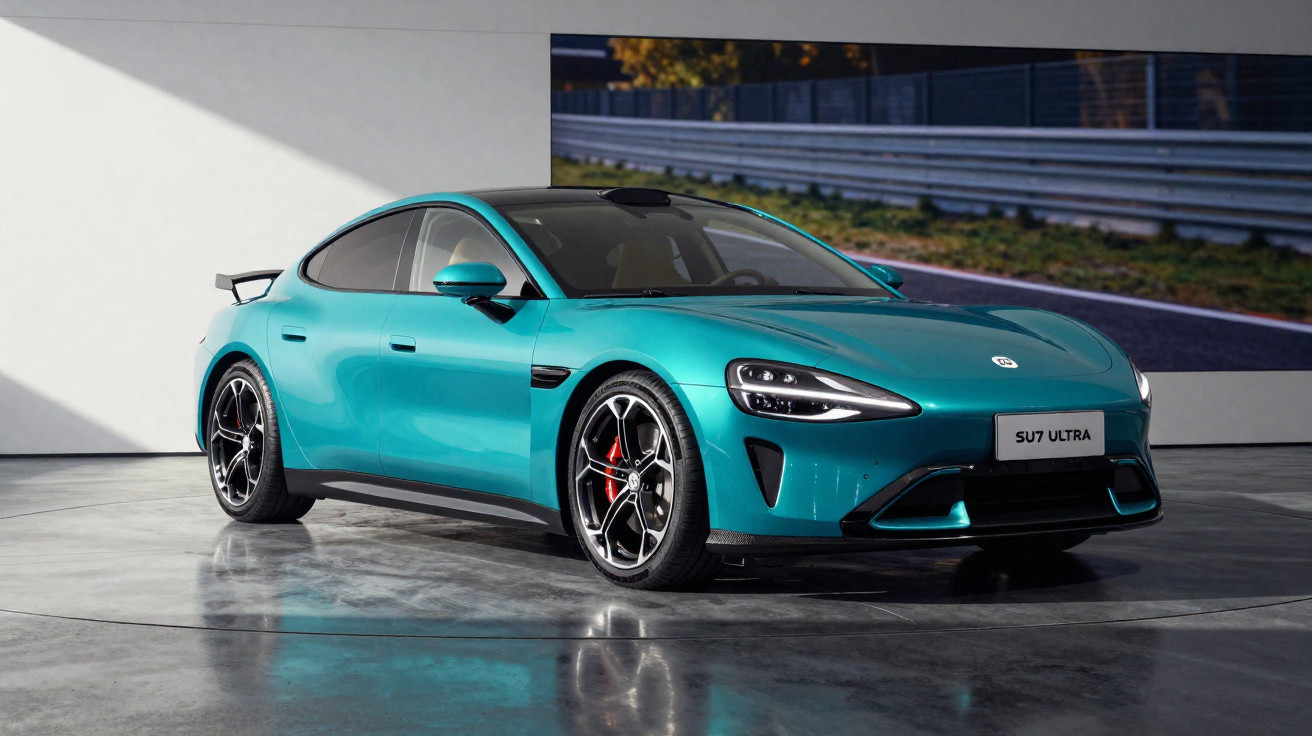
Xiaomi has now unveiled the SU7 Ultra Prototype, the most extreme version of the SU7 saloon, created with one goal in mind: to defeat the “swot” Taycan Turbo GT in the “Green Hell”. Believe us, it has done its homework...
One, two, three motors
To achieve that, Xiaomi has fitted the SU7 Ultra Prototype with three motors: two V8s and one V6s. Do not mistake those names for internal-combustion engines. The SU7 is a fully electric saloon, and Xiaomi is showing its sense of humour by giving its electric motors names that mean so much to petrolheads.
The first two are the most powerful, with each producing 425 kW (578 hp) and 635 Nm of torque. Their maximum rotational speed reaches 27,200 rpm. The nearest comparison is the 22,000 rpm of the epic Hyundai IONIQ 5 N, which we have already covered.
Altogether, the Xiaomi SU7 Ultra Prototype claims a combined maximum output of 1139 kW, equivalent to 1548 hp - considerably more than the 1108 hp of a Porsche Taycan Turbo GT or the 1250 hp of a Lucid Air Sapphire.
That output is paired with a relatively “modest” mass of 1900 kg, helped by the use of carbon fibre. The result is remarkable acceleration: under two seconds from 0 to 100 km/h.
Its battery uses LFP (lithium iron phosphate) chemistry and forms part of an 897 V electrical system. CATL developed it specifically for competition cars.
The battery capacity and driving range have yet to be disclosed. We do know, however, that it takes just 12 minutes to complete a charge. So there is not much waiting around before attempting a record...
Xiaomi SU7 Ultra Prototype: a genuine performance car
The bodywork alone makes the Xiaomi SU7 Ultra Prototype’s intentions clear: it wants to be quick. Alongside a three-metre wheelbase and an overall length exceeding five metres, the body is now 2.064 m wide.
At the front, there is a generously sized splitter and two vast air intakes. Prominent side skirts run along the flanks, while the rear is topped by a huge fixed wing. In total, the SU7 Ultra can generate up to 2145 kg of downforce.
Lesson No. 1: acceleration and braking
Among the mechanical hardware, the AP Racing braking system for competition cars also deserves attention. It includes six-piston callipers at both the front and rear, while the pads can withstand temperatures above 800 ºC.
To deliver braking performance worthy of its pace, the SU7 also uses its electric motors to slow down and recover energy, up to a maximum of 0.6 G. With every system working together, Xiaomi’s prototype promises peak deceleration of 2.36 G. In other words, from 100 km/h, the brand claims a stopping distance of only 25 m.
Target: Nürburgring-Nordschleife
An electric car prepared to this extent exists to chase records. Anything less would be defeat. There is therefore no better proving ground than the Nürburgring-Nordschleife, the brands’ preferred decider.
On this circuit, the benchmark is the Porsche Taycan Turbo GT’s 7min07.55s lap, the fastest time for fully electric four-door saloons. We will have to wait until October to find out what the SU7 Ultra can achieve.
Despite its prototype status, Xiaomi intends to reveal the production version of the SU7 Ultra in 2025. Is it possible to manufacture and homologate a saloon with these characteristics? Xiaomi says it is. Yet some may struggle to trust a pupil allegedly caught copying...




Comments
No comments yet. Be the first to comment!
Leave a Comment