
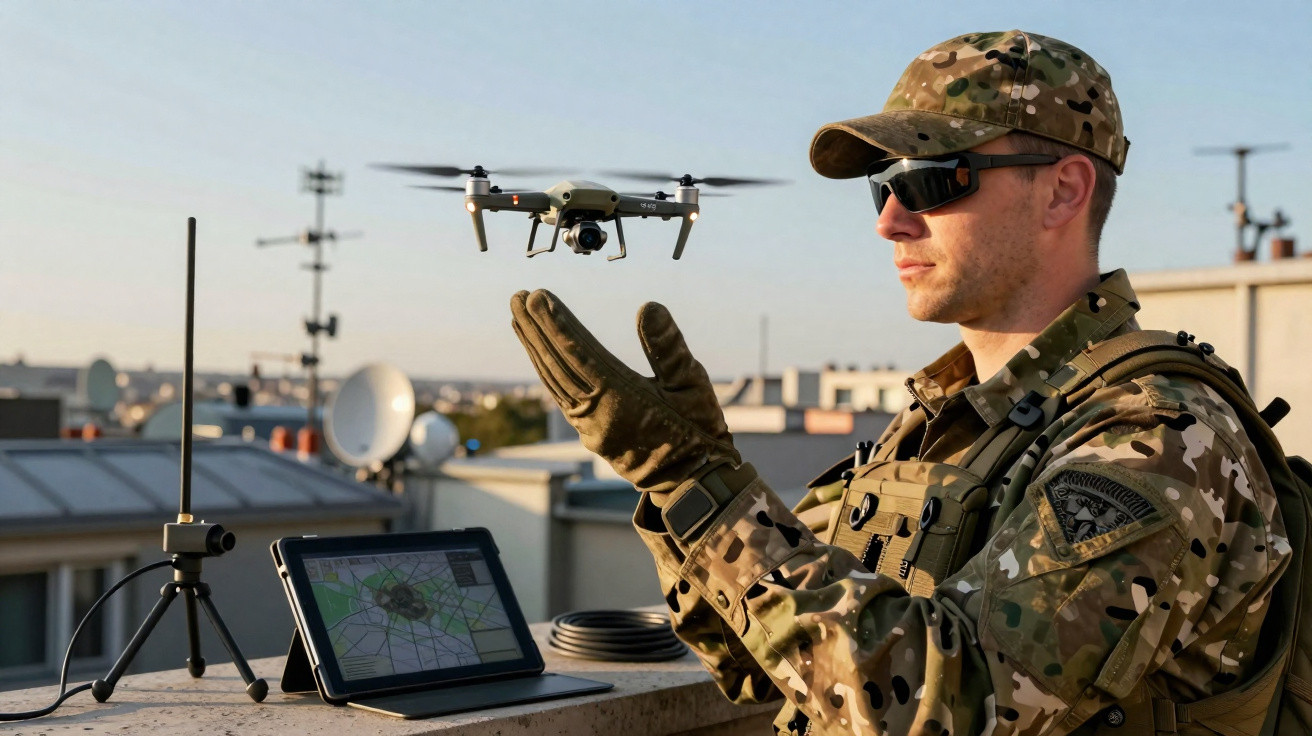
Picture a “bee” that is actually a military-grade micro-drone: it slips beneath curtains, pauses on a window frame and streams video live. French soldiers recently practised exactly that scenario in a closed demonstration near Paris. There was no buzzing and no spectacle, only a tiny shadow achieving something significant. Foreign intelligence services are unsettled for one basic reason: it is hard to defeat something you cannot see, and hardly anyone notices a bee.
The test ground carried the scent of rain and heated metal. One soldier in a fleece repeatedly checked a rugged tablet as several engineers swept their index fingers through the air in smooth arcs, tracking something unseen. Then came the faintest movement. It was neither a buzzing propeller nor a toy, but more like a mote caught in an air current. It slid beside a breeze-block wall, dropped lower and disappeared through a cracked window seemingly too narrow for a pigeon, much less a machine.
It was as though nature had been reprogrammed. The operator made almost no contact with the controls, applying only minute adjustments, like someone training a fly to settle. A minute later, a small image appeared: a desk, a telephone and a handwritten note. Someone murmured “It works.” Then the drone vanished.
The bee that changed the briefing
Put aside the dramatic drone footage of blockbuster films and their roaring rotors. The French Army’s new micro-drone is something else altogether: bee-sized, nearly silent and designed to enter spaces people neglect to check. It is a reconnaissance tool for the forgotten gaps around doors, vents and window catches. This is the sort of device that can do more than record a room; it can establish that the room exists in the first place.
Soldiers who tested it said operating it was closer to gently guiding than flying. The craft “perched” briefly on a windowsill before moving on, using the frame as concealment in the way a real insect might. Boots scraped and radios murmured, yet the drone itself could not be heard. The demonstration made its case through a repeated sequence: outside to inside, then inside to outside, with no fuss and no collision. It was a bee that had learnt to stop breathing.
From a strategic perspective, this represents a shift. Conventional surveillance drones remain at range, accepting that their visibility is the price of doing business. This micro-drone removes that compromise. At distances below forty metres, it falls beneath the background sound of a busy street. It need not fly for hours to be useful; it only has to arrive at the crucial moment with sufficient pixels. This wasn’t a toy. It demonstrated that reconnaissance succeeds when it appears to be nothing at all.
Why intelligence agencies are nervous
Intelligence professionals spend their careers pursuing signatures: heat, noise, battery consumption and movement patterns. A bee-sized drone removes many of them. Guards cannot be placed at every window, nor can microphones cover every vent. It also makes attribution more difficult. If a micro-drone arrives briefly, sends a small burst of information and then deteriorates or stows itself away, who deployed it? Was it a unit elsewhere in the city, a competing service or a contractor carrying out deniable work?
Over the past decade, agencies have spent heavily on counter-UAS systems intended for bigger, noisier dangers. They became highly capable at detecting the obvious. This approach reverses the premise by exploiting the ordinary. The small intruder behaves like urban background life: quick, erratic and easy to forget. Everyone has felt something brush the air beside their face and waved it away without a thought. In that split second, a micro-drone can obtain its target and leave behind little more than a shrug.
Scale creates another difficulty. If one drone can enter, ten could assemble a mosaic of a building in less than a minute. A swarm of “bees” might identify radio dead zones, assess gaps beneath doors and locate active phones before disappearing. For spies, the nightmare isn’t size - it’s deniability. When a craft seems disposable and produces only seconds of data, demonstrating that an intrusion occurred becomes an exercise in conjecture. In modern espionage, that uncertainty is not a flaw; it is an advantage.
How France got here-and where this goes next
The achievement was not merely reducing the size of the airframe. Engineers also had to make a tiny machine operate like a field scout rather than a plaything. They adopted bio-inspired “perch and peek” methods: land, use existing structures to stabilise, reduce power spikes and move when no one is looking. The demonstration showed short pauses on ledges and lintels, preserving energy while reducing camera shake. It is the reconnaissance equivalent of moving across stepping stones.
Policymakers usually concentrate on airports and stadiums because they attract headlines. Flats, service passages and hotel lobbies are less visible, more complicated and more representative of real life. Frankly, nobody does that every day. Urban planners will soon need to consider how buildings breathe-their vents, gaps and pinch points-and not simply for fire regulations. Anyone picturing a future in which micro-drones are routine should begin with the places forgotten at 2 a.m., not those seen on television.
Defence insiders call the French method “pragmatic stealth”. It is not invisibility, merely inconspicuousness. The airframe blends its hum into city noise, follows thermals around concrete and limits its communications links to avoid exposing itself.
“We leaned into the world as it is,” a person involved in the trials told me. “If you try to beat physics, you lose. If you look like a bee in summer, people ignore you.”
- Bio-inspired tactics: short perches, brief dashes and lifelike movement.
- Short-burst communications: rapid snapshots transmitted via low-power links, followed by silence.
- Urban camouflage: routes close to walls that conceal the drone amid heat and texture.
- Disposable mindset: if it is captured, it discloses very little.
The quiet arms race you won’t hear coming
There is an undercurrent to this story that extends beyond France and a single machine. It concerns who controls silence. When armed forces pursue quiet capabilities, everyone else lives with the consequences: new rules, altered building standards and fresh boundaries around privacy. Its arrival feels as clear as a phone vibrating in a pocket: small, yet capable of reshaping the day.
The geopolitical logic is simple on paper but complicated in the street. Countries that master near-invisible reconnaissance can verify facts more quickly than their rivals. That might defuse tensions or intensify them. A tiny drone confirming that a convoy crossed a boundary could avert a catastrophe. One looking into the wrong room could trigger one instead. What happens when silence becomes a weapon? The response will be contested in courts, written into procurement documents and discreetly tested in the shadows.
There is a human dimension as well. Soldiers do not want technology that impresses at first but fails once grit reaches the lens. Cities do not want to become pincushions filled with sensors. Parents do not want to wonder whether an insect in the kitchen is simply an insect. The French trial revealed a route that is both inventive and troubling: small machines that follow the rhythms of everyday life. The issue is no longer whether others will follow, but how far they will go without informing us.
| Key point | Detail | Why it matters to readers |
|---|---|---|
| Bee-sized reconnaissance | The micro-drone enters small openings, perches briefly, sends snapshots and then disappears. | Understand why scale and silence outperform brute force in modern espionage. |
| Urban camouflage tactics | Lifelike movement, wall-hugging routes and short-burst links calibrated to city noise. | See how cities themselves can provide cover-and what that means for privacy. |
| Debate over new countermeasures | Traditional anti-drone equipment misses near-invisible threats; policy and architecture will change. | Anticipate changing security expectations where you live, work and travel. |
FAQ:
- Is it really the size of a bee? That is the comparison used by people who witnessed the demonstration: an insect-scale footprint, a tiny profile and a presence that merges with ordinary life. Its precise dimensions have not been released, but imagine “pocket lint that flies.”
- How quiet is it? Within an urban soundscape, it sits below the level your brain identifies as machinery. In a silent room at close range, you may notice a flicker of movement rather than hear anything. That is the essential trick: being present without being registered.
- What can it actually collect? Brief, high-value image bursts, fast views of screens or room layouts, and signs of activity. It is made for verification rather than lengthy surveillance operations. A few seconds of truth can alter a briefing.
- Could swarms make it unstoppable? Swarms could increase both coverage and resilience, but would also make control and logistics harder. Initially, expect small groups serving as relays and scouts rather than cinematic clouds.
- How do you defend against something so small? Think in layers: improved building “hygiene”, more intelligent access points and policies for sensitive rooms. Technology will follow, including pattern-based detection and targeted shielding, but the starting point is design, training and a clear understanding of what genuinely matters.



Comments
No comments yet. Be the first to comment!
Leave a Comment