
Within just a few years, Europe’s maritime landscape could change quietly, driven by unobtrusive rotors and unseen sensors.
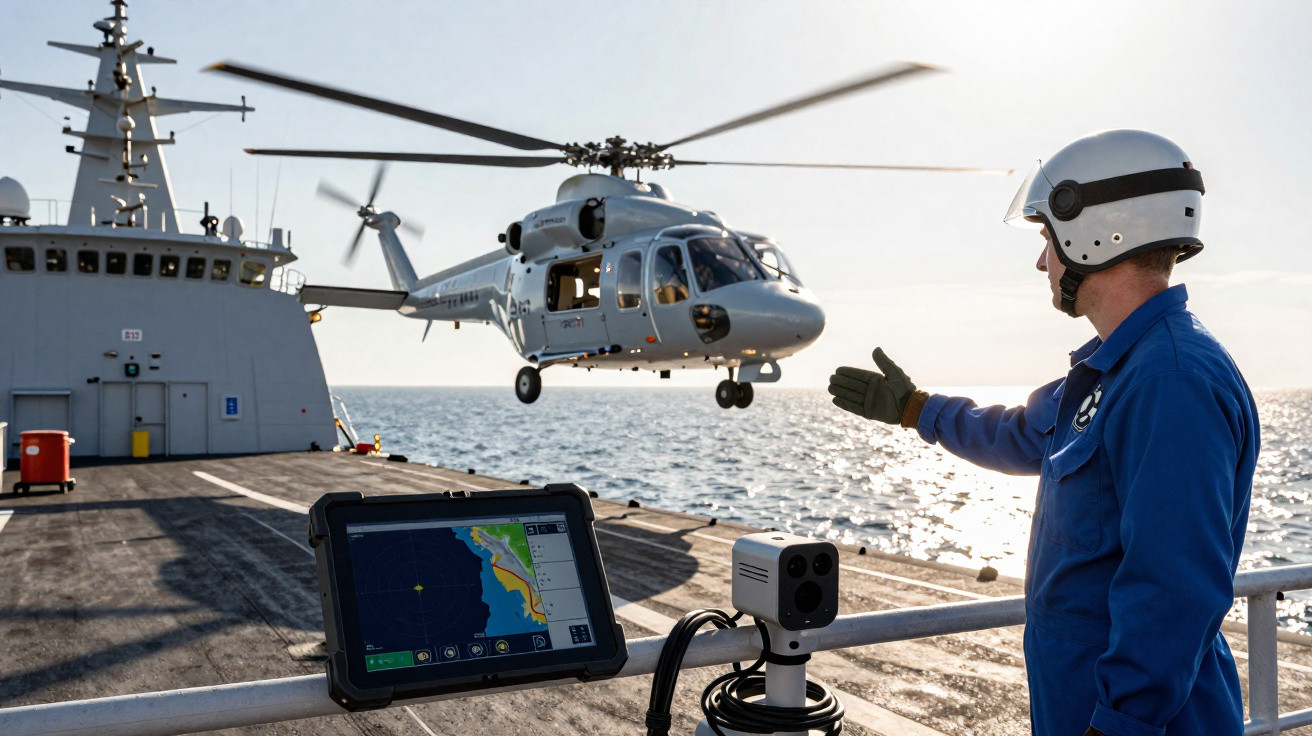
Although much of the military debate still centres on fighter aircraft and frigates, France is preparing a technological advance in a far less conspicuous but crucial area: rotary-wing naval drones. These aircraft can take off from and land on warships to monitor activity, identify targets and support operations at sea.
France becomes launch customer for a new naval drone
In January 2026, France’s Directorate General of Armaments (DGA) signed a contract with Airbus Helicopters and Naval Group to manufacture six VSR700 aerial drone systems for the French Navy. The first units are expected to enter service from 2028.
Six systems may not appear striking in absolute terms. Strategically, however, the decision carries considerable weight: France becomes the first country worldwide to adopt this new type of naval drone in series production. It has been designed from the outset to operate as an integrated part of the ship, almost as a floating “extension” of its radars and sensors.
The VSR700 takes France from a hesitant follower to a global benchmark in shipborne naval drones, with a system designed for the fleet from the outset.
The transition from an experimental prototype to a small industrial production run changes the programme’s scale. Building a certified, repeatable and safe drone requires assembly lines, a supply chain, maintenance standards and regular technological upgrades. This is precisely where many military drone programmes stall.
How the VSR700 operates aboard a warship
An “electronic head” that sees beyond the horizon
The version selected by the French Navy is configured for Intelligence, Surveillance and Reconnaissance (ISR) missions. Put simply, it works as an advanced sensor able to see farther than the ship’s own systems.
The VSR700 is expected to fly with:
- A surveillance radar, extending detection range well beyond the vessel’s horizon;
- An electro-optical system, including day and night cameras, for detailed visual identification;
- An AIS receiver, which receives and interprets the positioning signals transmitted by civilian ships.
Naval Group will integrate the drone into the onboard architecture, linking it to the combat system through the Steeris Mission System. In practical terms, the VSR700 will be handled as another “node” within the weapons system, much like a radar or sonar already fitted to the vessel.
Rather than being an isolated gadget, the VSR700 is created as part of the ship’s brain, sharing data in real time with every other sensor.
The drone does not replace a helicopter, but it changes the equation
The VSR700 has not been developed to take over from the conventional embarked helicopter. Instead, it is intended as a complement.
While the crewed helicopter remains responsible for complex missions, search-and-rescue operations and direct combat tasks, the drone can sustain surveillance for many hours without human fatigue. It can orbit a naval convoy, discreetly track a suspicious vessel or observe an area in crisis.
Airbus has already demonstrated cooperation between crewed helicopters and the VSR700 through a solution called HTeaming. It operates as a “two-layer naval aviation” model: people retain command and decision-making authority, while the drone expands the field of view and gathers data.
A civilian platform adapted for the sea and combat
From the civilian Cabri G2 to the military VSR700
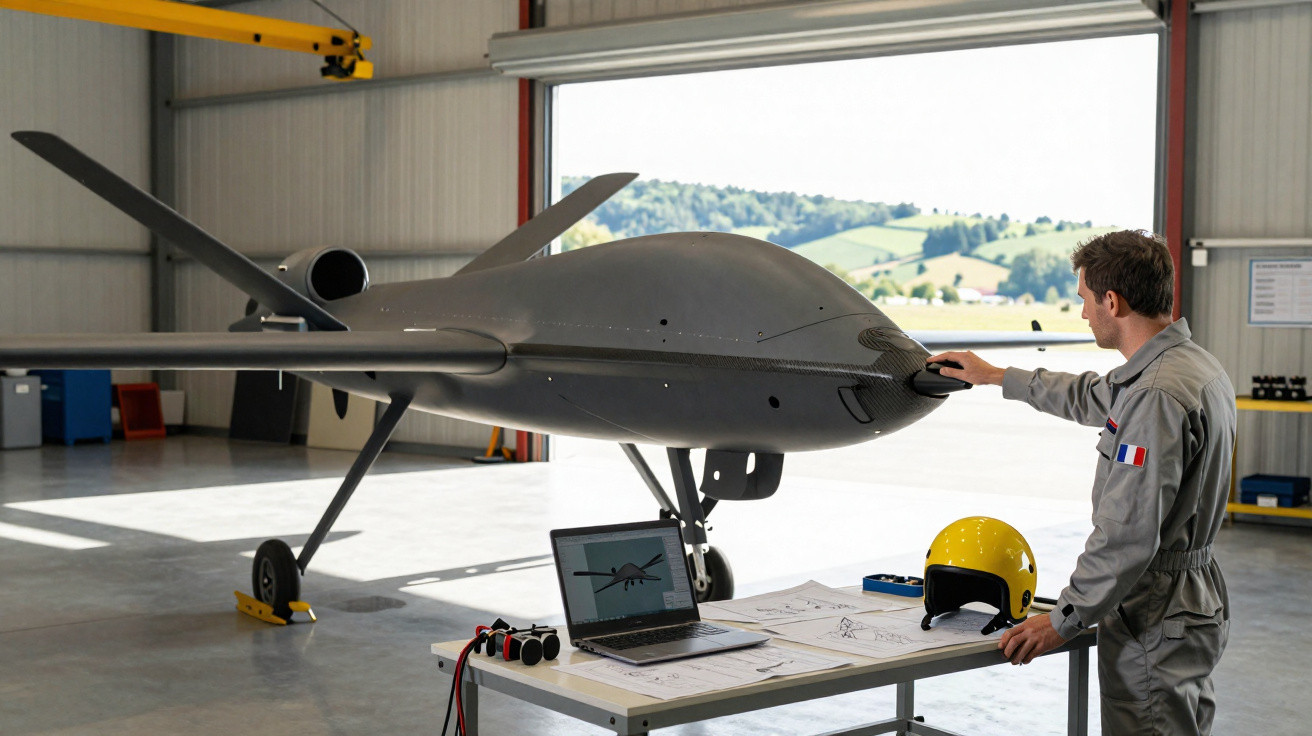
One of the programme’s strengths lies in its choice of platform: the VSR700 is derived from the Cabri G2 light helicopter, developed by French company Hélicoptères Guimbal. Starting with a civilian aircraft that is already proven, certified and flight-tested lowers technical risks and shortens development.
Using that familiar “skeleton”, the drone was extensively modified under the SDAM programme, led by the DGA and the French Navy in partnership with Naval Group. The naval variant received structural reinforcement, remote-command systems, equipment tailored to shipborne operations and combat-system integration.
Before the procurement decision, the system was pushed to its limits in operational trials. The objective was not merely to establish whether the drone flew well, but whether it could withstand daily use, sea conditions, strong winds across the flight deck, electromagnetic interference and the entire hostile environment of a warship on deployment.
Beyond military use: potential civilian missions
Despite its current focus on naval ISR, the VSR700 was designed as a multi-mission platform, leaving scope for future roles, including beyond the military sector.
- Logistics: carrying small loads between ships, or between ship and shore, without putting crews at risk.
- Armed reconnaissance: the potential to carry light weapons, depending on the doctrine and requirements of each country.
- Civil applications: monitoring wildfires, disaster rescue and inspection of offshore infrastructure.
That flexibility appeals to governments looking to spread costs. In theory, one type of drone could serve the Navy, Civil Defence and even environmental agencies, with sensors and configurations changed as required.
A narrow market, but France takes the lead
Few competitors and many watching closely
Rotary-wing naval drones occupy a highly technical niche. They differ substantially from fixed-wing drones used ashore and from small commercial aircraft.
The main models currently in service or under development include:
| Model | Origin | Key features |
|---|---|---|
| Camcopter S-100 | Austria | Widely used and straightforward, but with limited payload capacity. |
| MQ-8 Fire Scout | United States | Capable and robust, but expensive and too heavy for many ships. |
| Rotary UAV Panther | Israel | Focused on ISR and special operations, with a limited profile abroad. |
| Chinese VTOL systems | China | Poorly documented, with limited integration into NATO standards. |
In this setting, the VSR700 occupies the middle ground: larger and more ambitious than light drones such as the S-100, yet more affordable and agile than heavyweight models in the Fire Scout class. It also has a differentiator: from the initial design stage, it was intended to connect closely with modern frigates and communicate deeply with their combat systems.
Many drones can fly. Few integrate seamlessly into the electronic heart of a Western warship. The VSR700 was shaped specifically for that purpose.
For now, France is the only customer with a firm order, but it is not the only observer. The British Royal Navy has already tested the VSR700 aboard one of its own ships, assessing its value for maritime surveillance. The navies of Italy and Spain are following the programme closely, while demonstrations in Asia have also generated interest, particularly among countries seeking embarked ISR capability without buying a dedicated helicopter.
What changes in practice for French naval strategy
From a reputation for delay to an image of leadership
For years, analysts criticised France for its slow adoption of drones on land and at sea. The VSR700 selection and its series production signal a change in approach: rather than acquiring improvised solutions, France is investing in a system designed to endure, supported by a domestic industrial base and with room for future development.
From 2028, the routine aboard French frigates is likely to include almost daily drone flights. Rather than relying solely on the helicopter, which requires greater resources and specialised crew, a ship’s commander gains an additional sensor that is always available and can remain airborne for extended periods.
In situations such as:
- Counter-drug patrols in the Atlantic;
- Monitoring exclusive economic zones and fishing areas;
- Escorting commercial convoys in high-risk areas;
- Responding to humanitarian crises in the Mediterranean,
the VSR700 is likely to become a regular part of the French Navy’s toolkit.
Concepts worth explaining
Several terms appear frequently in this discussion. ISR, for example, means Intelligence, Surveillance and Reconnaissance. In real-world practice, it involves detecting something on the horizon, tracking its movements, identifying what it is and rapidly passing the information to those who need to act.
Another key concept is “combat-system integration”. A drone may be technically excellent, but if it sends data through isolated channels without fusing it with radars, sonars and weapons systems, the operational benefit is reduced. The French effort has focused precisely on linking the VSR700 to the rest of the ship’s electronic “bubble”, avoiding extra displays and operators that do not communicate with the wider system.
Future scenarios and risks at stake
The use of naval drones also raises new questions. There is a risk of data saturation: the more sensors are deployed, the greater the volume of information that must be processed. This places pressure on command systems, which need algorithms and user-friendly interfaces to help people make decisions quickly.
Cybersecurity presents another concern. A drone so closely connected to the combat system inevitably becomes a potential target for electronic attacks. Encrypted links, protection against interference and frequent software updates therefore become central to operational doctrine.
The benefits, on the other hand, are clear. Every surveillance mission flown by a drone means one fewer flight hour for the crewed helicopter, reducing maintenance and fuel costs while exposing fewer people to accidents in extreme sea conditions. In high-intensity conflicts, the ability to risk a drone in threat-saturated areas while preserving the helicopter and its crew could make a difference to the final balance of losses and damage.





Comments
No comments yet. Be the first to comment!
Leave a Comment