
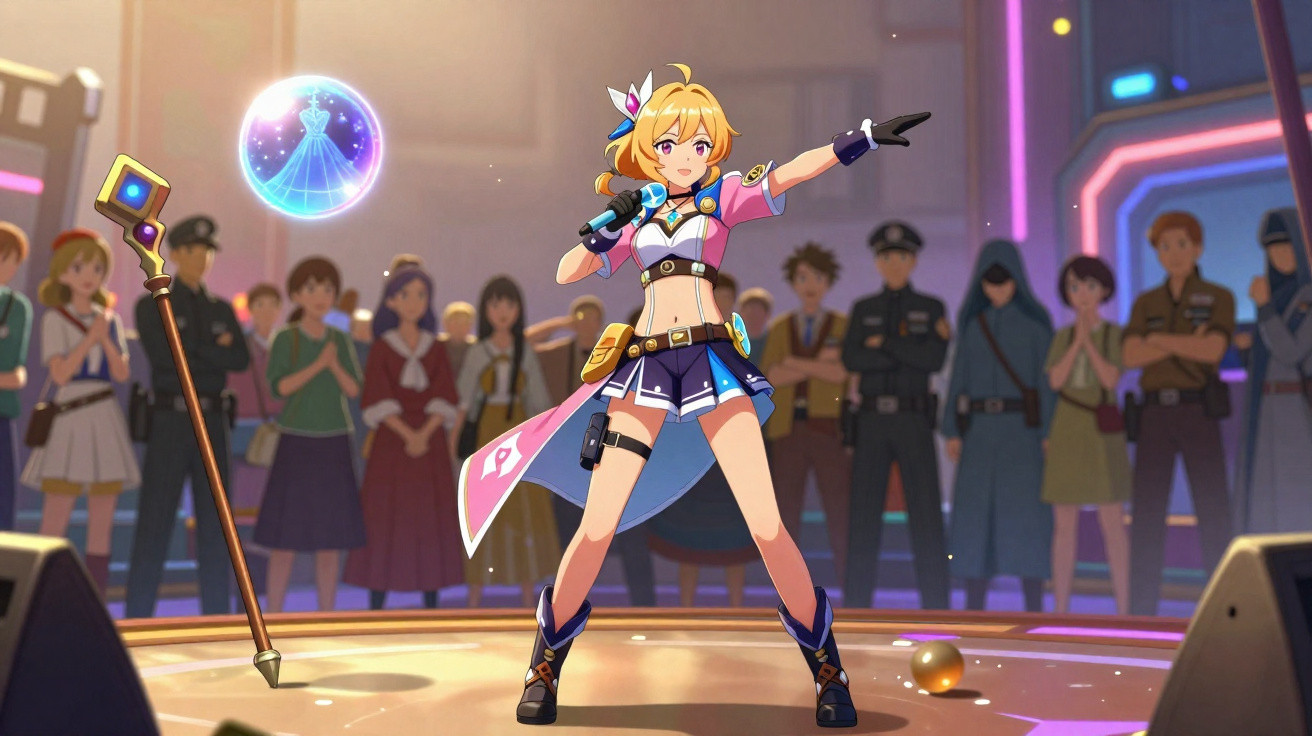
Final Fantasy X ended its story with a quiet stab to the heart. Then X-2 arrived with stage lights, glitter and J-pop. Conceived as a fascinating look at Spira after the end of Sin's threat, it has divided players ever since: between curious appreciation and the instinct to call in the police of good taste.
The first break with a sacred tradition
Final Fantasy X-2 launched for PlayStation 2 in 2004, before later appearing on PlayStation Vita. For the first time in the series' history, Square told a direct sequel rather than creating an entirely new universe. Spira, the world of Final Fantasy X, remained in place, as did much of the graphics engine and many environments.
This choice was not driven by creative whim alone. The merger between Squaresoft and Enix made production more efficient, allowing assets to be reused and development time to be reduced. It also created a rare opportunity: for the first time, a Final Fantasy team could systematically explore what happens after the finale instead of simply fading the screen to black.
“Final Fantasy X-2 wants to answer this question: what does a heroine do when the great sacrifice has already been made and fate has already been fulfilled?”
From a production perspective, the decision made complete sense. For fans, however, returning to Spira still came as a shock.
From melancholy to neon: Spira after Sin
In its predecessor, Spira was a realm under permanent siege. Sin shaped religion, politics and everyday life alike. X-2 picks up precisely there, except that the enemy holding everything together has suddenly disappeared. The Yevon Church loses its authority, competing factions recruit followers, and old certainties begin to crumble. More accurately, the setting presents a society caught in a kind of collective intoxication with freedom.
Yuna is at the heart of this new order. No longer a summoner destined for sacrifice, she works as a sphere hunter, travelling with Rikku and Paine while trying out roles, outfits and attitudes. The quiet martyr becomes a young woman finally living for herself, rather than solely for the salvation of the world.
On paper, that is a genuinely mature idea. Yet the execution barely considers the emotional state of players still marked by X's ending. Anyone who said goodbye to Tidus with tear-filled eyes is dropped, only minutes into X-2, into the middle of a dazzling stage performance.
An opening that hits like a spotlight in the face
X-2 opens with a pop concert: artificial fog, a screaming crowd, a J-pop number, spotlights and choreography. Yuna appears as a stage idol while intrigues unfold in the background. For anyone still thinking of X's silent temple corridors and its lost coast, this introduction feels like an almost aggressive rupture.
- Instead of sacred stillness: stadium atmosphere
- Instead of farewell and grief: cheers, dancing and costume changes
- Instead of a tragic heroic death: carefree treasure hunting with girl-band vibes
This change in tone creates distance. The world of X-2 feels as though it has already carried on for years without the player. Spira is celebrating, while the person holding the controller is still mourning. That imbalance has continued to shape many fans' relationship with X-2 to this day.
The police of good taste report for duty
If X-2 had changed only its mood, the initial shock might have been manageable. Instead, the game turns nearly every visual dial. Pastel shades, pink, glitter, asymmetric costumes, revealing designs and deliberately exaggerated gestures: its aesthetic leaps from the predecessor's melancholy realism into an early-2000s music video.
The soundtrack follows the same path. Noriko Matsueda and Takahito Eguchi provide a far more pop-oriented, beat-driven score, defined by keyboard sounds and funky bass lines. Those who loved Nobuo Uematsu's melancholy flute melodies suddenly find themselves in a lounge club.
“Between minigames in hot pants, a pop concert and squeaky colour accents, many fans felt as if Square itself were staging a parody of Final Fantasy.”
Humour plays a much bigger part too, although not every punchline lands. Flirtatious camera angles, slapstick and scenes with considerable cringe potential: much of it feels tailored to a very particular Japanese teenage audience. Those who associate Final Fantasy with tragic epics will often reach for X-2's emergency exit for good taste.
Between bold and tasteless
There are two ways to read X-2. The more generous interpretation sees a work deliberately breaking with expectations. Why should a world that suffered for centuries under a monster of death not descend into colourful, loud excess once it is gone? Why should a formerly holy heroine not go to extremes when she experiences freedom for the first time?
The other reading sees, above all, product design seeking quicker selling points through sex appeal, pop visuals and comedy than through quiet undertones. The balance often tips into shrill exaggeration. This is exactly where the famous “police of good taste” likes to step in and issue internal warnings.
Beneath the glitter: a strong Final Fantasy X-2 combat system
Beyond the visual overload, X-2 has one area in which it is convincing almost throughout: its combat system. The developers take the Active Time Battle principle of the older instalments, increase its pace and connect it all to the Dress Sphere system. Roles can be switched in the middle of battle, actions work together, and combos reward timing.
As a result, every fight feels like a small dance - fitting the show-stage presentation, but far more substantial in gameplay terms. Players who enjoy fine-tuning builds will find plenty to explore. Dress Spheres function as classes that develop through combat and unlock new abilities. The Garment Grid allows synergies to be planned, meaning a role change can even deliver benefits such as buffs or stat bonuses.
“The heroines’ ‘dressing up’ in particular reflects Spira’s inner transformation: identity becomes flexible, and roles are no longer destinies but options.”
The narrative approach is therefore also embedded in the combat system: Spira experiments, Yuna experiments, and the player experiments with class combinations. Change is playable rather than merely narrated.
Strengths for players willing to engage
Those prepared to accept the exaggerated surface will discover several appealing elements in X-2:
- dynamic, tactical battles with considerable variety
- a non-linear mission structure with optional tasks
- compelling insights into supporting characters from Final Fantasy X
- multiple endings determined by decisions and game progress
This makes the game feel almost like a laboratory for design experiments: less linear, less solemn and more modular in construction. Anyone interested in game design can spot numerous ideas here that later JRPGs adopted or refined.
How much disruption can a cult series withstand?
Final Fantasy thrives on change. No numbered entry resembles another. Even so, X-2 occupies a special position. For the first time, a game is so closely tied to the emotions of its predecessor. Its shift in tone therefore lands harder than the contrast, for example, between VIII and IX.
The reactions at the time can be viewed as an early case of a debate that now follows every major franchise: how far may studios unsettle expectations before fans mentally check out? X-2 demonstrates how a bold approach, pushing both setting and heroine in a new direction, can lose credibility through overstated aesthetics.
| Aspect | Final Fantasy X | Final Fantasy X-2 |
|---|---|---|
| Mood | melancholy, tragic | colourful, playful, theatrical |
| Structure | linear, pilgrimage | mission-based, freely selectable |
| Heroine | self-sacrificing summoner | self-determined sphere hunter |
| Combat system | turn-based, relatively static | fast, role-flexible |
| Musical style | orchestral, melancholy | pop-heavy, club-oriented |
What today's players can take from X-2
Anyone playing X-2 today encounters a period piece. Its fashion taste screams early 2000s, while the pop music visibly carries the stamp of its year of creation. At the same time, this title makes it easy to understand the risks a studio takes when redirecting established brands.
For players, a deliberate change of perspective is worthwhile. Rather than seeing X-2 as a “ruined X”, it works better as an experimental spin-off. The tone then feels less like betrayal and more like an alternative reading: what if Spira, after the apocalypse, found itself not in bitter realism but in an over-the-top celebration of liberation?
It is also interesting how the game addresses questions of identity. The constant changes of costumes and roles may look like fan service on the surface, but they also mirror Yuna's search for a new self. In game studies or narratology workshops, X-2 is well suited to precisely this discussion: where does symbolism become slapstick, and how intentional is that shift?
A scenario for nostalgic returnees
Imagine a Final Fantasy X fan returning after 20 years without ever having touched X-2. The best strategy is probably to treat expectation management as if it were a system in a role-playing game:
- Accept clearly before starting: this is not X 1.5, but a deliberately different tone.
- View the first hour primarily through gameplay mechanics rather than emotionally linking it to X.
- Use Dress Spheres actively as the central feature instead of becoming fixed on favourite roles.
- Treat embarrassing scenes as products of their time, not as the standard by which to judge the entire work.
Those who take this approach are more likely to recognise its strengths without despairing at its weaknesses. X-2 remains a contentious game, but that very argument keeps it interesting today - for fans, critics and anyone wondering when the police of good taste really need to intervene, and when they might be allowed to turn a blind eye instead.






Comments
No comments yet. Be the first to comment!
Leave a Comment