
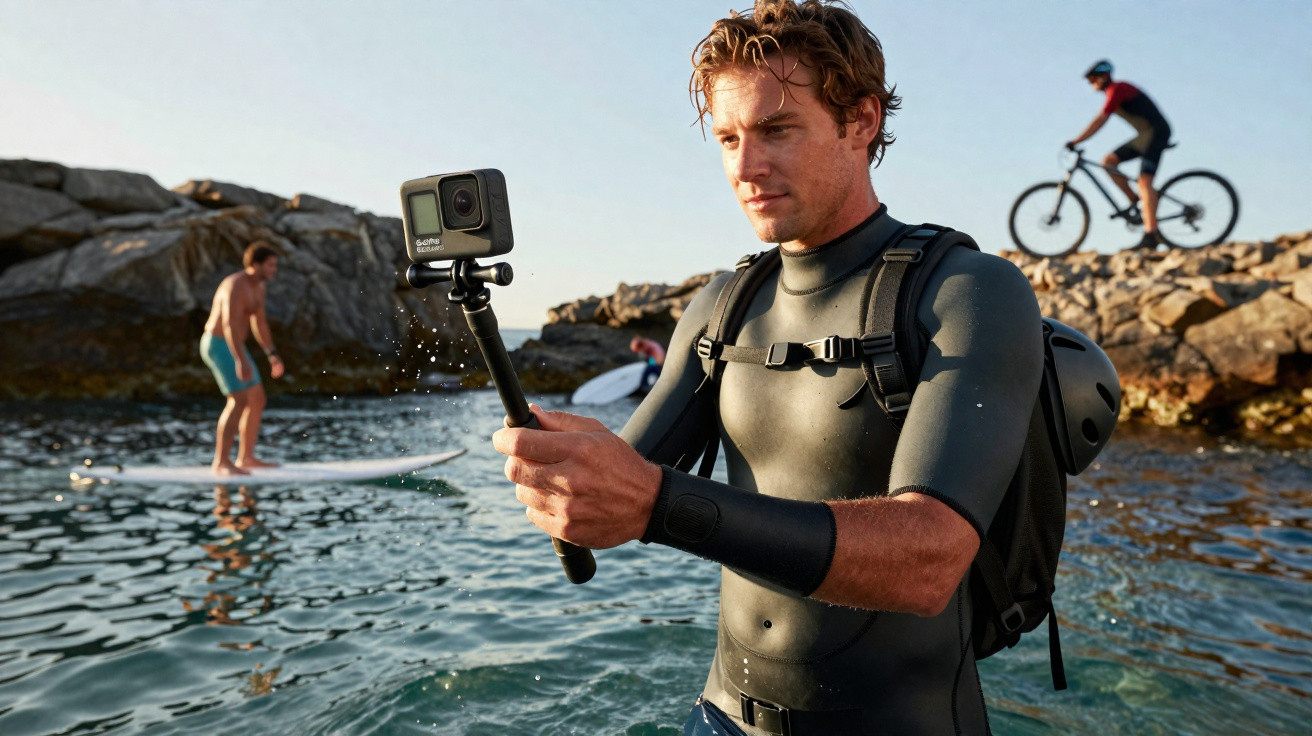
Five years is an eternity in the technology world. Yet that is how long GoPro took to bring the Max 2, its third 360 camera, to market. Released in 2019, the previous model was appealing but flawed - though considerably less so than the GoPro Fusion, the manufacturer’s first attempt.
It was soon overtaken by more innovative competitors. With its X range, Insta360 steadily captured the market, turning the 360 camera from an early-adopter gadget into a mainstream content-creation tool.
Can GoPro make up lost ground? The company certainly believes so, piling on tempting specifications: a move to 8K, a LOG mode intended to appeal to professionals, and 10-bit colour handling. But will this be enough to win over prospective buyers, particularly following DJI’s surprise entry into the segment with the highly accomplished Osmo 360? To find out, we examined every aspect of it and used it for a month.
Durability and ergonomics first
There is no major overhaul to the design or handling. Apart from a few ridges on the front and the logo switching to blue, the Max 2 looks exactly like the Max 1. There is, however, one welcome difference: alongside the usual GoPro mount, the newcomer also includes a standard 1/4-inch thread.
It may seem a small touch, but it is genuinely useful. Do not expect to reuse batteries from GoPro Black cameras or the first Max, however, as they are incompatible. GoPro would have done well to take a leaf out of DJI’s book: the latter uses the same battery format in its regular Osmo models and its 360 version. A missed opportunity.
The Max 2 is waterproof to a depth of 5 metres. In this respect, GoPro is slightly disappointing: the DJI Osmo 360 reaches 10 metres and the Insta360 X5 goes down to 15 metres, all without a housing. Diving and snorkelling enthusiasts will therefore need to look elsewhere, or wait for a possible dedicated diving case. That is somewhat disappointing from a brand whose reputation was built on hard-core all-terrain use.
Otherwise, there is little to criticise: the camera is carefully built and feels reassuringly robust. Should the lenses break, GoPro finally offers an instant replacement kit. Priced at €50, it includes two glass lenses and a replacement tool. It is designed to be fitted without sending the camera to customer service, allowing replacement in the field. This is an excellent idea that deserves praise. It is not entirely new, as Insta360 sells a similar kit for the X5 and X4 Air, although GoPro’s version appears slightly easier to fit.
GoPro Max 2 8K: what is it for?
The GoPro Max’s main shortcoming was its insufficient resolution given its ambitions. The Max 2 puts this right, moving from 5.6K to 8K 360° video (7680×3840 pixels) at 30 frames per second.
Why is 8K so important? For 99% of users, the primary purpose of a 360 camera is not to create spherical video. Its real appeal is the freedom to reframe footage during post-production. While recording, the camera captures everything around it, removing the need to compose the shot in advance.
Composition happens afterwards, by extracting conventional “flat” clips and choosing their viewing angles. A single recording can produce very different videos: following a subject before switching to a POV view takes one click, as does tilting the horizon, and so on.
At 5.6K, extracting a traditional “flat” video was not always satisfactory. Zooming had to be avoided to prevent a loss of detail, and even achieving clean Full HD quality could sometimes prove difficult.
When recording in 8K, extracted Full HD shots are impeccably sharp, while offering zooming and reframing flexibility previously reserved for professional cameras. 4K is usable too, but excessive zooming or aggressively reframing the scene should be avoided if final image quality is to be retained.
GoPro describes the Max 2’s output as “true 8K”: no black or overlapping pixels, which are needed to stitch the image edges, are counted towards the stated 8K resolution. The manufacturer says each sensor image contains at least 3840 active pixels on two axes. Its effective resolution is therefore 16 to 21% higher than that of its competitors.
It is even possible to extract 4K shots that remain comfortable to watch. The Max 2 also finally provides a convincing single-lens mode in 4K at 60 fps, or Full HD at 60 fps. Based on our testing, it can readily replace an action camera in many situations.
10-bit encoding
On the technical side, the Max 2 supports GP-LOG recording, which is essential for professional videographers, as well as 10-bit colour encoding. It joins the DJI Osmo 360 in the big league by capturing more than one billion shades.
In practical terms, this provides a far wider dynamic range. Details can be recovered in crushed shadows and blown highlights during post-production. GP-LOG supplies a neutral foundation for precise colour grading afterwards. Naturally, GoPro’s familiar colour profiles remain available for more conventional users.
Footage is of a very high standard in bright and medium lighting, which is hardly surprising for a GoPro product designed with outdoor use in mind. We did not have an opportunity to test underwater recording quality, but it should at least be decent.
As light levels fall, image quality drops slightly. It remains perfectly acceptable, although extracting 4K clips reveals a faint graininess in darker areas.
The Max 2 features 6 microphones, compared with 4 on its rivals, for immersive spatial audio capture. More importantly, wind-noise reduction - often the weak point of action cameras - proved highly effective in our tests. Another advantage is the ability to connect Bluetooth earphones to the camera and use them as a wireless microphone.
Power comes from a removable 1960 mAh battery. Depending on the resolution, bitrate and selected mode, it lasted between 60 and 150 minutes in our use. Adventurers should plan to buy one or two extra batteries, along with the optional fast charger.
A polished interface and well-designed app
Designed to be operated with a fingertip, the Max 2 interface is the same as that used on Hero Black action cameras. It is straightforward, responsive and effective, including while in the middle of an activity. We particularly liked being able to set up customised on-screen shortcuts to suit individual requirements, along with the effective voice control.
The companion Quik app provides access to every setting and control on a smartphone screen. It also enables footage to be edited manually or through pre-set templates. Either way, you do not need to be a video professional to get to grips with it! Reframing is carried out afterwards according to the creator’s preferences.
The app uses a keyframe system: simply set two of them and it generates a smooth movement between each point. A few examples can be seen in the video included with this review. Creating clips to share on social media is enjoyable, quick and genuinely intuitive.
Although the app is satisfactory, it has not yet reached the level of sophistication offered by Insta360. It does stand out, however, for its HyperSmooth stabilisation technologies, which deliver a “drone” effect even when the camera is severely shaken during recording - for example, on the end of a 1.5-metre pole while cycling.
Naturally, raw footage can also be transferred for processing on a computer. This requires installation of the GoPro Player application. Much less comprehensive than the smartphone version, it is mainly intended to prepare clips for assembly in conventional editing software.
Premiere Pro, After Effects and DaVinci Resolve users can instead use GoPro ReFrame, a free plug-in that processes videos directly in their software. One pleasing detail is that the current plug-in version works with any 360 file, including footage from DJI and Insta360 cameras.
Our verdict on the GoPro Max 2
After our testing, it is clear that the Max 2 addresses many of the Max 1’s shortcomings. We particularly appreciated the quality of Full HD and 4K clips, along with the ease of use of the companion app. Battery life is respectable for a camera in this category, although buying one or two additional batteries will soon become advisable.
Elsewhere, it brings back the qualities that made GoPro cameras successful: a simple, intuitive interface, excellent image quality in good light and, above all, near-perfect stabilisation. Captured audio is of a good standard, while unwanted noise reduction, including wind noise, works very well.
We have very little to hold against the Max 2, apart from noticeable heat generation when recording in 8K and waterproofing limited to 5 metres (10 metres for the DJI Osmo 360 and 15 metres for the Insta360 X5). This is all the more regrettable as GoPro does not offer a waterproof housing at launch.
At €420, the Max 2 sits between the Osmo 360 (€348) and the Insta360 X5 (€590). This pricing feels fair: DJI is cutting prices to establish its first model, whereas Insta360 reinforces its premium positioning with a high-end product that makes virtually no compromises.
| Price | Overall score |
|---|---|
| €420 | 8.9 |
| Category | Score |
|---|---|
| Design | 9.5/10 |
| Video quality | 8.5/10 |
| Battery life and charging | 8.5/10 |
| App | 9.0/10 |
| Value for money | 9.0/10 |
What we liked
- Outdoor image quality
- Excellent stabilisation
- Accomplished companion app
- Premiere, After Effects and DaVinci Resolve plug-ins
- Easily replaceable lenses if damaged
What we liked less
- Heat generation in 8K
- Waterproof to only 5 metres



Comments
No comments yet. Be the first to comment!
Leave a Comment