
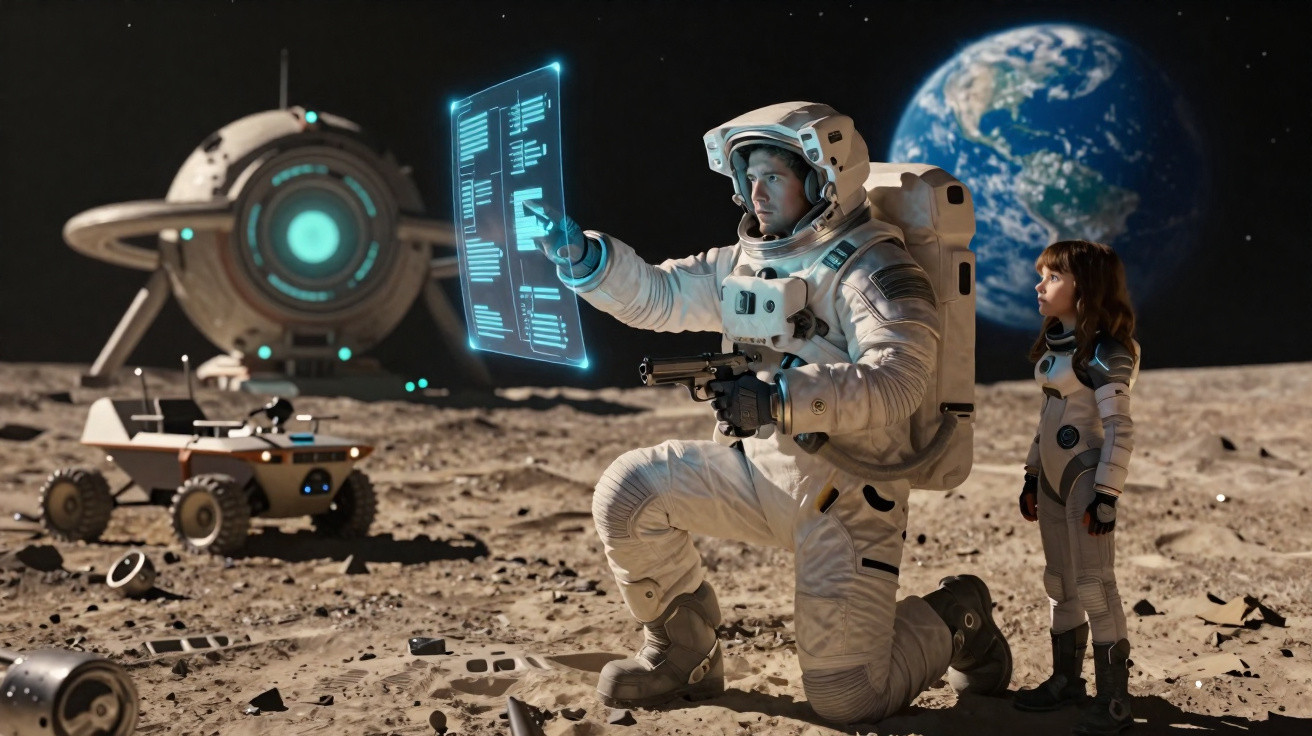
Pragmata’s lunar mission and story
First revealed during the PlayStation 5 showcase in 2020, Pragmata has remained among the most puzzling games on the upcoming release slate. Repeated delays prompted concerns that Capcom might have another Deep Down situation, but those fears appear unfounded. Pragmata is very much real, and having spent 30 minutes with it at Summer Game Fest Play Days in Los Angeles, I’m keen to find out more about this science-fiction adventure.
The game follows Hugh Williams, an astronaut dispatched with a team to examine the Cradle, a lunar research station on the Moon that has suddenly fallen silent. When he arrives, an earthquake wrecks the facility and leaves him incapacitated. Diana, an android who looks like a young girl, comes to his aid and repairs him. My demo starts once Diana has helped Hugh back to his feet, with the pair needing to survive a space station occupied by lethal robots and a hostile AI before they can return to Earth.
Pragmata combines hacking with third-person shooting
Pragmata is an over-the-shoulder third-person shooter, though Diana - who sits on Hugh’s back - gives it a distinctive hook. Robot armour makes gunfire largely ineffective, but Diana can hack adversaries, briefly freezing them and revealing their internal circuitry for Hugh to target. Hacking takes the form of a mini-game: players target an enemy and use the face buttons like a D-pad to move through a grid.
The objective is to steer a cursor towards a green square to finish the hack, while passing through as many blue squares as possible on the route. It resembles entering digits on an unusually large telephone keypad. Finding the best route to the green square is important, as certain tiles cannot be used.
Because hacks happen in real time, the action does not stop and enemies continue attacking. You therefore need to disable foes swiftly before turning them into scrap. The result is an enjoyable, hectic combat tempo as I attempt to complete hacks while dodging incoming strikes. Special nodes can grant hacks additional effects, and triggering several of them stacks those benefits. Yellow nodes, for instance, reduce a hacked enemy’s defence. Although these nodes can be ignored, the extra advantage may justify the effort needed to activate them.
Hugh had access to a regular pistol named the Grip Gun, the shotgun-style Shockwave Gun, and the Statis Net. The latter ensnares enemies in an energy field, giving you time to hack them without interruption. Shooting feels satisfying, with machines bursting apart in a gratifying spray of components. It takes some adjustment, but the pattern of hacking before firing works smoothly, bringing reflex-driven strategy to conventional gunplay.
Exploring the Cradle with Hugh and Diana
A scanner helps guide exploration through the fairly linear Cradle section, directing you towards the objective while also marking collectibles. These include repair cartridges for restoring health, though only a limited number can be carried, alongside diary entries and holographic messages left by the Cradle crew. Accessing sealed locations and completing puzzles calls for other hacking challenges, such as pressing the right face-button sequence within a few seconds.
Away from the combat, Hugh and Diana’s exchanges are enjoyable. Diana’s playful, innocent personality is charming, while Hugh - whom I expected to be a gruff counterpoint - comes across as quite friendly and even entertained by Diana’s company.
The brief Pragmata segment I played has eased some of the uncertainty surrounding the game’s status, and I’m enjoying its mixture of hacking and shooting. We will need to wait until 2026 to discover how Hugh and Diana get back to Earth, but this encouraging first showing has me willing to let Capcom cook.



Comments
No comments yet. Be the first to comment!
Leave a Comment