
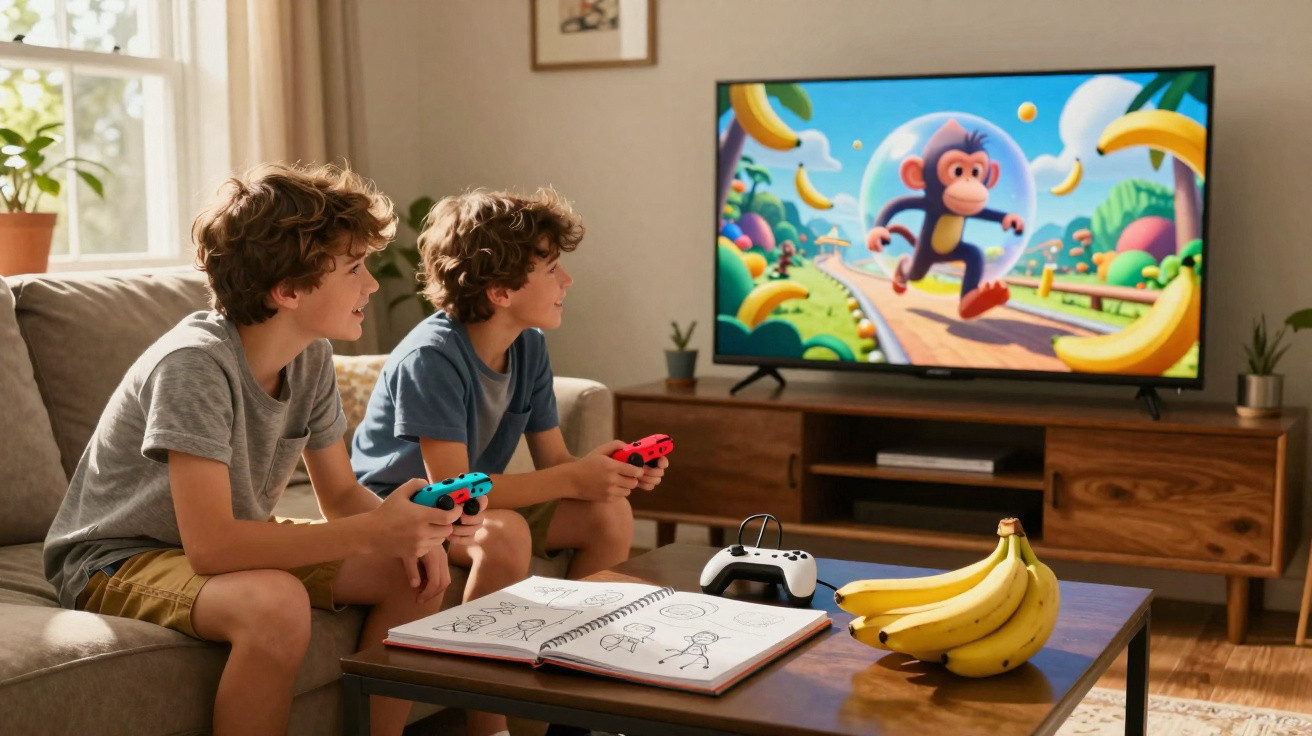
Last month, I got to play Super Monkey Ball Banana Rumble, the first completely new instalment in the Super Monkey Ball (SMB) franchise for more than a decade. I approached the demo unsure whether a series that enjoyed its strongest period in the early-to-mid 2000s could genuinely feel current in 2024. However, I came away impressed by its gameplay refinements, single-player stage design, and approach to multiplayer. You can read my full preview here.
Soon afterwards, I spoke in greater depth with several developers working on Ryu Ga Gotoku’s franchise that is not centred on the shady underworld of Japanese organised crime. They explained how the team set about updating the series without losing sight of what made it distinctive in the first place.
Reviving Super Monkey Ball for a New Generation
The series has received remakes and remasters in recent years, but no entirely new instalment for a long time. What led to such an extended break?
Nobuhiro Suzuki, Producer: We think several circumstances contributed. Development resources may have been redirected to other major projects, creators may have left the company, sales figures may have played a part, and there were other factors as well. The SMB development line ultimately disappeared, leading to a period in which production stopped. However, after launching the two remakes, Super Monkey Ball Banana Blitz HD in 2019 and Super Monkey Ball Banana Mania in 2021, we received encouraging feedback from fans and decided to create a wholly new game: Super Monkey Ball Banana Rumble. We hope fans are looking forward to this first brand-new entry in more than a decade!
Given that unusual situation, what were the central objectives for Super Monkey Ball Banana Rumble?
NS: Having released the two remakes, Banana Blitz HD and Banana Mania, we wanted this completely new title to firmly establish the SMB franchise’s return. Our aim was therefore to make a game that retains and captures the finest qualities of earlier SMB titles, while still feeling entirely fresh through 16-player online battles, improved game and character designs, plus new characters and storylines.
Modernising Super Monkey Ball Banana Rumble Gameplay
With such a long interval since the previous fully new release rather than a remake or remaster, what design and gameplay practices needed updating to make this instalment feel modern in 2024?
Daisuke Takahata, Director: Using data including the number of players who completed each world in Banana Mania, along with feedback from various playtests, we adjusted the challenge level so that newcomers and long-standing fans alike can enjoy it. The opening worlds are gentler than they were in past games, where the difficulty could be too high from the outset. We also ensured that, when players launch the game for the first time, they are taken to a tutorial that teaches them the game and its controls.
We made similar changes to the camera, with small adjustments to its default settings intended to make the experience smoother. Players can also fine-tune those settings through the Options menu, which we believe veteran fans will value.
The physics in Super Monkey Ball Banana Rumble feel excellent. How did the team approach revising them, and how did you determine when they were right?
Jack Ko, Programmer: The physics in Banana Rumble are built on those from Banana Mania, which itself drew heavily from the original GameCube version’s physics. We made particular movement adjustments in the previous game to make it work as a remake, but fan comments helped us identify several aspects that may have caused some of Banana Mania’s unintuitive physics-based behaviour. Since Banana Rumble is a new series entry with newly designed stages, we could focus this time on making movement more straightforward and intuitive.
The physics system is also heavily parameterised, allowing designers to alter different elements of it as they work. Internal testing took place at least weekly throughout development, and changes were made gradually whenever they were required. We knew we had achieved the right result once anyone could pick it up and immediately roll like a professional.
Why was the Spin Dash so important to include in this instalment, and what do you feel it contributes most to the experience?
NS: While making this new game, we wanted to introduce an appropriate technique that would offer users broader ways to play and take on challenges. We also needed something for the 16-player battles that would clearly highlight a user’s skill and let them overcome their rivals. That led to the Spin Dash being added.
Although the Spin Dash is easy to perform, we feel it brings a great deal to the game. For beginners, it is an exciting feature that enables them to sprint and rebound from obstacles; for advanced players, it offers a way to discover shortcuts and reach the goal quickly. We are very pleased how players have been responding to it.
This may be a question better suited to the localisation team, but as the Super Monkey Ball franchise relies so heavily on banana-related puns and wordplay, did the team consider naming it “Peel Out” rather than “Spin Dash?”
NS: To be honest, we didn't think about it at all. [Laughs] We wanted to make it easier for users to understand just by looking at the name, so we made it straight out "Spin Dash."
Adventure Mode Stages and Battle Modes
When designing an Adventure mode level, which factors need to be considered to make a stage effective?
Yukio Oda, Designer: In terms of “what elements”, our fundamental approach is to combine “various elements” in a complex and effective way. If a stage is divided into smaller components, for instance, its “path” contains elements including “thickness,” “curve,” “slope,” “moving path,” and more. The way those parts are put together can make a stage easy or difficult, engaging or dull.
The Monkey Ball team has extensive expertise in making these combinations, accumulated through many years spent working on the series, and we always use that know-how to pursue interesting stages. Still, the first step in creating any individual stage is the stage designer’s inspiration.
How does the team strike a balance between enjoyment and difficulty when creating stages?
YO: Our stage designers’ work is regularly playtested by dozens of people both within and outside the team. We collect a wide range of feedback, while also examining data such as completion percentages and times, then continually make changes to improve the stages further.
We are also very conscious that the Monkey Ball series has always been defined by the contrast between extremely easy stages and extremely challenging ones. There are times when a playtester judges a stage to be “too difficult”, yet we decide to leave it unchanged. Even so, we are always delighted after release to see users uploading videos in which they complete exceptionally difficult stages with apparent ease.
The stages I played were highly enjoyable and occasionally over-the-top, though they were only in the first two worlds. How extreme can players expect Adventure mode’s challenges to become?
DT: We are glad you enjoyed the game’s early stages! As announced, Banana Rumble’s Adventure Mode includes 200 completely new stages, spread across different worlds. The final world especially contains a range of exciting gimmicks awaiting players, and these will be challenging even for fans who began with the earlier titles. Stay tuned for a "very wild" challenge!
Could you explain the process behind creating the Battle modes? They put enjoyable spins on the Super Monkey Ball formula, and I have always found the minigames and side modes as enjoyable as the main Adventure mode.
YO: Thank you very much! For Battle Mode’s game design, we paid particular attention to representing “control” and “sense of speed” during play, as these are defining features of the series. We also made sure that skills players learn and develop in Adventure Mode can be used in Battle Mode too.
One of this game’s major features is its focus on “ease of understanding”. In essence, when introducing twists and variations, we took care not to make the rules too complicated, allowing players simply to enjoy themselves.
The Future of the Super Monkey Ball Franchise
How would you like the Super Monkey Ball franchise to develop from here? Do you think there is scope for multiple releases within a shorter timeframe than in recent eras?
NS: First and foremost, we will continue carrying forward the enjoyment and originality for which the SMB series is known, ensuring SMB fans can fully enjoy their time with it. Beyond that, we would like the series to progress to a point where it provides a variety of exciting new ways to play that are uniquely Sega.
With players’ support, we believe we can continue releasing new games regularly. We would really appreciate everyone's support for Super Monkey Ball Banana Rumble and the Super Monkey Ball series!
Super Monkey Ball Banana Rumble launches for Switch on 25 June. For more on the forthcoming series revival, read our full hands-on impressions here.


Comments
No comments yet. Be the first to comment!
Leave a Comment