
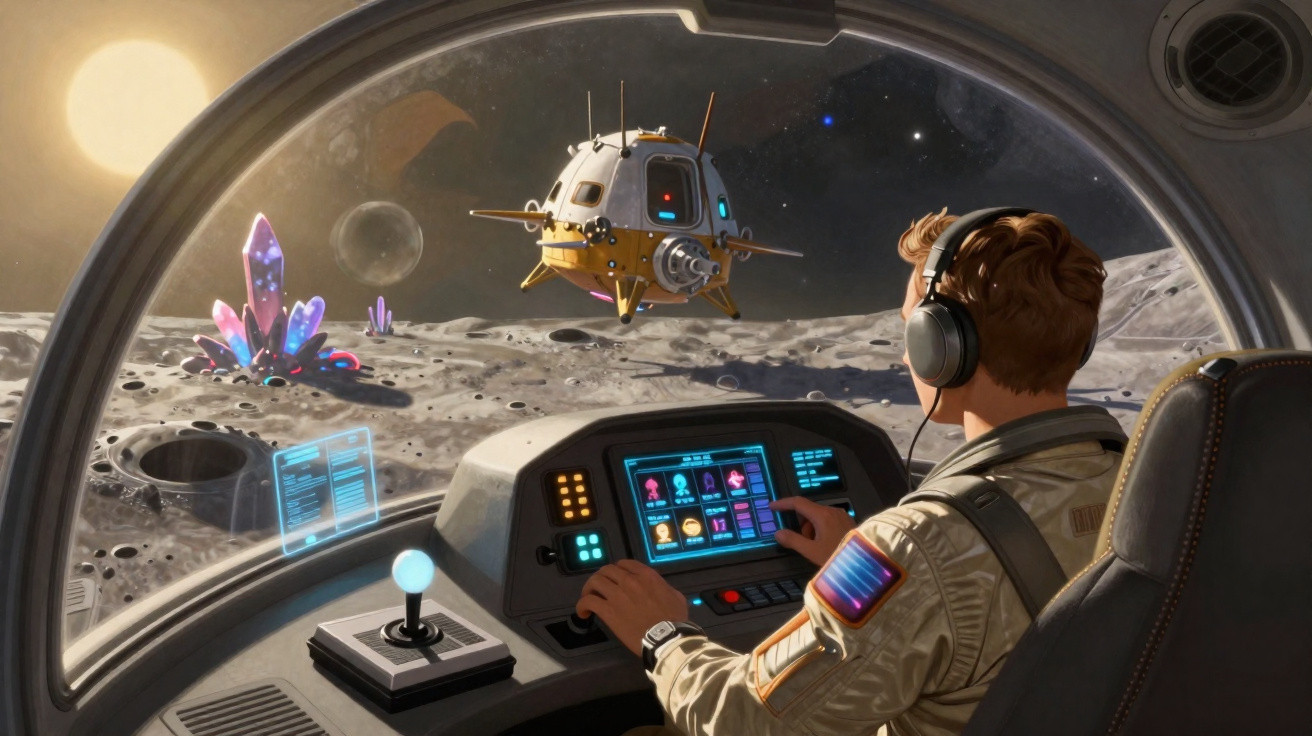
In July last year, Atari revealed the newest revival from its extensive catalogue of classic games. Lunar Lander: Beyond builds substantially on 1979's Lunar Lander, introducing fresh visuals, simulation and exploration systems, plus a considerably deeper narrative. Atari enlisted Colombian developer Dreams Uncorporated - the studio responsible for the exceptionally beautiful 2021 retro-inspired RPG Cris Tales - to create this reimagining of the classic.
Lunar Lander: Beyond trailer and features
This new take on Lunar Lander brings Dreams Uncorporated's flair for striking hand-drawn art to both gameplay and cinematics, as Atari's newly released trailer demonstrates. In Lunar Lander: Beyond, players will visit five distinct celestial bodies throughout 30 missions, using character and ship customisation options alongside procedurally generated pilots with individual attributes.
Watch the trailer below, then continue for our Q&A with Dreams Uncorporated game director Alvaro Martinez and executive producer Jeff Cardenas.
Dreams Uncorporated on creating Lunar Lander: Beyond
How did this partnership between Dreams Uncorporated and Atari come into existence? Was Lunar Lander the first game that was planned to be worked on together?
Jeff Cardenas: Following the release of Cris Tales, Atari - who enjoyed the game - began discussions with us and asked how we might approach one of its IPs. Our business development team was aware of the Atari Recharged series, while we are huge admirers of Atari's classic games, so the partnership felt like an excellent fit. We considered several IPs, but our conversations led us to Lunar Lander, which we felt would be compelling to develop with the narrative and distinctive gameplay ideas we love. We have also kept talking about other IPs we would like to tackle. Hopefully, more titles will follow in the future.
When expanding so drastically on a classic game that had very little in the way of story, what does that process look like?
Alvaro Martinez: Since the original game offered very little narrative beyond its broad premise of landing on the Moon, I would say the process was actually more straightforward. It was rather like working on an almost empty canvas: there were a few guidelines, but overall we had a great deal of freedom.
Our starting point was the original game's concept and the feeling it created for us. The answer was tension. We then needed to find a way to turn that sensation into a story.
We thought we could establish tension immediately: what if Earth had been lost? In that situation, how could humanity endure? That would establish a need to explore and search for hope while retaining a high degree of agency, and exploration in such extreme circumstances would produce the experience we wanted.
But how difficult would it be to explore these possible new homes? With severe hot and cold temperatures, no oxygen and varying gravity, imagining life in those environments made it obvious that the narrative needed a dystopian future setting. It would be a dystopia drawing from classic late-1970s and 1980s novels, television series and films. For example, Blade Runner, Alien, Cosmos - Lunar Lander: Beyond’s universe had just been born!
Lastly, we needed to regularly align the story with gameplay, ensuring the lore supported it. The narrative developed alongside the gameplay and level design, and we did our best to ensure each complemented the other.
How did the team work with Atari to ensure the remake and its universe-building are consistent with the spirit of Lunar Lander?
AM: Throughout development, we shared many ideas with the Atari team about the type of universe we wanted for the game. Given several key gameplay requirements - such as multiple planets rather than only the Moon, as in the original, and multiple landers - Dreams was afforded significant creative freedom to "fill in the gaps" while following those requirements. For example, how would the game's universe explain the need for numerous landers? Why would players land on planets other than the Moon? Why would lander pilots put their lives on the line in such a dangerous profession? The answers to those questions, among others, became the seeds from which the game's universe grew.
It was also trust that we earned. We first tried to communicate the intended experience through gameplay, beginning with a single ship and a single landing. How could we make that engaging? How could it feel new while remaining familiar? We developed the stabiliser mechanic, which let us introduce more risk and test players in numerous scenarios while still providing a fair chance to recover from brutal situations. The Atari team appeared to like it! Since then, we have maintained an ongoing conversation to identify the right moments for it.
How did the studio leverage its prior experience to create the end product here?
AM: Cris Tales was an unusual, demanding and highly valuable learning experience, covering everything from engineering and production to game design. Our studio aims to experiment with game concepts and create new experiences, but it also values deliberate self-assessment and continual improvement. We did our utmost to follow those principles.
However, we are focused on storytelling and creating compelling experiences, so we placed significant emphasis on that and made sure it informed the vision we proposed for this new version. We particularly wanted to sharpen our skills with the technology we had developed for conversations and art production, while also exploring how to tell a story rooted in feelings - not only for an IP of our own creation, but for ideas we can work with and develop further. The team greatly enjoys doing that.
The original Lunar Lander is such a simple concept but carries with it so much challenge. How are you keeping that spirit alive in this new version of the game?
AM: There are many answers, but the first concerns how the lander operates and flies. Once we had established that, we began exploring other ways to fly. Drawing heavily from classic arcade games, we made different lander types with their own controls and features. Some closely resemble the original lander and therefore provide a "classical" form of challenge; others differ substantially, making them more forgiving in certain respects but harder in others. This allows players to experiment and find different forms of enjoyment within the same level.
We also implemented multiple difficulty settings. Easy mode applies only a minor penalty when players crash, while a more demanding setting introduces permadeath for pilots whom players have been improving, creating a genuine loss upon death.
Most importantly, to preserve the original's spirit, we concentrated on tense, stressful landings, as the classic did, but approached in a new way. That is why we created a stress system with status conditions including insanity, maintaining the original version's sense of "tension".
For example, rather than merely include a "stress" bar, we introduced hallucinations too. The feature has two functions: it raises the difficulty by disorienting the player, and it offers a glimpse of what a pilot might feel in those conditions, thereby deepening immersion.
We also considered what life was like when Lunar Lander launched. I grew up in the 1980s, and I remember that period vividly: arcades, electronic music, synthesizers, supercars, super helicopters, robots, my 2600 (sadly gone), and my old DOS computer, which required a floppy disk to start. That is why one of my directional goals was to make fans who played the original remember the '80s. Lunar Lander Beyond should make them nostalgic for both the original game and the period that surrounded it.
As a result, a number of the game's elements take inspiration from the '80s, from the UI - modelled on the "futuristic" displays that represented how we imagined the future - to its music, which draws upon electronic scores from films such as Blade Runner, Tron, Alien, and similar works.
What considerations must be made when remaking a classic title that you don't have to worry about when developing an all-original title?
AM: The central consideration is this: how can we retain the spirit of the original while ensuring the new game succeeds on its own? More specifically, which aspects can we remake or reinterpret, and which parts of the classic must remain untouched?
To address those questions, we first examined the original game and the audience it was intended for at the time. Why was it made in that particular way, beyond the obvious technological constraints? What emotions do players experience when playing it? What might its designers have altered if they had access to today's game-development technology?
After carefully studying it, we concluded that the original designers sought to make a difficult game that echoed the real landing process. That means not only challenge, but tension, stress, precision and responsive controls. We consider these the game's core principles, or its spirit, and they were the principles we needed to retain.
Yet recognising and following the original game's spirit is only half of the task. The new game requires its own identity, otherwise it would simply be a clone. How could we move from Lunar Lander to Lunar Lander Beyond? At that stage, we asked: how could we still deliver stress, tension and challenge through a different approach? We have already mentioned several answers, but another particularly strong one was the pilots: the human factor behind the landing procedure, which the original game did not consider.
That opened up many possibilities. Adding the pilot to the equation allowed us to build more elements around the classic core gameplay. One example is Lunar Lander: Beyond’s stress system, in which a pilot's psychological condition affects the core gameplay and the player's perception of the game world. Stress can also influence how players plan their next missions, because some accumulated stress remains with a pilot - even if they are the best pilot available. That creates strategy and risk before missions even begin.
Obviously, players' expectations of game content have evolved in the nearly 45 years since Lunar Lander came out. How do you design for players who are fans of the original while still appealing to the new generations of players who have either been born or discovered games since the original arrived?
AM: We feel that great gameplay does not age, so beginning with a simple but robust foundation is a strong first step. Naturally, we also wanted to expand everything around it exponentially, making a more modern game that still preserves the feelings from which it originated.
To achieve this, we built new gameplay systems around the "classic" experience. For instance, we added more landers, each providing a different sensation when landing, as well as a straightforward way for players to tailor their gameplay experience: traits and abilities.
Traits result from treating the pilot as part of the "lander simulation." Players receive a group of pilots and must select one to undertake each mission according to that pilot's traits and current psychological state, or stress level. These traits have a substantial effect on the core simulation. For instance, a pilot with the Fuel Saver trait significantly reduces fuel use. A pilot with the "Fast and Furious" trait, meanwhile, has considerably greater acceleration and top speed. Each pilot receives traits randomly when joining the roster and whenever they level up.
Abilities, by contrast, are not assigned to players randomly; they must be "discovered" in levels, encouraging exploration. Every lander can equip up to three abilities. Naturally, these also transform the landing experience in several ways, such as the Warp ability, which enables the lander to teleport.
So, while the original game provides the basis for the core gameplay, numerous customisation options surround it. Combining traits, abilities and landers produces many strategies and play styles. A careful player might select a slow, heavily armoured lander with a pilot who has defensive traits, such as Fuel Saver, and defensive abilities, such as Shield. In contrast, a speed-loving player might opt for the fastest lander, flown by a pilot with the Fast And Furious trait and equipped with Turbo Boost. There is everything in between as well.
We also added planets, each with its own environmental dangers, hallucinations and other penalties triggered by high stress levels - and even a boss!
Lunar Lander: Beyond is scheduled to launch on PlayStation 5, Xbox Series X/S, PlayStation 4, Xbox One, Switch, PC and the Atari VCS in early 2024. For more on Atari's recent work, read our review of Atari 50: The Anniversary Celebration or listen to our episode of All Things Nintendo featuring Atari CEO Wade Rosen.



Comments
No comments yet. Be the first to comment!
Leave a Comment