
Concord’s world-building ambitions
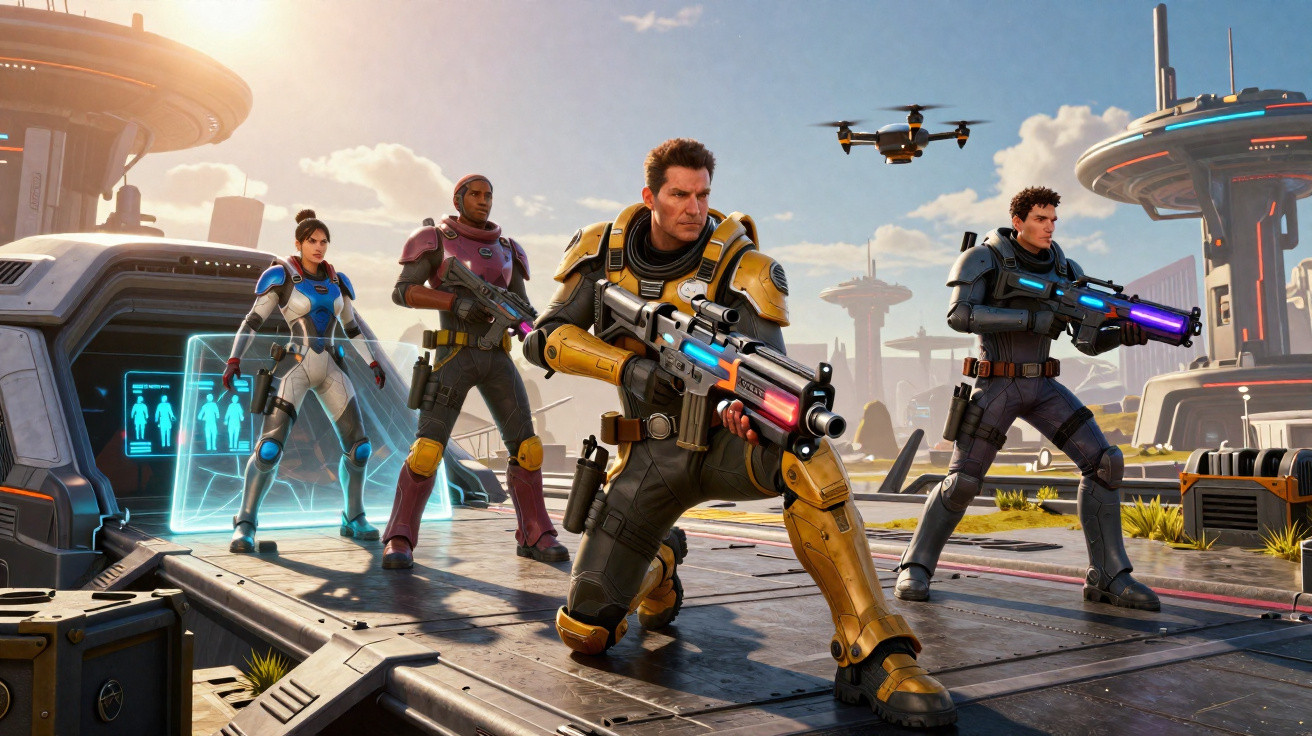
Last month, PlayStation offered the first substantial look at Concord, the forthcoming 5v5 multiplayer hero shooter from Firewalk Studios, which Sony acquired last year. While the new cinematic footage suggested a single-player, story-led heist adventure in the vein of a Guardians of the Galaxy film, the gameplay reveal that came afterwards presented a purely multiplayer game from a different perspective. I will admit that reveal initially left me rather indifferent: it looked perfectly competent, but not especially unlike anything I had seen previously. After spending several hours playing it at a recent preview event, though, I am keen to get back into the action. It resembles a blend of Destiny and Overwatch, although I remain cautious about the studio’s focus on lore and narrative, and whether that approach can succeed in a multiplayer-only game.
Ahead of my hands-on time with Concord, Firewalk director of IP Kimberly Kreines and lead gameplay designer Claude Jerome guide me and the other attendees through a presentation introducing the game’s sci-fi setting. Kreines says Firewalk aimed to create something "unlike anything out there today": a multiplayer game with a tactile, visceral quality, "like taking an action game and bashing it with a shooter," alongside characters that feel authentic. Players take command of different Freegunners, members of an outlaw mercenary crew that accepts jobs carried out in the game’s multiplayer matches. The Guild, this universe’s government, controls freedom among the stars, but a crew has recently stolen a Galactic Guide. Our crew then gains access to it, giving them - and players - access to this special map.
My initial glimpse of that map impresses me. It is vast, colourful and vivid, packed with locations, planets, points of interest and more. I later discover, however, that it cannot be explored or interacted with as it might be in a single-player RPG, as I had hoped. Instead, it functions as an enormous lore archive, with every point of interest serving as an entry that reveals more about Concord. It is a nice feature and, as someone who enjoys lore, I appreciate it, but I can also imagine many players simply overlooking it. The same may be true of Concord’s opening vignette, which players see when they launch the game for the first time. Beautifully produced and backed by excellent voice performances, it is a brief, entertaining burst of personality that offers some insight into the game’s cast. Firewalk says it will release a new vignette every week, yet I find it difficult to picture players regularly returning to see what comes next, particularly during the game’s early days. When I ask whether these vignettes will form a broader narrative, perhaps unfolding across a full year of play, Kreines says they will be a mixture of serialised stories, crew insights and more - so probably not.
There is much more evidence of the character work, world-building and lore that Firewalk is trying to embed in Concord from the outset. Map graffiti and props hint at a recent rebellion, while skyboxes signal approaching storms. The studio clearly wants players to grow as fond of these Freegunners as the Overwatch community has become of its heroes. During my time with Concord, however, I keep wondering whether a developer can manufacture that attachment immediately. Overwatch unquestionably has it, but Blizzard earned it through years of work built on exceptional gameplay; it did not impose it through an abundance of lore entries, a huge catalogue of universe mythology and more.
Concord gameplay recalls Destiny and Overwatch
Fortunately for Firewalk, lore and storytelling are not what make or break a 5v5 multiplayer shooter - gameplay does, and Concord feels excellent so far.
Destiny is the nearest comparison I can draw, particularly in its time-to-kill (TTK), map design, first-person feel and match flow. I was surprised by how strongly I felt that connection, although I probably should not have been, even if my recent effort to catch up on every Destiny 2 expansion undoubtedly influenced me. Director Ryan Ellis, design director Josh Hamrick, lead character designer Jon Weisnewski and Jerome have all worked on Destiny 2, and that experience is apparent.
I quickly warm to Jabali, a machine gunner able to fire Life Pulse Orbs at allies for healing and Hunter Orbs at opponents for bursts of damage - and the Overwatch comparison is probably already obvious. Picking off enemies while aiming down sights as Jabali is immensely enjoyable. Because the TTK is longer than in quicker first-person shooters such as Call of Duty, I need to prioritise precision, including headshots, if I am to kill an opponent before they kill me. Every hero has distinct abilities, making the use of my orbs in the middle of a fight essential. Without a Hunter Orb’s damage, eliminating handgun expert Lennox - the Star-Lord-like character shown in the reveal, whose bullets shred my health bar - would be difficult. Even then, I need to account for Lennox’s explosive knife and self-healing ability.
With each successive match, I enjoy having to consider every Freegunner’s loadout. Will the fire sorceress Haymar hover above the battlefield, deploying firewalls and blinding flash grenades? Is Teo, a soldier who most closely resembles a conventional first-person shooter hero, looking through the smoke-bomb fields he has created with vision unaffected while I can see only grey haze? Has sniper Vale placed a trip mine around the next corner? Has former recycling robot 1-Off deployed an air barrier to stop incoming projectiles such as my orbs? Both of those deployables remain between rounds unless someone destroys them. These are the rapid match-up calculations I must make in every encounter. I like the extra layer of strategy, and it distinguishes Concord from the familiar FPS formula of whoever fires first winning.
Modes, Freegunners and crew-building systems
Those decisions are especially important in Trophy Hunt, a team deathmatch variation in which a point is only earned by collecting the trophy dropped by a defeated enemy. They also matter in Cargo Run, which asks players to secure a Blue Buddy robot and return it to one of two zones, and Clash Point, where teams battle to control one capture zone, though perhaps not in the way Firewalk intended. The latter two modes are round-based and have no respawns: once killed, you remain out until the following round. Consequently, the other four players on my team, along with the five players on the opposing side, mostly disregard the objective unique to each mode and instead concentrate on eliminating the other team first. This is a familiar problem in modes of this kind - I am looking at you, Search and Destroy in Call of Duty - but I still hope Firewalk can find a solution for Concord. If not, I can see myself favouring Trophy Hunt and other modes closer to team deathmatch, where respawning ensures I remain involved in the action.
Regardless of mode, though, I have a terrific time with Concord’s combat. The action is frantic, with plenty of variation provided by well-crafted maps - I get to try three of the game’s final 16 - and 16 Freegunners, all equipped with individual abilities.
Firewalk says there are no fixed Freegunner categories such as tank, DPS or support. Instead, its characters combine skills and weapons that let them move between those traditional archetypes. In practice, however, certain characters absolutely feel like tanks, healers or assault-oriented heroes, and my team soon begins factoring those roles into our choices when assembling a crew for a match. There are also several other systems that I cannot fully get to grips with yet, including individual Crew Building, which acts as a subset of the roster, Crew Bonuses, Freegunner variants and more. Still, if the post-match screens glowing with unlocks and experience bars are any indication, this shooter has a great deal happening beneath the surface. I am looking forward to understanding how all of it fits together.
I leave this Concord preview far more enthusiastic about its forthcoming PlayStation 5 release, which a simultaneous PC launch will hopefully help to support with a stronger player base. I still have many questions about progression, seasonal content, crossplay safeguards for controller and mouse-and-keyboard players, and whether the emphasis on world-building will prove worthwhile. Firewalk nevertheless seems to have got the crucial element right: the gameplay.


Comments
No comments yet. Be the first to comment!
Leave a Comment