
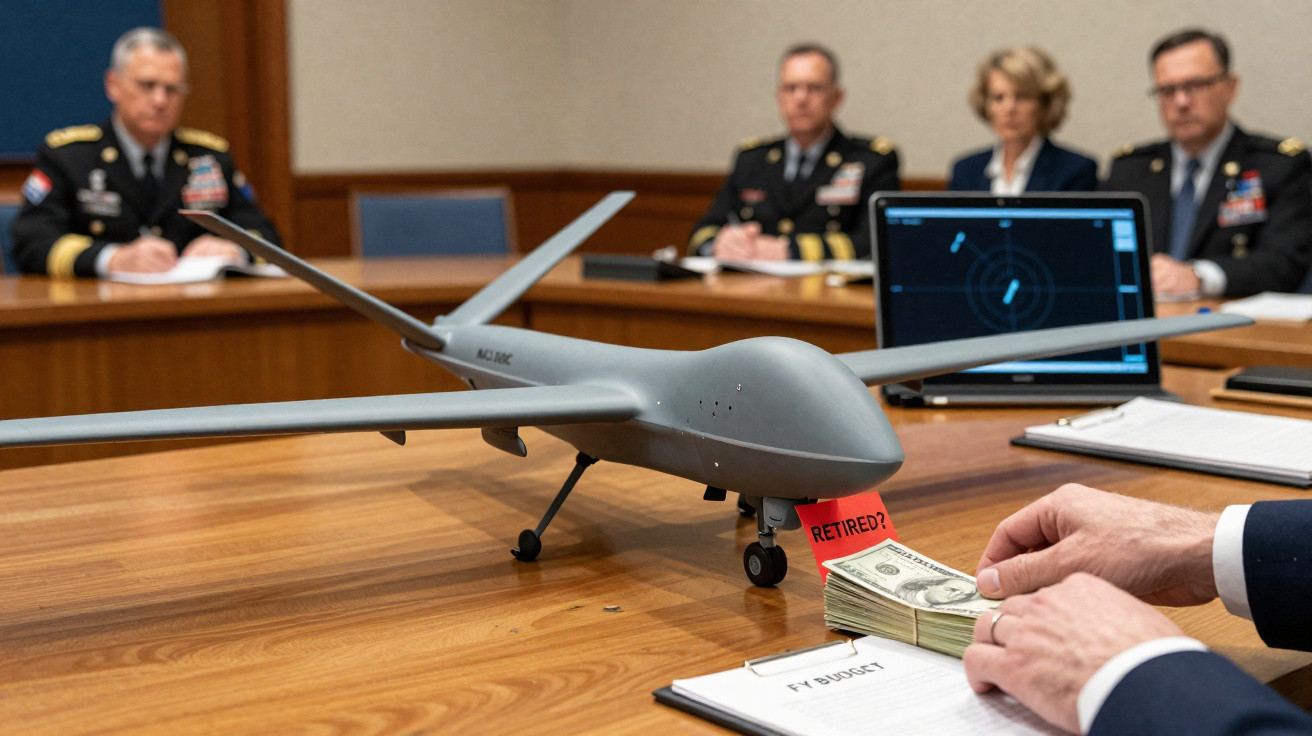
Washington’s latest defence bill gives a familiar drone, previously dismissed by Army leaders, an unexpectedly quiet return to prominence.
Congress is seeking to finance additional MQ-1C Gray Eagle drones, despite senior U.S. Army officials having described the aircraft as “obsolete” and pledged to end its procurement. The decision reveals an increasing divide between legislators and military planners over which uncrewed aircraft will prove useful in a future conflict with Russia or China.
Congress adds $240 million to the Gray Eagle programme
The draft Fiscal Year 2026 Defense Appropriations Act provides an additional $240 million for the MQ-1C programme.
The funding is intended specifically for the Army National Guard rather than the regular active-duty Army, and for its newest Gray Eagle 25M model. Since 2024, prime contractor General Atomics has been supplying this improved variant to Guard units under signed contracts.
The Army requested no new Gray Eagle purchases in its own 2026 budget proposal. Congress is now forcing the issue.
Officially, the Army had sought only $3.44 million to continue modernising its existing MQ-1C fleet. Its procurement allocation was due to fall to zero.
Nevertheless, Senate and House appropriators agreed on the additional $240 million, indicating that Congress continues to see a role for armed, long-endurance drones, especially within Guard formations that may be mobilised for a major war.
Army leaders: “Yesterday’s weapons will not win tomorrow’s wars”
This new funding stands in sharp contrast to statements made by senior Army officials only a year earlier. In a forthright letter setting out a broad revision of modernisation priorities, Army Secretary Dan Driscoll and Chief of Staff Gen. Randy George placed the MQ-1C among the systems to be discarded.
The Army promised to “cancel procurement of… obsolete UAVs like the Gray Eagle” as part of a pivot to a leaner, more lethal force.
The same letter grouped the Gray Eagle with ageing AH-64D Apache helicopters and legacy land vehicles, including Humvees and JLTVs, characterising them all as “outdated” or “excess” in a future high-end conflict.
The service’s position was unmistakable: it wants fewer legacy platforms developed around counterinsurgency operations in Iraq and Afghanistan, and more capable, survivable aviation assets.
From Global War on Terror drone to budget dispute
The MQ-1C originated in the late 2000s. Initially known as Warrior, it was designed as an Army-oriented counterpart to the U.S. Air Force’s well-known MQ-1 Predator.
As with the Predator, the aircraft has a heavy-fuel piston engine instead of the more powerful turboprop used by the MQ-9 Reaper. This configuration sacrifices speed and operating altitude in return for extended endurance, a comparatively limited support requirement and lower operator-training demands.
Army units employ Gray Eagles for three principal tasks:
- Intelligence, surveillance and reconnaissance (ISR) across large areas
- Precision-strike operations using guided weapons
- Working alongside AH-64 Apache helicopters in combined crewed-uncrewed “packages”
Every drone has an electro-optical/infrared sensor turret beneath its nose, while four underwing pylons can carry weapons or pods. During operations in Afghanistan and Iraq, this allowed the aircraft to remain over isolated valleys and desert routes, monitoring roadside-bomb corridors and supporting forces on the ground.
The Gray Eagle 25M upgrade seeks to extend an ageing design
Rather than allow the MQ-1C to disappear from service, General Atomics has spent years pursuing upgrades. Revealed in 2022, the 25M update represents the latest effort to prolong the platform’s useful life.
| Gray Eagle 25M feature | Intended benefit |
|---|---|
| Improved engine | Better reliability and endurance |
| Increased onboard electrical power | Support for more sensors and payloads |
| New flight computer | More processing headroom for advanced software |
| Open-architecture systems backend | Faster integration of new weapons, sensors and electronic warfare tools |
Its open-architecture design is particularly important because it enables the Army to add new payloads, including so-called “launched effects” - small drones or loitering munitions released from the Gray Eagle itself.
In principle, this would allow the larger and more exposed aircraft to remain farther from hostile air defences while sending smaller expendable systems towards the threat.
Survivability concerns in missile-saturated airspace
The central dispute over the MQ-1C is not what it can carry, but whether it can survive at all in a high-threat environment.
Like the Predator and Reaper, the Gray Eagle built its reputation in permissive airspace, where insurgent groups did not possess radar, fighter aircraft or long-range surface-to-air missiles. A conflict with more heavily armed opponents changes that calculation substantially.
Recent U.S. missions against Iranian-backed Houthi forces in Yemen demonstrated how exposed MQ-9s can be, even when facing relatively limited air-defence capabilities. Surface-to-air missiles and anti-aircraft fire damaged or destroyed several aircraft.
The core concern: large, slow drones are easier to spot, track and shoot down than many of the threats they’re supposed to watch.
The war in Ukraine has added weight to those concerns. At the start of the conflict, Ukrainian forces employed Turkish-built Bayraktar TB2 drones - broadly comparable to the Gray Eagle in their role - to striking effect. Once Russia strengthened its air defences and electronic-warfare measures, however, the drones were driven back or restricted to narrower missions.
New MQ-1C roles: shooter, decoy and drone hunter
Against this background, the Army and General Atomics have been trialling more imaginative roles for the MQ-1C.
The company has shown a Gray Eagle destroying other drones with AGM-114L Longbow Hellfire missiles directed by millimetre-wave radar. This points towards a possible future role as a mobile counter-drone system defending bases, convoys or groups of ships.
Attention has also turned to self-defence. A specialised pod has been developed with threat-warning sensors and decoy-flare launchers mounted beneath the fuselage. The Army had planned a more ambitious step with a larger electronic-warfare pod, known as MFEW-AL, although it has subsequently stepped back from that programme.
Special operations aviation formations are already conducting experiments. Col. Stephen Smith, commander of the elite 160th Special Operations Aviation Regiment, has described training uses for MQ-1Cs as decoys and lead aircraft for helicopter formations.
By changing its emissions and appearance, the MQ-1C can be made to “look like” a Black Hawk or Chinook to enemy sensors, drawing fire away from real crews.
In a Pacific setting, Gray Eagles could also defend isolated island positions by supplying persistent surveillance and local air defence without consuming crewed-aircraft resources.
Army aviation plans remain unsettled
The argument over the MQ-1C forms part of a broader restructuring of Army aviation. Over the past two years, several significant programmes have been cancelled or reconsidered.
- The Future Attack Recon Aircraft (FARA), a high-speed helicopter once presented as an important scout aircraft, was cancelled in 2024.
- Plans for a direct successor to the RQ-7 Shadow drone have likewise been stopped.
- Fresh requirements have been released for drones with short or vertical take-off capability, reducing dependence on runways.
The most recent industry “challenge”, issued only last month, seeks STOL or VTOL drones able to complete at least some elements of the Gray Eagle’s mission set. Army planners are looking for systems that can operate from short, rough landing areas or small clearings rather than exclusively from full-scale airfields.
That requirement reflects worries about long-range precision missiles and targeting satellites. Permanent runways are prominent, fixed targets, whereas dispersed drones able to move from road to road or beach to beach are more difficult to destroy.
Gray Eagle STOL and future systems
General Atomics is already developing a link between present capabilities and future concepts. Its Gray Eagle STOL programme, tested with a demonstrator aircraft called Mojave, is intended to combine MQ-1C endurance with far shorter take-off and landing distances.
Mojave has flown from improvised land strips as well as ships at sea, suggesting that larger armed drones could eventually operate from amphibious vessels or small island bases.
Other U.S. companies are developing alternative STOL and VTOL concepts, including tilt-rotor drones and lift-fan designs. Such systems could ultimately take on some tasks now performed by Gray Eagles, particularly during a Pacific campaign spread across thousands of kilometres.
Why Congress still supports more “obsolete” drones
Lawmakers may have several reasons for resisting the immediate closure of the MQ-1C production line.
- Near-term readiness: Guard formations receive an established platform promptly instead of waiting years for unproven systems.
- Industrial base: Maintaining General Atomics’ production line retains skilled employment and manufacturing capability.
- Cost calculus: For missions outside dense air-defence zones, an upgraded Gray Eagle could cost less than deploying a wholly new system.
- Political signalling: Congress frequently resists when military services appear ready to retire platforms before replacements are available.
For Guard commanders responsible for homeland defence, disaster-response support or operations in less threatening regions, a Gray Eagle upgraded to 25M standard may remain highly appealing: it offers long-range surveillance and precision weapons without using valuable crewed flying hours.
Key concepts and practical scenarios
A number of terms are central to this discussion and influence how the drones could actually be employed.
Launched effects: This Pentagon term refers to smaller uncrewed systems, including loitering munitions, that are transported and deployed by larger platforms. A Gray Eagle might remain at a safer range before releasing or firing a swarm of smaller drones over a contested island for electronic attack, decoy tasks or one-way strikes. The larger aircraft would become more of a mothership than a frontline target.
Permissive vs contested airspace: Above a lightly defended desert or coastline, even a “legacy” MQ-1C can remain airborne for hours, transmitting live video to land forces and striking targets of opportunity. Over territory protected by modern radar and long-range missiles, by contrast, the same drone could be limited to operating around the edges, observing the battle from the side and sending information to stealthier aircraft or submarines.
One plausible Pacific scenario would involve Gray Eagles operating from a chain of small island airstrips. Each could observe neighbouring sea routes, provide targeting information for ship-launched missiles and give early warning of hostile patrol aircraft. In this task, survivability has a different meaning: losing a drone may be acceptable if it creates time or supplies targeting data that safeguards a crewed squadron or amphibious force.
The risks remain. Retaining an older platform can delay the transition to more survivable designs, while crews may become overly attached to familiar equipment. Conversely, a sudden end to the programme would create shortfalls in training, ISR coverage and strike capacity when worldwide demand for drones is increasing rather than declining.
The Gray Eagle therefore occupies an awkward middle ground: it is no longer state of the art, has not yet been retired, and remains sufficiently important for Congress to overturn the Army’s judgement and fund several more years of service.






Comments
No comments yet. Be the first to comment!
Leave a Comment