
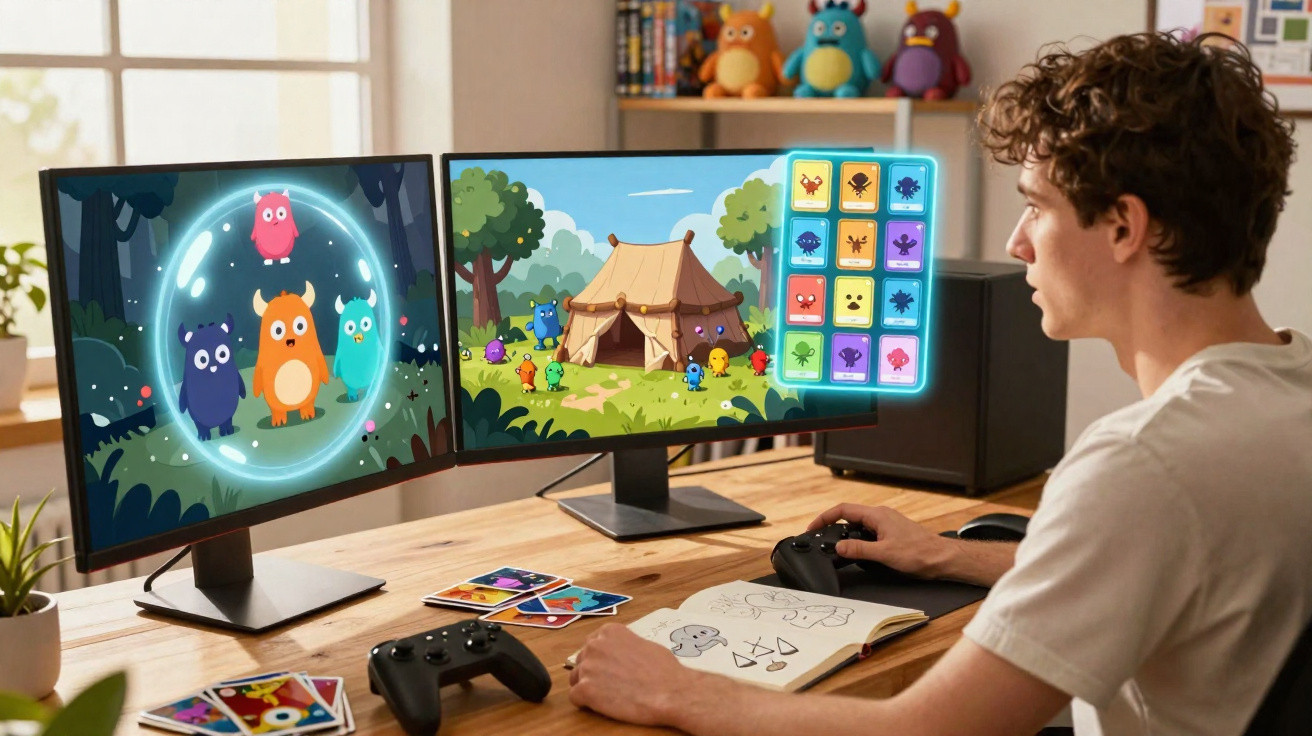
No sooner had the fuss surrounding Palworld begun to die down than the gaming community found a new target for debate. Pickmon is the upcoming title from a small studio, and it draws so openly on Pokémon and Palworld that many players can only shake their heads. The obvious question is: where does “inspiration” end, and shameless copying begin?
From Pokémon to Palworld to Pickmon: an endless cycle?
Games borrowing from successful predecessors are nothing new. Without influences, tributes and copied ideas, the modern games industry would probably not exist at all. Pickmon, however, sits in a particularly unusual position. It appears to be copying a game that was itself already heavily influenced by a third one: a genuine recycling loop of creatures, mechanics and designs.
The starting point was the hype around Palworld. This survival game, featuring cute Pokémon-like creatures alongside hard-hitting gun action, divided opinion online. Some saw it as a brilliant combination of monster collecting and crafting, while others considered it a tasteless and legally questionable mash-up built on Nintendo’s iconic series.
Nintendo even took the matter to court, seeking a legal ruling on whether Palworld infringed copyright. So far, however, that has not produced a decisive result. Visual similarities alone were not enough to force a clear verdict. This legal grey area now appears to have encouraged another studio to go a step further.
What Pickmon is meant to be
Pickmon is being developed by PocketGame, with Networkgo acting as publisher. It is planned as an open-world survival game. Its core premise sounds familiar: players explore the landscape, encounter small creatures, capture and train them, make them battle, and use them to build a base.
Pickmon combines Pokémon’s monster-catching approach with Palworld’s survival and base-building elements, creating a contentious mixture.
Among other tasks, the monsters are intended to gather resources, construct buildings and defend the camp. Anyone who has played Palworld will immediately recognise the concept. At the same time, the visual design of many creatures picks up precisely where Pokémon and Palworld had already sparked debate.
In early images, some monsters appear to be a cross between familiar Pokédex entries and Palworld creatures. Fans have drawn comparisons to dragons and mythical beings that strongly resemble well-known characters. A certain “déjà vu atmosphere” is difficult to deny.
Legal position: when does inspiration become a problem?
The issue is particularly intriguing because Palworld itself had already attracted Nintendo’s attention over possible similarities to Pokémon. The case illustrates just how difficult it is to define plagiarism clearly in legal terms within the games industry.
Several factors are especially important to lawyers in cases like these:
- Specific one-to-one copies of graphics or models – in other words, assets taken directly from another work.
- Trade mark law – the use of protected names, logos or highly distinctive brand elements.
- Patents covering gameplay mechanics – for example, clearly defined systems for capturing or using creatures.
- The overall impression created by characters – if one character looks too much like another, this may cause problems, although it is difficult to prove.
One issue in the dispute surrounding Palworld was a mechanic that came very close to the familiar Poké Ball system. This is exactly the area Pickmon is now entering, while attempting not to cross the line.
Cards rather than balls: legal technicality or clever workaround?
One detail stands out in particular: Pickmon’s monsters are not captured with balls, but with cards. It may sound like a minor change, yet it could be highly significant in any potential legal case.
Rather than throwing balls, Pickmon throws cards at creatures – formally a different system, but one that is clearly related to the monster-catching familiar to millions of players from other series.
Patents generally apply to very specific processes. If Palworld had to alter its ball-based mechanic to avoid becoming a target, cards look like a carefully selected detour. Capturing remains the central mechanic; only the “tool” has been swapped.
Legally, that may be sufficient to keep the game on the safe side for now. Among players, though, it has prompted ridicule. Forum posts and social-media comments are already piling up, describing Pickmon as a transparent attempt to evade legal boundaries without rethinking the creative core.
Platform, status and release: what is known about Pickmon so far
Pickmon remains in development and has no confirmed release date. For now, only its platform is certain: PC. Whether consoles will follow later remains unknown.
| Factor | Current status |
|---|---|
| Genre | Survival game with monster catching and base building |
| Platform | PC (further systems not yet confirmed) |
| Developer | PocketGame |
| Publisher | Networkgo |
| Release | No date announced yet |
Another unanswered question is whether Nintendo, or Palworld developer Pocketpair, will intervene before the game even reaches the market. Previous legal proceedings have shown how drawn-out such cases can be. In practical terms, it is likely to be difficult to halt a project entirely on the basis of similarities alone, as long as no clear legal violation can be proven.
Why monster survival games are booming
The popularity of series such as Pokémon, open-world games and crafting survival titles has created something of a perfect storm. Many studios are trying to combine the desire to collect, build and fight within a single package. Palworld demonstrated just how much attention this type of mix can generate.
Players enjoy not simply collecting creatures, but integrating them into a base of their own. Anyone who has watched their monsters chop wood, mine ore or put up buildings quickly understands the appeal. The line into exploitation can sometimes seem deliberately provocative, which had already triggered heated discussions around Palworld.
Pickmon is stepping directly into this niche. For fans of such concepts, that could mean more choice. At the same time, smaller studios face increasing pressure to establish themselves through their own ideas instead of merely copying the successful formula behind the latest hype.
Creativity versus calculation: what players can expect
The key question remains: will Pickmon introduce ideas of its own, or will it remain a visually altered remix? The information available at present points more towards the latter. That does not automatically make the game bad, but it does raise questions about its identity and value.
Many players now look beyond graphics and scale, and also want the feeling of experiencing something distinctive. The community often responds more positively to a few additional risks in game design than to a purely formulaic product clinging to existing models.
For developers, this balancing act is difficult. Too much originality can overwhelm new players, while too much imitation makes a game feel interchangeable. Pickmon’s success will depend heavily on whether it can offer ideas beyond the clone debate, such as distinctive interactions with creatures, unusual progression systems or a genuinely fresh style.
What terms such as plagiarism and “inspired by” really mean
In everyday use, many people apply the term “plagiarism” rather loosely. Legally, the threshold is higher. A game may draw on genres, fundamental mechanics or themes. No one exclusively owns the principle of “catching and training monsters”. It only becomes critical when highly specific, recognisable elements are taken: graphics, names, sound effects or exactly recreated playable characters.
As a result, “inspired by” has become the favoured label for many studios. At its best, it means taking a familiar idea and expanding it boldly. At its worst, it is a fig leaf concealing cautiously altered copies. Pickmon exemplifies this fine line, and in the coming months it is likely to become a test of how far the industry is prepared to accept this game.



Comments
No comments yet. Be the first to comment!
Leave a Comment