
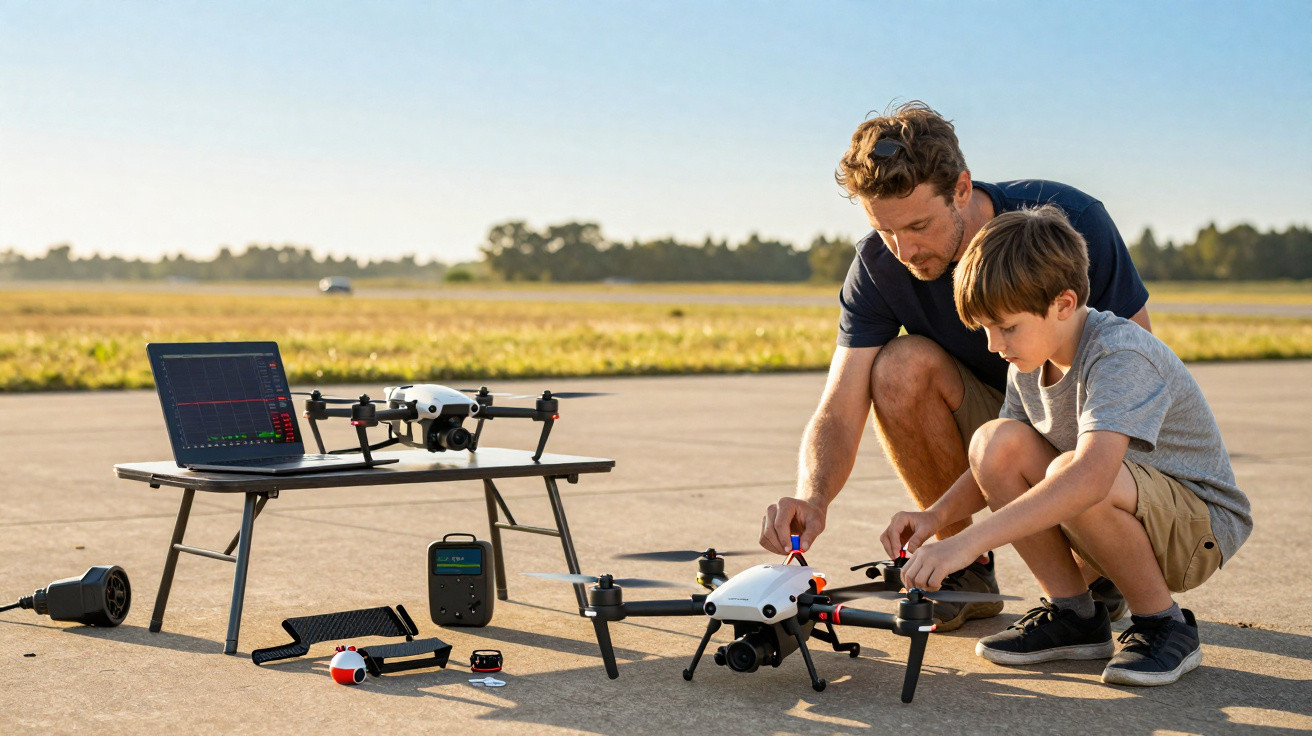
The achievement did not come from a defence supplier or a Silicon Valley research lab. Instead, a YouTuber and his father transformed a back-garden experiment into a Guinness World Record – then found they needed another drone simply to keep the record-breaker on camera.
A YouTube rivalry that became a speed arms race
Within YouTube, a small yet intensely competitive group of makers shares one goal: creating the world’s fastest quadcopter. There is no GPS or sophisticated autopilot involved – only outright speed, precise tuning and plenty of wrecked prototypes.
South African creator Luke Maximo Bell and his father joined that contest several years ago. Their project, named “Peregreen”, began as a personal challenge. In early 2024, Peregreen 2, their second significant iteration, reached an officially measured 480 km/h (about 298 mph), securing their first Guinness World Record.
That might have been the end of the story, but Bell continued to develop it. Later in 2024, Peregreen 3 pushed the benchmark up again, reaching 585 km/h. That result alone would have established the pair as major names in the drone community.
However, Australian engineer Benjamin Biggs – known online as Drone Pro Hub – entered the contest with a custom-built machine of his own. His quadcopter achieved 626 km/h, taking the Guinness record and immediately turning the maker competition into a high-speed story watched by millions.
The record now stands at a staggering 657 km/h, set by a home-built quadcopter tuned in a family workshop.
Inside Peregreen 4, the 657 km/h home-built missile
When Biggs’ record received confirmation, Bell and his father were already discreetly developing a fourth model. After five months of late-night work, test flights and design adjustments, Peregreen 4 was ready to take back the title.
Minor changes with major results
Bell has documented much of the development on his channel, explaining the differences between each version. The upgrades are not science fiction; the crucial factor was perfecting dozens of seemingly small details:
- Larger 3D-printed frame: A marginally bigger frame, produced on a new and larger 3D printer, created a more efficient arrangement for the propellers and components.
- Sanded, streamlined shell: The team carefully sanded the body to remove minute surface flaws that generate drag at extreme speeds.
- New motors: They moved to powerful T-Motor 3120 units rated at 900 kV, delivering an aggressive thrust-to-weight ratio.
- Meticulous wiring: Wires and connectors were routed and cut shorter to make the drone’s profile as clean as possible.
- Software tuning: Flight-controller settings were refined to keep the quadcopter stable as it cut through the air at speeds approaching 400 mph.
At such speeds, air behaves in a different way. A tiny propeller imbalance, a slightly crooked arm or a poor solder joint can become a catastrophic fault. The father-and-son team therefore had to approach their home project with the rigour of an aerospace test.
Too fast for the camera: why a second drone was needed
When Peregreen 4 was prepared for its record attempt, the team encountered another issue: no one could film it effectively. From the ground, cameras captured only a blur as the drone tore past.
Their answer was almost as ambitious as the primary build. They created a second quadcopter solely to pursue the record-breaking drone.
The camera drone that could only just keep pace
The “camera drone” had a single role: carry a 360-degree camera and travel quickly enough in a straight line to keep Peregreen 4 within view.
The main drone flew so fast that its creators had to build a dedicated chase drone with a 360° camera just to capture usable footage.
Even then, the video was far from flawless. Peregreen 4 accelerated so rapidly that the chase drone struggled to equal its pace. The resulting shaky, dramatic footage shows just how extraordinary 657 km/h appears when the aircraft itself measures only a few centimetres across.
How a drone speed record is measured
Guinness does not recognise a single peak-speed reading from a GPS log. To prevent inaccurate wind-influenced results or measurement errors, it uses a more demanding approach involving radar and repeated passes.
To confirm a record, the quadcopter must meet the following requirements:
| Criterion | Requirement |
|---|---|
| Flight path | Travel over a measured straight course in both directions |
| Speed measurement | Capture peak speed in each direction with certified equipment |
| Official speed | Take the average of both runs to offset wind effects |
| Verification | Submit raw data, video evidence and independent witnesses |
For Bell’s attempt, Peregreen 4 recorded 656 km/h in one direction and 659 km/h in the other. The official record, calculated as the average, is 657 km/h.
It is quicker than many light aircraft and nearly three times the cruising speed of a typical consumer camera drone.
Why home-built drones are becoming so fast
Performance of this kind has emerged from several connected developments in hobbyist technology.
Off-the-shelf components, extreme performance
Most parts used by Bell and his competitors can be bought online by anyone with a credit card. Powerful brushless motors, lightweight carbon fibre, sophisticated flight controllers and high-discharge lithium-polymer batteries were previously confined to industrial applications. Today, they are standard equipment within the racing-drone world.
3D printing provides an additional degree of flexibility. A frame can be designed, printed, tested and altered within days. Bell’s choice to use a larger 3D printer for a slightly bigger frame demonstrates how readily available tools can support highly detailed optimisation.
The record illustrates how consumer-grade parts, smart design and persistence can rival traditional aerospace projects on a niche metric like raw speed.
What this speed does to a drone
At 657 km/h, a quadcopter is subjected to stresses far beyond those experienced by ordinary recreational drones.
- Propellers face intense centrifugal forces, so they need to be perfectly balanced.
- Aerodynamic pressure causes the frame to flex; any movement can trigger oscillations and a loss of control.
- Electronics become hot quickly as the motors pull extreme current from the batteries.
- Control movements must be gentle, because even minor stick inputs produce major directional changes.
This is why record attempts generally happen well away from built-up areas, on lengthy flat routes where a failure is unlikely to damage people or property.
Risks, safety and what hobbyists need to know
Experimental high-speed drones occupy a space between a hobby and test-pilot work. Crashes happen regularly, and every run involves risk. Pilots require spotters, fire extinguishers and clearly defined safety procedures, even in rural locations.
Anyone inspired by these records should begin much lower down the speed scale. Conventional FPV (first-person view) racing drones already feel rapid at 120–150 km/h. They provide a safer route to learning about tuning, battery maintenance and regulations before considering serious record attempts.
From record attempts to everyday technology
Projects such as Peregreen can inform more mainstream drone applications. Methods for cutting drag, controlling motor heat and maintaining stable flight at high speed may help search-and-rescue platforms, inspection drones and even future air taxis.
For audiences, the broader lesson may be more straightforward: leading-edge innovation is no longer exclusive to major corporations. In a quiet workshop, equipped with a 3D printer, a soldering iron and a determined urge to go faster, a father and son took a home-made machine beyond 650 km/h – before building another one merely to keep it in shot.





Comments
No comments yet. Be the first to comment!
Leave a Comment