
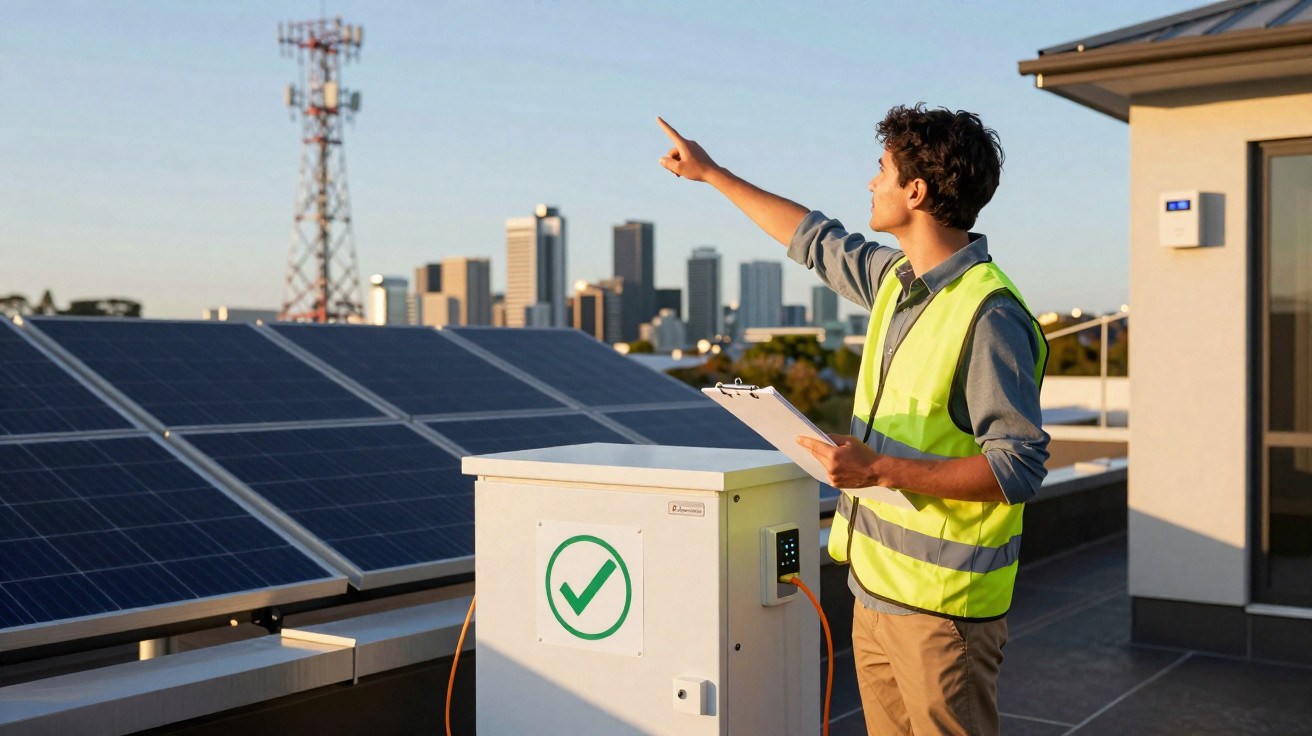
The email arrived at 7:42 a.m., just as the first sunlight reached the office solar array. Its subject read: “CIS project – federal clearance granted.” There were no emojis, celebratory graphics or overblown language. Instead, three concise words marked a potentially decisive moment in Australia’s clean-energy race: “Approval. Effective immediately.”
Across the open-plan office in Sydney’s technology district, a handful of engineers lifted their eyes from coffee cups and unfinished CAD plans. Their solar-battery hybrid system - a substantial combination of rooftop solar panels, intelligent inverters and a bank of stacked lithium batteries - had passed through a federal approval route that normally takes months.
One engineer laughed: “Did Canberra’s servers glitch?”
They had not. Something else had shifted.
Solar-battery hybrids go from trial technology to the fast track
A glance at almost any Australian news feed reveals two recurring concerns: steadily rising household energy bills and the threat of blackouts. That is the pressure-filled environment in which this new generation of solar-battery hybrid systems has moved rapidly into focus.
What was once viewed as a desirable technology toy for renewable-energy enthusiasts is increasingly being treated as essential infrastructure: rooftop panels, a garage battery and a smart control system constantly monitoring the grid and moving power when it is needed.
That is the kind of system the government has now approved at unusual speed through the Capacity Investment Scheme, or CIS.
The project receiving this accelerated green light is not a remote giant solar farm in the desert. It is an extensive but tangible hybrid programme connecting commercial rooftops, suburban properties and a powerful battery hub on the outskirts of a regional town.
Picture supermarkets with solar-covered canopies supplying a shared storage facility, which then sends electricity back into nearby streets as the grid comes under strain at 6 p.m. Picture households barely registering a storm-related line outage because their hybrid equipment automatically switches into island mode.
Those were the images circulated through Canberra in the internal briefing pack: long rows of panels, metallic battery racks and a dashboard where demand curves had been smoothed as though the pressure had been ironed from the grid.
The case for such a rapid approval is straightforward. Australia needs reliable, backed-up renewable electricity quickly, or the energy transition could become bogged down by outages and public resistance. Conventional solar farms generate a rush of power at midday, when demand is lower, then fall away at sunset - exactly as people return home, prepare dinner and turn on appliances.
Systems that combine solar generation, storage and intelligent controls reverse that pattern. They collect the midday surplus, retain it and dispatch it during the early-evening period when the grid most needs support.
For regulators, this is not simply another gadget. It is a buffer against shocks.
How the CIS federal “green tick” shortcut works in practice
The exceptionally quick green tick resulted from a modest-looking but significant change to the way the CIS assesses projects. Rather than repeatedly working through paperwork on theoretical future capacity, assessors now make extensive use of standardised templates and pre-approved technical building blocks.
For the successful solar-battery hybrid, this meant its main equipment - panel models, inverter specifications, safety systems and battery chemistry - was already included on a federal list of recognised, understood technology. The developers still faced demanding questions, but did not have to start from scratch for each cable, circuit breaker and connection.
That removed weeks from the usual exchange of documents and queries.
The project manager does not offer lofty speeches about climate policy when asked about the experience. His account centres on a spreadsheet that unexpectedly shifted from red to green.
He had allowed for an approval period of three to six months, including difficult contingencies in case of delay. Contractors had been booked with flexible start dates, land agreements contained exit clauses, and the team had set aside a sizeable reserve of patience.
Then, less than six weeks after the process began, the CIS team responded with what one insider called “the cleanest risk profile we’ve seen in this round.” There were no dramatic contract renegotiations, no eleventh-hour redesign of the battery compound, only several clarifications followed by the formal notification: the project was approved and eligible for capacity payments. By bureaucratic standards, it felt almost indecently fast.
Why was this project selected, and why was it handled so quickly? Its strength on paper is not unusual or exotic technology. It is the way its separate elements fit neatly into the national policy framework.
The scheme provides firmed capacity: not merely megawatts that may be available if sunshine permits, but guaranteed output when requested by the grid operator. It combines local employment, grid reliability and lower emissions in a single package that is straightforward to justify both in Parliament and around the kitchen table.
Realistically, few people read 300-page regulatory impact statements. What resonates is a simple message: the lights remain on, bills do not spiral and the town gains employment.
What the fast-track approval means for renters, households and grid operators
For anyone wondering what this means beyond the headlines, it helps to begin with a household electricity bill and the roof overhead. The solar-battery hybrid that has moved so quickly through the CIS is a large-scale relative of systems increasingly appearing in everyday suburbs.
The underlying approach is identical. Panels gather energy when it is cheap or effectively free, batteries retain it, and smart software determines whether it should be used, stored, shared or sold.
The practical lesson from this federal green tick is that technology capable of shifting electricity through time - rather than merely producing it - is rapidly moving up the priority list.
Many households hesitate at the first stage. They may like solar power but pause over the expense and complication of adding a battery. Will regulations change? Will feed-in tariffs fall again? Is this another trend politicians support today before abandoning it tomorrow?
The CIS result offers a restrained but meaningful indication that storage is not a temporary fashion. It is becoming structurally embedded in the way Australia designs its electricity system and funds capacity.
That matters for people who remain undecided. It will not instantly reduce a battery quotation, but it indicates that long-term planning is moving towards hybrid systems rather than away from them.
Officials involved with the scheme can be notably direct in private:
“We’re backing combinations – solar plus storage, wind plus storage – because single-tech projects don’t carry enough weight when coal exits,” one senior adviser said. “We don’t have time for fragile solutions anymore.”
That approach flows through to:
- Which projects are assessed first
- Which technologies lenders regard as “bankable”
- The skills local workers will be trained in during the next decade
The accelerated approval sends a clear signal to engineers, councils and homeowners: the 2030s grid will not be defined only by a greater volume of renewable generation on bright days. It will rely on renewable energy that can be controlled, stored and directed deliberately.
A subtle turning point in Australia’s energy transition
Step back from the acronyms and the level of quiet industry interest becomes easier to understand. Australia has been caught in an uncomfortable transitional stage: shutting coal-fired power stations, promoting renewables, yet still reacting nervously to each summer heatwave in case it pushes the grid to its limits.
A solar-battery hybrid progressing rapidly through the federal CIS process does not resolve that tension by itself. It does, however, demonstrate a workable model for scaling dispatchable renewable power without becoming overwhelmed by red tape.
Future developments will scrutinise this project closely. Councils deciding how ambitious to be in local planning will do the same, as will communities weighing whether a battery enclosure on the edge of town represents a risk or a lifeline.
| Key point | Detail | Value for the reader |
|---|---|---|
| Solar-battery hybrids are receiving fast-track treatment | A CIS-supported project has secured swift federal approval because it uses standardised equipment and provides firmed capacity | Indicates the technologies most likely to receive support and funding over the next decade |
| CIS rewards “firm” clean electricity | Projects able to guarantee output at peak periods, rather than only when the sun is shining, move to the front of the queue | Helps households and businesses see why storage and smart controls are as important as panels |
| Local effects may be substantial | Hybrid projects can strengthen regional grids, create jobs and reduce bill shocks as coal plants close | Provides a practical way to assess future local projects: risk, benefit and long-term opportunity |
FAQ:
Question 1 What exactly is a solar-battery hybrid system?
It is a system combining solar panels, a battery and intelligent control software. The panels produce electricity, the battery keeps surplus power, and the control system chooses when to use, store or export it.Question 2 What is the Capacity Investment Scheme (CIS)?
The CIS is a federal framework intended to underwrite and speed up new clean-energy capacity, particularly projects capable of delivering dependable electricity when demand is high and older fossil-fuel plants are retired.Question 3 Why did this project receive such a rapid federal green tick?
It relied on established components, supplied firmed capacity and closely matched CIS objectives. This lowered regulatory risk, reduced technical exchanges and made the approval easier to justify politically and economically.Question 4 Does this mean home batteries will suddenly become cheaper?
Not immediately. Costs still depend on manufacturing, supply chains and demand. However, strong policy support for storage may stimulate competition, scale and financing choices that progressively reduce costs for households.Question 5 How does this affect someone renting or unable to install solar?
Large-scale hybrids supported through schemes such as the CIS can make the broader grid more stable and help limit wholesale prices. This will not eliminate every bill shock, but it may lessen the impact for renters and apartment residents who cannot install panels on their own roofs.




Comments
No comments yet. Be the first to comment!
Leave a Comment