
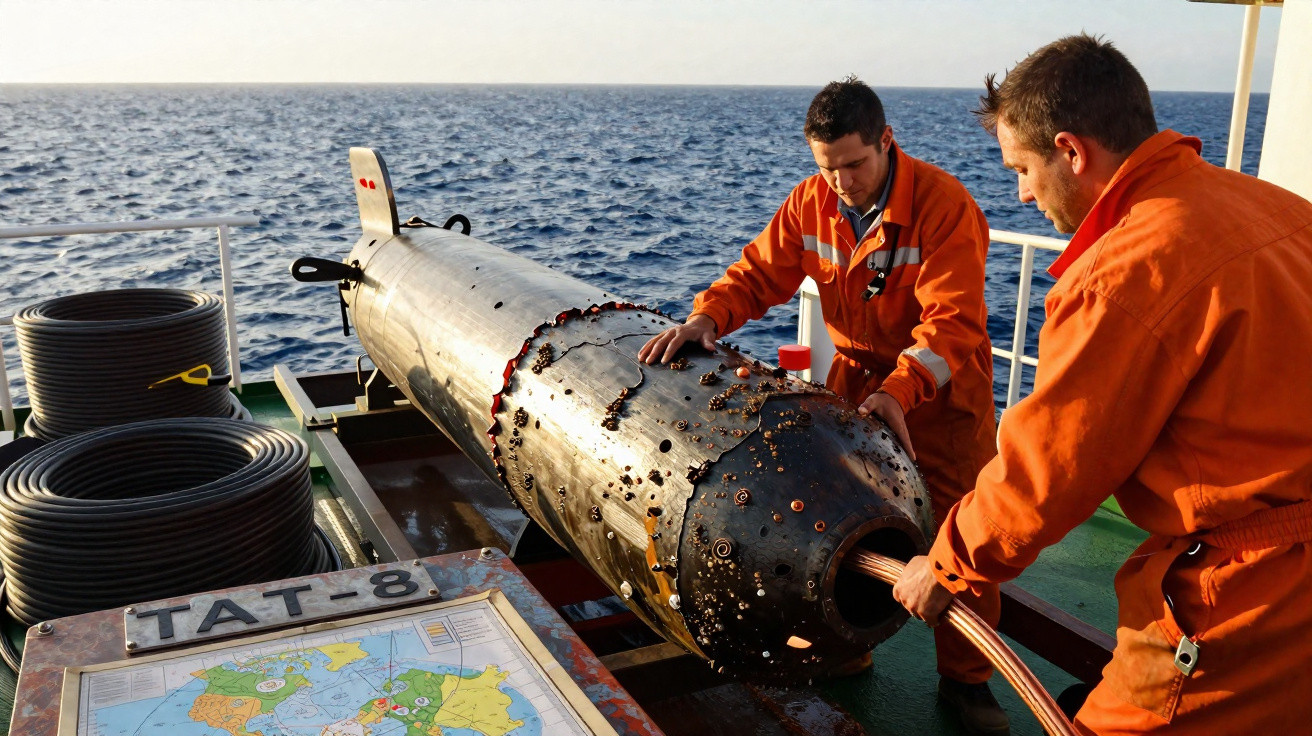
The TAT-8, regarded as one of the submarine cables that helped pave the way for the global internet, is being recovered from the ocean floor after more than 35 years. Installed in the late 1980s, it was the first major transatlantic fibre-optic cable and played a role in reshaping communications between continents.
Which submarine cable is being removed from the ocean?
The cable in question is TAT-8, a transatlantic system commissioned in 1988 to link the United States, the United Kingdom and France. At the time, it marked a major departure from earlier cables, as it used fibre optics to carry data and telephone calls with far greater capacity.
Later generations of submarine cables eventually delivered much higher speeds, reliability and transmission volumes. TAT-8 was taken out of service in the early 2000s, yet it remained on the seabed for decades before its removal began.
Why was TAT-8 so significant to the digital age?
Before fibre optics, international communications relied on more restricted systems. TAT-8 demonstrated that large amounts of information could be sent over long distances with less signal loss and greater reliability.
- Fibre optics: enabled faster transmission than earlier technologies.
- Transatlantic link: strategically connected North America and Europe.
- Foundation of the global internet: helped prepare the infrastructure for the modern digital world.
- It reduced barriers to international calls, data transfers and services.
- It paved the way for increasingly powerful submarine cables.
Why remove an old cable from the seabed?
Recovering decommissioned cables can free up space along important submarine routes and make it possible to reuse materials. Older cables contain metals, outer protective layers and components that can be recycled when recovery is feasible.
- Recycling: materials including copper, steel and polymers can be reused.
- Route management: reduces abandoned infrastructure on the seabed.
- Infrastructure maintenance: helps prevent confusion with cables that remain active.
- New cables require planning in areas that are already occupied.
- Recovery must take environmental safety and maritime logistics into account.
How have submarine cables changed since then?
Today’s cables are vastly faster and carry an incomparably greater volume of data. They support video, calls, banks, social networks, cloud services, financial transactions and much of the world’s day-to-day international communication.
Despite satellites and wireless networks, most global internet traffic still relies on submarine cables. They create an unseen infrastructure that crosses oceans and links continents in fractions of a second.
What does the removal of TAT-8 represent?
The removal of TAT-8 brings a physical end to a technology that helped launch modern digital communication. The cable became obsolete, but its historical importance remains because it demonstrated the potential of fibre optics on a global scale.
More than an operation on the ocean floor, the process is a reminder that the internet was not created by computers and servers alone. It also depended on ocean engineering, enormous cables and decisions that, decades ago, began shaping the connected world we live in today.






Comments
No comments yet. Be the first to comment!
Leave a Comment