
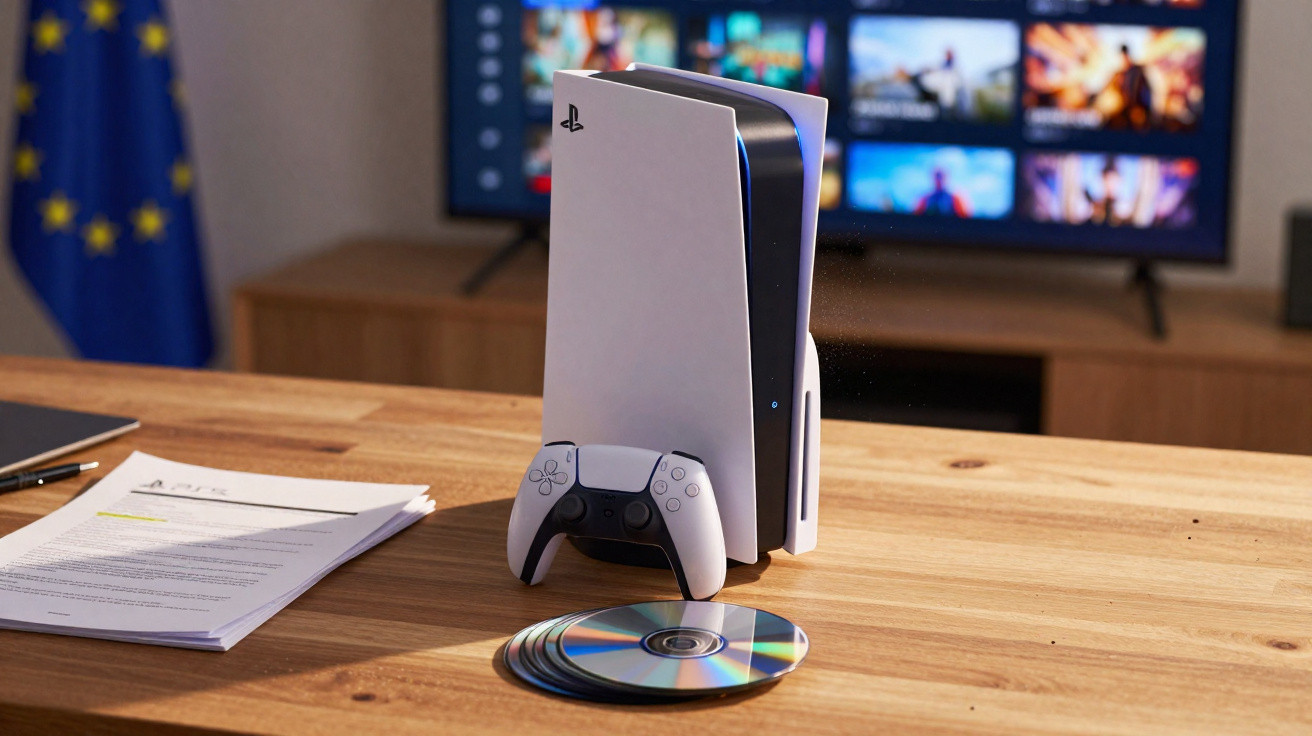
Sony has decided to end physical games and, amid players’ outrage, politicians are already attempting to capitalise on the issue.
On 1 July, Sony made a bombshell announcement: from January 2028, no new PS5 games will be sold on disc. Every title will instead be released digitally. This is a major-perhaps historic-decision for the video game industry, prompting extensive reaction from both the sector and players. The first political responses followed swiftly.
Jean-Luc Mélenchon was the first politician to respond publicly. In a tweet posted on 2 July, the La France Insoumise leader criticised the Japanese giant’s strategy, arguing that consumers no longer truly own games bought digitally. He pledged to “open the debate” on the matter if elected. More specifically, he proposes introducing legislation to protect video games as the cultural asset they are and, therefore, to give consumers control, whether a game is on disc or digital:
With GTA 6 without a disc in 2026 and Sony’s announcement that it will end physical disc sales for games in 2028, the question of how we regard these products must be asked.
Tomorrow, you will pay without ever owning anything. No lending, no resale and no guarantee of keeping what you paid for. Video games are not simply merchandise; they are a cultural asset, and the law in force must apply to them.
We will open the debate in 2027. Gamers have rights too!
On the substance, it is hard to disagree with him. Yet we have become accustomed to politicians reacting-or overreacting-to current events. They make one uncommitted promise after another to win votes, particularly in an electoral climate such as ours. Still, credit where it is due: for now, Jean-Luc Mélenchon is the only French political figure to take a position on the Sony issue. He is also one of the few who regularly discusses video games. Other parties will no doubt seek to ride the wave.
Can a politician force Sony to sell games on disc?
Could Jean-Luc Mélenchon, or anyone else, force Sony to sell games on disc in France if elected? Such a move would conflict with freedom of trade and industry, enshrined in the Constitution-which underpins freedom of enterprise, recognised by the Constitutional Council as having constitutional status since 1982-as well as with the freedoms guaranteed by the European Union within the single market. However, political will can bring about legal change very quickly.
Physical game preservation and Stop Killing Games
Preserving physical games is not a new issue among campaigners. One example is the international Stop Killing Games movement, which advocates preserving purchased games, whether they are physical or digital. A few weeks ago, a petition on the subject was submitted to the European Commission, which acknowledged that it was powerless to keep certain titles playable:
“The Commission considers that, at this stage, it cannot propose a legal obligation to maintain the playability of video games after their commercialisation has ended. This is also due to existing intellectual property rights. Under EU copyright law, rightsholders benefit from exclusive rights over their creations.”
In practice, if Jean-Luc Mélenchon intends to legislate, he will face a genuine legal obstacle course in seeking to compel Sony, which could respond by leaving the market. Finally, it should be noted that owning a physical game does not guarantee that it can be played forever. If a title includes an online component, it may become inaccessible at any point, even if it also offers a single-player mode. Ubisoft’s The Crew is the clearest example: it was shut down and even removed from players’ libraries. Whether physical or digital, few games are fully owned by the consumer.






Comments
No comments yet. Be the first to comment!
Leave a Comment