
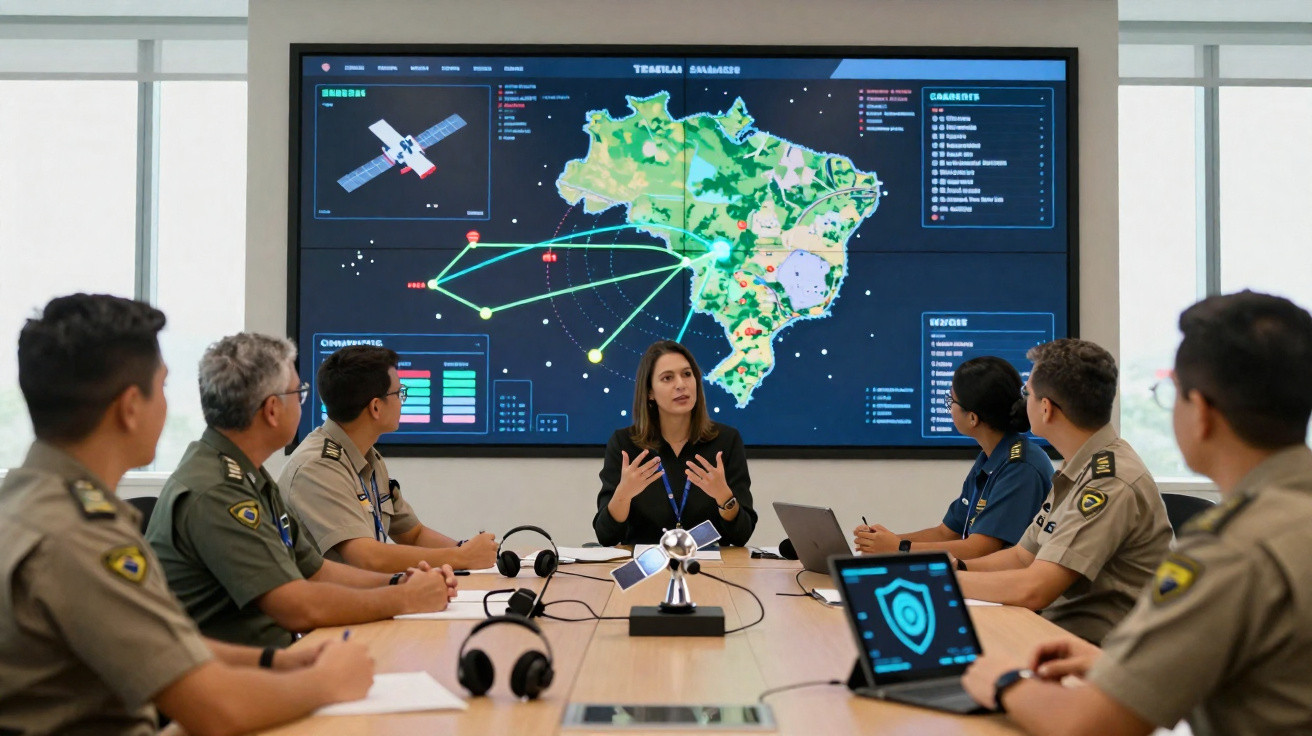
DECEA debate on telecommunications and cyber security
On the 4th, the Department of Airspace Control (DECEA) brought together representatives from different organisations within the Brazilian Airspace Control System (SISCEAB) to discuss the future of telecommunications, space connectivity and cyber security in the aviation sector. The occasion included a presentation by José Raimundo Cristovam, representative of UNISAT and Integrasys.
Hosted in the auditorium of the Special Flight Inspection Group (GEIV), the event was organised by DECEA’s Technical Subdepartment and structured around two panels. The first examined the development of telecommunications in the age of artificial intelligence and space as the “fourth domain of defence”. The second considered radio-frequency (RF) communications and SATCOM systems in light of the growth of satellite megaconstellations.
The initiative brought together professionals from DECEA, the Airspace Control System Implementation Commission (CISCEA), the Rio de Janeiro Electronics Material Park (PAME-RJ), the First Communications and Control Group (1st GCC), and DECEA regional organisations.
Satellite connectivity and air traffic services
Discussions covered geostationary-orbit (GEO), medium-Earth-orbit (MEO) and low-Earth-orbit (LEO) satellites, as well as the Device-to-Device (D2D) concept, which enables direct communication between devices without relying solely on conventional terrestrial infrastructure.
Within SISCEAB, satellite systems have an important role in maintaining communications between aircraft and air traffic control bodies, particularly in areas beyond the reach of conventional ground infrastructure. Satellite links can extend operational coverage, support surveillance and aeronautical communication services, and provide greater consistency for air traffic flows.
As well as strengthening operational safety, these technologies support more efficient air circulation by reducing coverage restrictions and improving communications reliability across continental and oceanic areas under Brazilian responsibility.
Cyber security challenges for telecommunications
During the presentation, Cristovam described “telecommunications as the new battlefield of cyber security”. “As dependence on connected systems, satellite links and digital infrastructure increases, so too does the need to protect critical networks against cyber attacks, interference and attempts to disrupt services,” he said.
In this context, the integration of telecommunications, cyber defence and airspace control is taking on strategic importance for both civil and military aviation. The expansion of satellite constellations and progress in cloud computing deliver operational benefits, but they also create new challenges involving data protection, communications resilience and the continuity of air traffic management (ATM) services.
Cristovam also sees the use of low-Earth-orbit satellites emerging as an option to increase the availability of air traffic services. “The technology provides lower latency and wider coverage in remote, oceanic and hard-to-reach areas, which are sensitive points for the operational continuity of air navigation,” he noted.





Comments
No comments yet. Be the first to comment!
Leave a Comment