
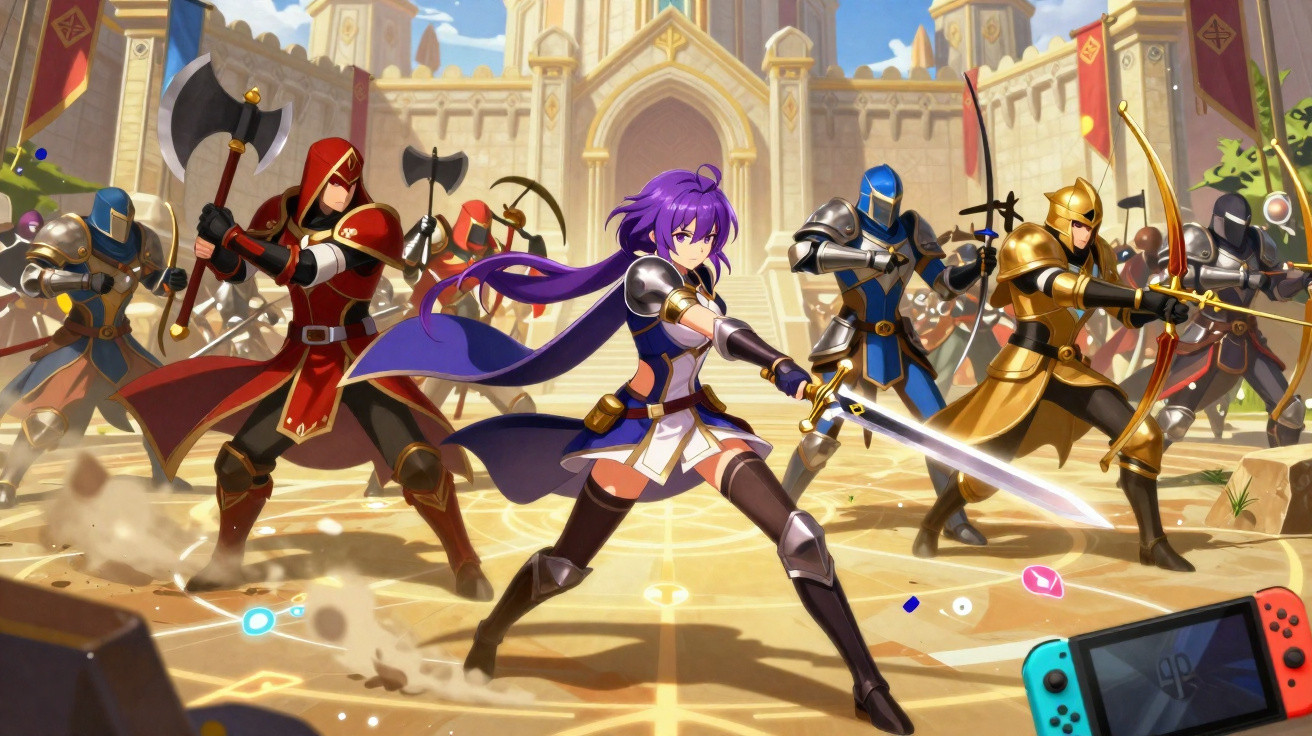
My last encounter with the Musou genre was in the PlayStation 2 era, and my hands-on session with Fire Emblem Warriors: Three Hopes has made me wish I had not left it so long. At this stage, Three Hopes is enormously enjoyable to play while its story is just as compelling. If this preview reflects what awaits in the full release, then when Three Hopes comes to Switch on 24 June, it could become one of my favourite gaming experiences of 2022.
Fire Emblem Warriors: Three Hopes and its familiar foundations
The aspects I most remember from my time with Three Houses are, fittingly, a trio: the friendships I formed, the political struggle driving its narrative, and the choices that made every character feel distinctly mine. Three Hopes has, so far, incorporated all of these elements, and I am captivated by it as a result. As I did with Byleth in the 2019 game, I placed protagonist Shez in the Black Eagles house. My stay at Garreg Mach Monastery was brief, however, because Three Hopes moves straight into the post-school period that follows the Three Houses time skip. Lessons and textbooks are replaced with a campaign map and fiercely contested battles.
I will not reveal how these events have unfolded so far, but they have certainly drawn me in. As a Black Eagle taking the Edelgard-led “Scarlet Blaze” Empire path, rather than Dimitri’s “Azure Gleam” Kingdom route or Claude’s “Golden Wildfire” Alliance route, I already feel at ease among my housemates.
That group includes the sinister, unusual Hubert; the cheerful, relaxed Caspar; and the anxiety-plagued Bernadetta (I feel ya, girl), alongside Ferdinand, Linhardt, Dorothea and Petra. I have thoroughly enjoyed spending time with these characters, and I appreciate that Three Hopes retains the systems for learning more about them through gifts, support ranks and more.
Seals also allow you to open up new classes for every character, while each combatant who takes part in a battle earns experience to level up. Remove the fighting, and Three Hopes is, in nearly every respect, Three Houses.
Musou combat with Fire Emblem strategy
Combat is where Three Hopes meaningfully separates itself from Three Houses. It remains unmistakably a Musou game: you spend much of your time striking huge enemy hordes and watching damage totals climb into the thousands, hoping the KO counter rises with them. Sending waves of foes flying has not lost its appeal, and the gratification I felt the first time I did so was still there at the end of my hands-on session.
That lasting enjoyment comes, I think, from how extensively Three Hopes draws on the Fire Emblem formula. Each character can use actions tied to their class, complete with grand, spectacular animations. There are also several gauges to fill, leading to stronger, larger attacks or even entirely new forms.
Fire Emblem’s familiar rock-paper-scissors-style mechanics are present too. Some classes inflict greater damage on particular enemy types, rapidly breaking through their armour and leaving them vulnerable to a powerful special attack. You can further slow the pace by opening the battle map and assigning orders to allies, any of whom you can take control of whenever you wish.
When a particularly formidable opponent ahead is susceptible to ranged options, such as Bernadetta’s arrows or Hubert’s fire magic, you can direct those units towards them. If an important target needs defending, you can instruct Edelgard to guard them. That same screen even displays the percentage chance a unit has of defeating an opposing enemy. Together, these systems create the sense that you command an army rather than merely one character, which suits the Musou genre perfectly.
Fire Emblem Warriors: Three Hopes visuals fall behind
My experience with Three Hopes has not been entirely positive, though. The game is great fun, but its visuals are noticeably underwhelming. It performs well, which is arguably the more important factor for a game of this kind. Yet apart from the character artwork shown during dialogue, most of what you see consists of jagged, bland castles, forts and trees.
There are occasional visual standouts, including the main camp, but even there the NPCs lack the sharpness and contrast that could make the presentation stand out. I wish Three Hopes’ visuals had received the same care given to the rest of the game, because Omega Force otherwise appears to have created something that feels essential for anyone who enjoyed Three Houses. That is also the greatest surprise of this hands-on preview: it is effectively more Three Houses, simply with another style of combat.
There is much more I could say about Three Hopes, but the central point is straightforward: so far, it expertly brings what made Three Houses so good into both its story and gameplay, making it a pleasure to play. I can only hope that the remainder of the game matches the portion I have experienced.
Fire Emblem Warriors: Three Hopes launches on Switch on 24 June.




Comments
No comments yet. Be the first to comment!
Leave a Comment