
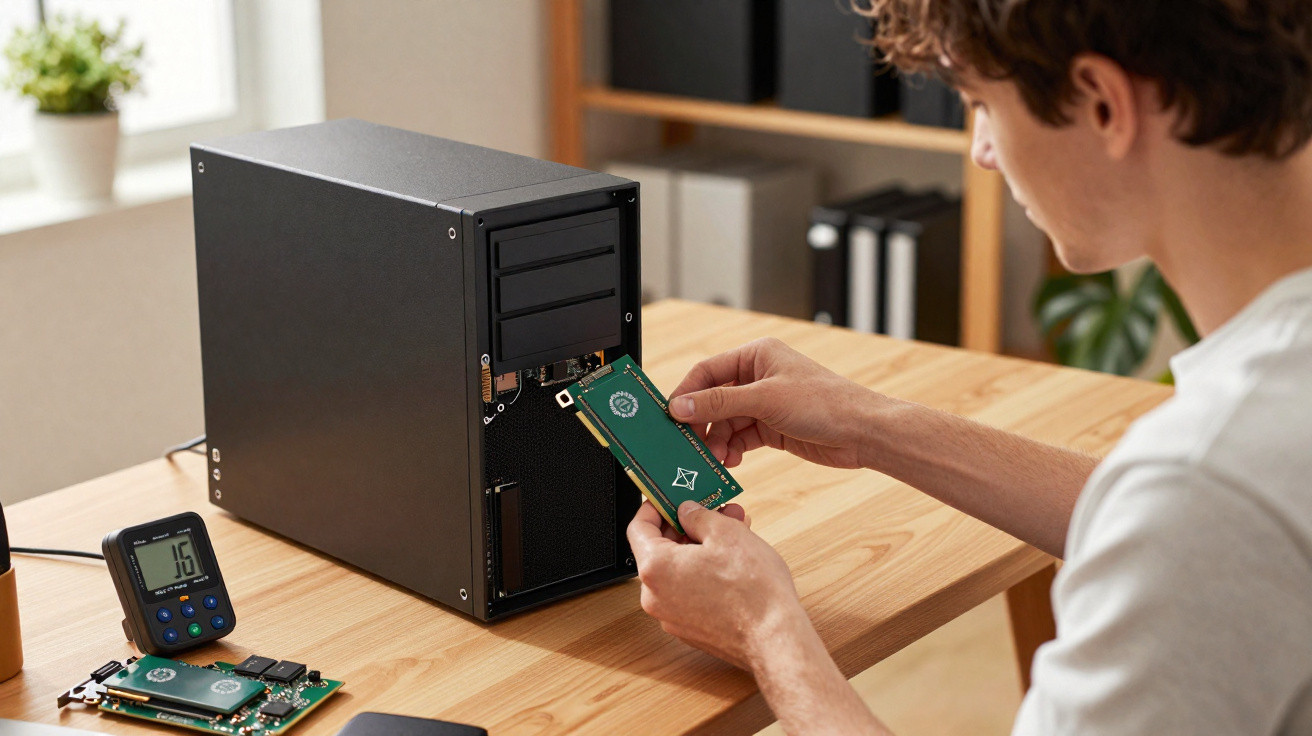
Skymizer unveils the HTX301 PCIe card with up to 384 GB of memory and just 240 W power draw - the company says it can rival Nvidia and AMD solutions
Taiwanese company Skymizer has introduced the unusual HTX301 AI accelerator, which its developers claim can run large language models with up to 700 billion parameters on a single PCIe card. Rather than relying on cutting-edge manufacturing processes and costly high-bandwidth HBM memory, the device uses comparatively old 28 nm chips and standard LPDDR4/LPDDR5 memory.
Skymizer’s principal focus is not peak compute performance, but memory capacity and power efficiency. A single HTX301 card integrates up to 384 GB of memory across six dedicated HyperThought HTX301 chips. The entire unit consumes roughly 240 W, considerably less than current Nvidia and AMD accelerators in a comparable class.
The company says the card can achieve up to 30 tokens per second with enormous models, and up to 240 tokens per second with the smaller Llama2 7B. It relies on dedicated weight- and KV-cache-compression algorithms which, according to the developers, enable the HTX301 to outperform the open-source llama.cpp engine by 9–17.8%.
HTX301 PCIe card for enterprise AI deployment
Skymizer says its product addresses one of enterprise AI’s main challenges: the need to build expensive infrastructure involving GPU clusters, complex cooling systems and very high power consumption. The HTX301 is intended for installation in standard air-cooled servers, without requiring data-centre upgrades.
The developers are also targeting local deployment of AI models within businesses. In their view, this can help avoid data leaks, dependence on cloud services and unpredictable computing costs.
Against the backdrop of modern accelerators, Skymizer’s claims appear particularly unusual. AMD’s Instinct MI350P PCIe card, for example, uses 144 GB of HBM3E memory and consumes substantially more power, while Nvidia’s RTX PRO 6000 Blackwell requires around 600 W. The Taiwanese start-up is effectively seeking to demonstrate that AI inference depends not only on raw teraflops, but also on memory architecture and efficient model handling.
For now, however, all HTX301 performance figures exist only in the company’s presentations. Independent testing of the card is scheduled for Computex 2026 in early June. Those tests will show whether Skymizer has genuinely created an affordable alternative to Nvidia and AMD accelerators, or whether the HTX301 will join the long list of ambitious AI start-ups that failed to substantiate their promises.





Comments
No comments yet. Be the first to comment!
Leave a Comment