
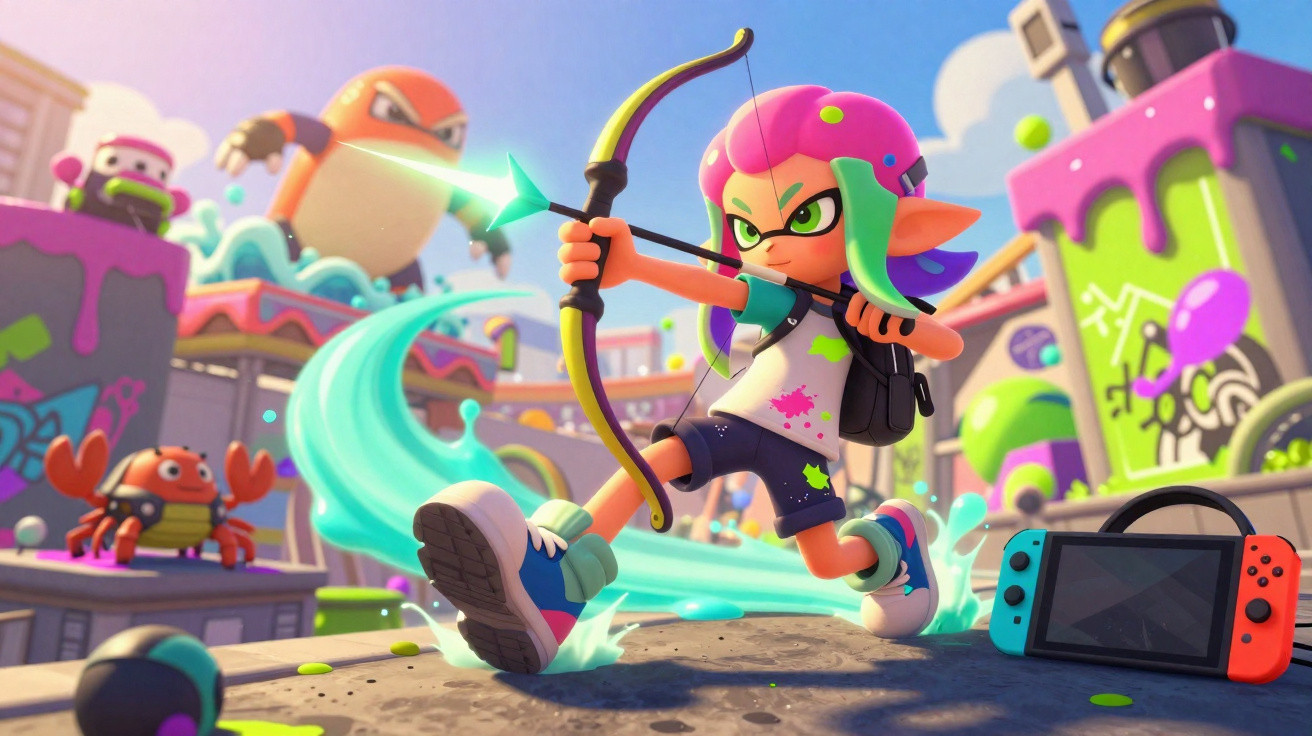
Two weeks ago, the Splatoon 3-focused Nintendo Direct impressed me with both the detail it offered and the amount of content the Splatoon team plans to have ready at launch. I greatly enjoyed the first two Splatoon games, along with Splatoon 2's Octo Expansion, so that presentation had already raised my excitement considerably. But spending time with the imminent Splatoon 3 pushed it rapidly towards the top of my most anticipated releases of 2022.
Across a 75-minute hands-on session, I tried Splatoon 3's three key components: the Hero Mode single-player campaign, 4v4 Turf War, and four-player co-operative Salmon Run. Each mode featured in Splatoon 2, although Turf War has served as the series' central draw since the original game. Multiplayer may always be what Splatoon is best known for, but the first two games' solo story modes remain seriously overlooked. Based on what I played here, this concluding chapter of the ongoing story looks set to offer more gratifying shooting, splatting, platforming, and puzzle-solving.
Splatoon 3 Hero Mode brings inventive single-player action
"Obviously, with such a heavy multiplayer focus in Splatoon, I think a lot of people kind of forget about Hero Mode," Nintendo vice president of product and player experience Bill Trinen says. "They forget just how inventive the level design and single-player platforming that they're doing in that mode is, and just how connected it is to, I think, what is a very traditional Nintendo approach to gameplay and level design that often gets overshadowed by the multiplayer side of Splatoon. I'm hoping a lot of people will dive into it right away rather than going straight to the multiplayer side like some of those longtime Splatoon fans may do."
I completed three story-mode stages, each demanding different approaches to reach its objective. In one, I worked through small puzzles and combat encounters to find four keys needed to reach the finish. Another required me to repeatedly prevent charging enemies from getting close. My favourite mission in the single-player campaign, however, gave me access to the new Tri-Stringer bow weapon.
This bow-and-arrow-inspired armament launches a three-arrow spread, which can be fired quickly or charged up. Holding the charge long enough turns those arrows into small bombs that detonate shortly after hitting their targets. That proved especially useful near the stage's end, where I faced shielded Octarians. While using the Tri-Stringer, jumping also changes its spread from horizontal to vertical.
Salmon Run adds bosses and always-available rewards
Salmon Run, meanwhile, receives a host of additions that further intensify its already frantic action. Players can now throw the golden eggs bosses drop, certainly, but the biggest change to the Splatoon 3 Salmon Run experience comes from new bosses that appear at a swift pace, including the Slammin' Lid. With both fresh and returning bosses in the mix, no single strategy can keep players comfortable for long. To genuinely endure a high-difficulty Salmon Run run, you need to prepare for surprises and support your teammates.
Our group made short work of a low-difficulty Salmon Run match, but our higher-difficulty attempt ended in the second wave when we failed to gather enough golden eggs before the timer expired. Salmon Run is now playable whenever you want rather than only in selected time slots, and its rewards can be carried into other modes. I am eager to spend much more time with this horde-style mode.
"Previously, you'd go into Salmon Run during the window that it was open, and you'd have special gear that was going to be available for that Salmon Run," Nintendo senior vice president of product development Nate Bihldorff says. "Now, with Salmon Run available all the time, not only are you going to be going after those temporal awards, but also your progress there is feeding back into the seasonal catalog and unlocking items there as well. So, with the way the game's economy is working with Salmon Run being available all the time is a much bigger part of that big, virtuous circle of driving you back and forth between different modes, so that you're always re-engaging with the game."
Turf War, weapons, and Splatoon 3's launch content
The last mode I sampled in the hands-on session was Turf War. As expected, the flagship mode remains just as enjoyable, while several smaller refinements make it even better. I appreciate being able to choose a direction when spawning after being splatted, and the fresh weapons and special abilities are highly effective. In my third match, I had a great time wielding the new Splatana.
The new player moves also make subtle but important changes to movement and combat. Squid Surge lets you propel yourself up a wall after briefly holding the button, making climbs quicker. Squid Roll could transform individual encounters, though, as it allows players to repeatedly and rapidly alter swimming direction while a brief shield protects them. I used Squid Roll several times during the session, and on a couple of occasions it felt crucial to coming out ahead.
The era of Splatoon games arriving with relatively little content and the promise of completing the package after release appears to be over, even though a substantial two-year post-launch content programme is still planned. Splatoon 3 launches with 12 Turf War stages, almost equalling the combined launch totals of Splatoon 1 and Splatoon 2. The weapons menu also takes a considerable time to scroll through, underlining how far the arsenal has expanded since the original game's 2015 release. Nintendo nevertheless has an ambitious post-launch strategy: seasonal content every three months for two years, multiple free maps and weapons, plus paid DLC still to come.
"I think we're already dealing with an established audience that already has their favorite modes, and for that audience, you want to be able to entice them into the different modes to play them, but for a newcomer, it really is a matter of saying, 'Hey, look at all this stuff you can do,'" Bihldorff says. "On top of that, you can expect the same thing that happened with the other games, which is a continuous drip-feed of content coming post-launch."
Despite the range of modes I explored in the preview, Splatoon 3 still has more to reveal. Beyond the remaining maps, stages, and bosses across Turf War, Story Mode, and Salmon Run, I did not see how Splatfests work in this instalment, the items available to browse in the shops, or, perhaps most significantly, Tableturf Battle. Nintendo has remained largely quiet about this card battler, but like the other established modes, it connects to the wider Splatoon 3 ecosystem and encourages players to try it in order to unlock gear for the game's other modes.
"As you're going through and playing, you're going to unlock these packs of cards, which is another little reward you can get along the way," Trinen says. "In Splatoon, you just feel like you're constantly getting more things that are going to help the overall experience kind of grow and develop over time."
After playing Splatoon 3, it has plainly become one of my most anticipated games for the rest of the year, which is notable given the release slate of the coming months. With the Splatfest World Premiere only days away, I am looking forward to once again heading beneath the surface with my favourite kid/squid hybrid creatures. Splatoon 3 arrives on Nintendo Switch on 9 September. The Splatfest World Premiere is available free now through the eShop, while the online multiplayer event takes place on 27 August.
For more Nintendo discussion from Brian, subscribe to All Things Nintendo, his weekly podcast covering the biggest news and games from the Nintendo world.


Comments
No comments yet. Be the first to comment!
Leave a Comment