
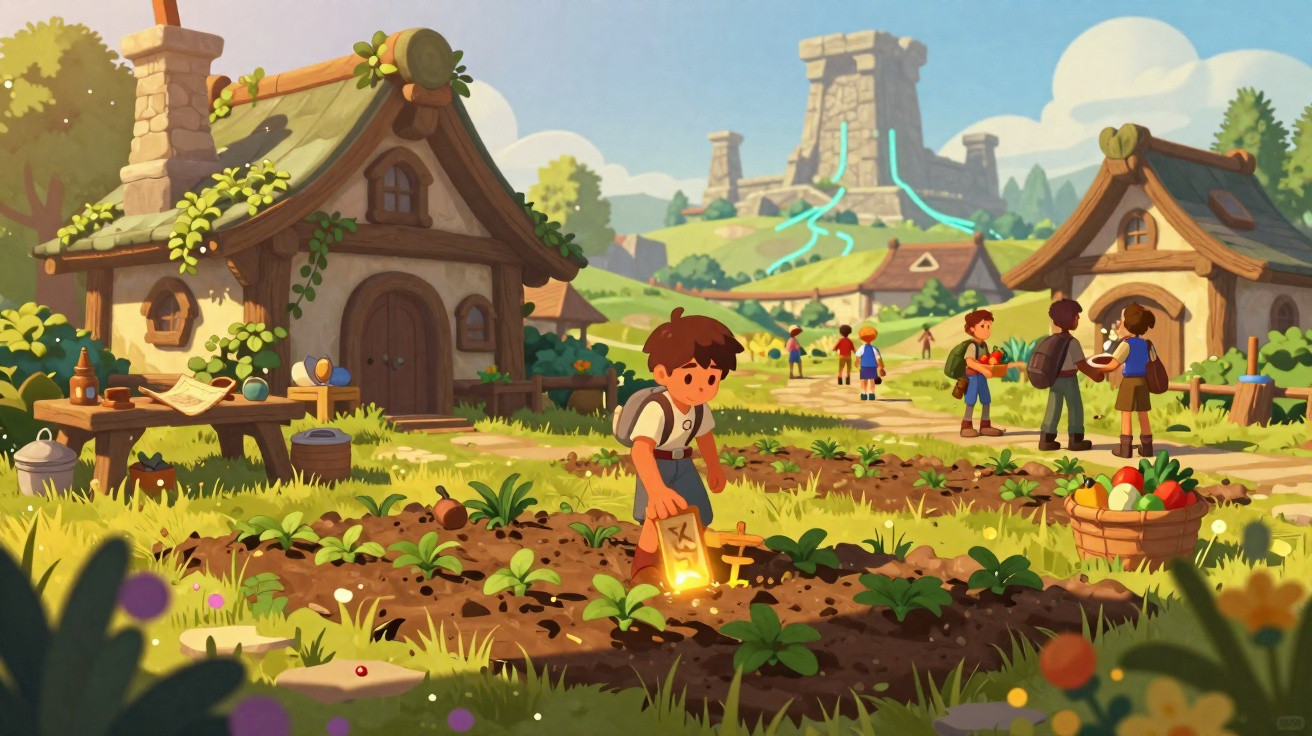
Palia’s fantasy world and central mystery
Life sims are often excellent for unwinding, allowing you to create a digital existence from scratch at your own relaxed pace. Yet many games in the genre are so open-ended that players looking for clearer goals may find themselves responsible for creating all their own entertainment. Palia looks to appeal to both audiences, placing dozens of players in a detailed fantasy world where they can establish a home while pursuing an epic quest. I began a fresh life in Singularity 6’s forthcoming free-to-play life sim MMO. Much of its formula is recognisable, but the prospect of building a home with friends as you uncover a core mystery is an appealing one for the genre.
Players take the role of a custom-made human avatar who is, quite literally, dropped into Palia’s world. Humans once inhabited this land, but they have been extinct for a very long time. A vibrant race of human-like beings known as Palians now occupies the world, knowing humanity only through myths and archaeological discoveries. You are not the only human to have suddenly fallen into this place: plenty of other player characters have arrived as well. How did you end up here, and for what reason? I do not know, but the question is intriguing enough to draw me in.
Palia takes a few cues from the recent Zelda games, allowing players to scale most surfaces using a stamina meter and, later on, obtain a glider. After leaving the opening temple for the town beneath it, I start introducing myself to Palia’s likeable residents. The game runs on a day-and-night cycle, while its citizens have work, homes, and daily routines. They therefore travel about rather than standing in place like animated signposts. Fortunately, the map generally shows their current whereabouts, although catching someone when you need to hand in a quest can be bothersome when they are travelling.
Speaking with residents and helping resolve their issues improves your friendship level, with rewards available at every milestone. You can also win them over by fulfilling their weekly requests. Should you turn on enough charm, it is even possible to romance your neighbours, though I did not play for nearly long enough to fall for any potential partners.
Building a Palia homestead and growing crops
My first assignment is to make the opening piece of my shelter: a tent. At my homestead, I discover a plot choked with trees and scattered with rocks and rubbish. Tidying it up simply involves choosing my axe from an item wheel and getting to work. The materials I gather go into an inventory that can be opened with hotkeys. Although the UI is straightforward to use, Palia currently offers limited controller support. For those who, like me, favour a gamepad, certain actions do not map to buttons, including some basic menu scrolling, so mouse and keyboard remain the best option for now.
After clearing the plot and collecting sufficient resources, I construct my tent along with several essential furnishings, including a storage box, wardrobe, and chair. Positioning objects is uncomplicated thanks to an in-game grid overlay that lets you place items precisely where you want them. An overhead perspective makes detailed decorating even easier. Before long, everything is arranged to my liking, leaving me with my next task: farming.
In practical terms, farming does not differ greatly from comparable games: you till soil, sow seeds, and water the plants until they are ready to eat. One clever strategic element, however, is that every crop has particular traits and benefits which encourage careful planting layouts. Carrots, for instance, may offer a perk that shields nearby plants from weeds. Different fertiliser types can provide buffs as well. Tilling can also reveal unusual treasure or, early on, an item for the main quest. Mature vegetables may be sold or cooked, with the latter offering a range of culinary possibilities through an assortment of tools and items.
You can install a prep station, mixing station, stoves, and other equipment to make meals from a collection of recipes. These kitchen activities include minigames; chopping ingredients, for example, is a timing challenge in which you hit nodes. Cooking is performed against a time limit, and leaving food too long results in it burning. Thankfully, you cannot set the kitchen on fire. Unfortunately, I did not play long enough to build a kitchen or test these mechanics personally.
Eating food restores Focus, a bar that essentially serves as your stomach. More Focus improves how effective you are when carrying out actions, while a full bar provides bonuses to all experience earned. To make the most of your activities, then, you will want a healthy supply of prepared meals or raw food for snacking.
Skills, ancient ruins, and Palia’s shared world
These activities increase your proficiency in individual skills, improving your ability in them and unlocking stronger equipment. The eight starting skills - fishing, cooking, gardening, mining, hunting, bug catching, foraging, and furniture making - each have their own master. Every master has a level that adds fresh products to their corresponding shop. Reaching level 10 in a skill changes your rewards to skill medals, which can be spent on special shop items such as cosmetic trophies. All of this contributes to your overall player level, and because there is no level cap, that total can climb into the thousands.
With the basic tent and items now complete, I take a glowing object I uncovered while tilling to the town scientist, who tells me it is a key. I bring it to a doorway concealed behind a waterfall, opening a route into ancient ruins. While exploring freely, I discover further doorways of this kind, each with its own puzzle. The first one I find presents a riddle requiring me to fill a ritual bowl with an essential ingredient for life. I will not reveal the answer, but solving it opens a passage towards a larger underground ruin area connected to the game’s opening mystery: what was humanity, and what eventually became of it?
As you would expect from both the genre and the game’s MMO structure, everything progresses at an unhurried pace. Processing machines such as a sawmill require time to produce their results. Quests often advance only after someone gets in touch, normally by post, so you will spend the intervening time tackling other jobs. NPCs return home at night, meaning outstanding quests generally cannot be handed in until the morning. For players who enjoy management, overseeing the various gauges and timers to maintain an efficient pipeline has always been an attractive part of life sims, and that remains true here. However, newcomers more interested in the central quest and cooperative multiplayer may need to adjust to operating on Palia’s schedule rather than their own; in this type of game, the journey is often the destination.
Although I did not engage with the small number of players wandering around during this pre-beta period, Palia’s sense of community is another appealing feature. Whether you encounter new companions on the road or join an established group of friends, gathering resources together rewards everyone taking part. If somebody helps you chop wood, both of you receive loot. Players also cannot steal your belongings. You can visit one another’s homesteads to display your work, as well as give furniture and other items as gifts. One useful feature lets you issue public requests for donations of materials you need, allowing generous players to help you reach those goals sooner.
I would need considerably more time with Palia to be certain, but what I have seen so far has made for a cosy, enjoyable experience. Its potential is clear even at this early stage, and I am interested to see how its story develops alongside your homestead. Being able to do it all with a good group of friends is an attractive extra. Palia’s closed beta starts today, while everyone else can join when the open beta begins on August 10. Although these betas are PC-only, Palia is also planned for Switch at a later date. Singularity 6 has created a solid foundation so far, and I look forward to seeing how it continues building as more players make Palia their new home.





Comments
No comments yet. Be the first to comment!
Leave a Comment