
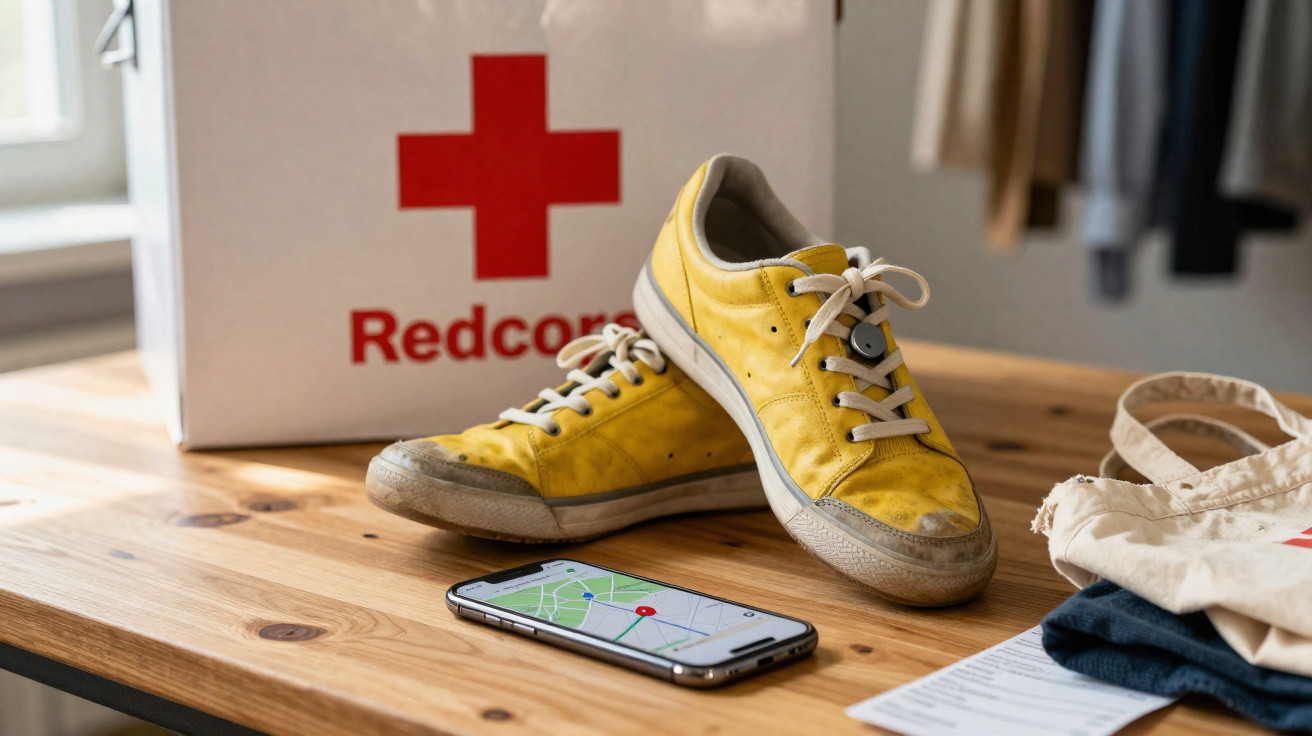
The label said it all. The campaign made the same promise. And that is what the donor believed when he left the box with the Red Cross. More out of curiosity than suspicion, he tucked a small Apple AirTag into one shoe. He simply wanted to see what happened. A few days later, his phone alerted him - not from a refugee centre or a disaster area, but from a commercial resale site many kilometres away.
The map on his phone bore little resemblance to the reassuring images on the charity’s posters. Instead, it pinpointed warehouses, distribution sites and a route that looked strikingly like a commercial supply chain. After he shared screenshots online, the story rapidly gained traction. The Red Cross was then forced to answer questions.
How a simple AirTag became a public relations problem
The story began with an ordinary, low-key act of generosity. A young professional with an interest in trainers and technology sorted through his wardrobe and chose a nearly new pair of running shoes. These were not worn-out shoes, but a pair he would have been happy to pass on to a friend. Just before donating them, he placed an AirTag beneath an insole. It was almost a joke: a modest experiment in transparency.
Initially, the AirTag’s location history looked exactly as he had anticipated. The marker travelled from his home to a local Red Cross collection point, then onwards to a regional sorting facility. Everything appeared routine and unremarkable. For a time, he stopped thinking about it, as people often do with tracking devices sitting unnoticed on their phones. That changed when an alert appeared from a city he had never visited, close to a large industrial estate that looked nothing like a relief camp.
He checked the map more closely and found the name of a major logistics company. The address was also connected to a used-clothing exporter. The shoes, supposedly “for those in need”, appeared to be very close to entering a second-hand commercial chain. He posted screenshots on Reddit, followed by X and TikTok. Within hours, thousands of comments had appeared, combining anger and confusion with one uncomfortable question: what really happens to donated goods?
This was not the first instance of someone tagging an item to follow its route, but this one struck a particular chord. Many people already have concerns about large charities and their administrative costs. Watching a charitable donation seemingly move into the resale market turned that concern into something visible. The story quickly became more than one donor’s curiosity; it came to represent a wider problem of trust. The Red Cross was abruptly under scrutiny, expected to explain complicated logistics to an audience that favours straightforward narratives and uncomplicated heroes.
Behind the scenes: what happens to Red Cross donated shoes
When the Red Cross eventually responded, its explanation was more complex than many people had expected. Not every donated item can be given directly to a person facing a crisis. Sizes may be unsuitable, cultural considerations can apply, local rules vary, and storage capacity is limited. Some goods are redistributed locally, while others are sent to partner organisations. A share is sold in bulk to textile recyclers or through second-hand channels, with the proceeds supporting other programmes.
Regarding the AirTagged trainers, the organisation said the shoes had probably entered a resale or recycling route designed to raise funds for relief work. From a logistical viewpoint, that approach can be reasonable. Selling one high-quality pair in an appropriate market may provide funding for blankets, medical kits or transport for essential emergency supplies. However, that does not remove the donor’s disappointment. He had pictured a particular person wearing his shoes, rather than the donation becoming a line on a funding balance sheet.
The disconnect is clear: charities speak about “supporting people in need”, whereas donors often imagine their physical items being handed over directly. That image is powerful because it is emotional, concrete and personal. When the reality involves pallets, contracts and buyers abroad, the unspoken emotional agreement can seem to have been breached. Even if the financial result still helps someone, somewhere. The AirTag exposed this behind-the-scenes reality without any soft-focus presentation.
Social media users broadly divided into two groups. Some argued, reasonably, that turning donations into funds is practical and efficient. Others said they felt misled, insisting that the Red Cross should state openly: “Your shoes may be sold, not given.” A tiny tracker hidden inside a trainer had suddenly made one of the world’s largest humanitarian brands address an unglamorous subject: supply chain management.
What this story changes for donors and large charities
Anyone donating clothing or shoes today may view this story with both interest and unease. One clear lesson emerges: if you want a particular result, choose a donation method suited to it. Financial donations are generally more flexible and effective for large organisations, as they allow supplies to be purchased precisely when and where they are required. Physical goods, especially second-hand ones, present more difficulties. They require storage, time, sorting and, on occasion, disposal.
One useful approach is to divide your giving between two routes. For direct, person-to-person help, donate items through local community organisations, shelters or mutual-aid networks, where distribution can be seen more clearly. For major crises, financial donations through trusted channels usually have greater impact. That may be less romantic than imagining old trainers racing towards a disaster zone, but it reflects the realities of modern humanitarian work.
Let’s be honest: nobody reads ten pages of a charity’s terms and conditions before dropping off a bag of clothes. It is within that information gap that frustration develops. If you want greater openness, you can politely ask for it: enquire about the fate of unsorted donations, see whether the charity publishes its resale agreements, or seek organisations that already set out their logistics routes online. One donor’s email may not change the world, but a large number of similar questions often can.
The AirTag case also points to a new form of power: ordinary people now have digital traceability at their disposal. Today, it is trainers; tomorrow, it could be medical equipment, electronics or even food consignments. As donors increasingly track goods, large charities will no longer be able to depend on vague narratives. They will have to accept that their behind-the-scenes processes may become viral online.
At a human level, that is the painful part. More deeply, it is an opportunity to restore trust on a more honest basis.
A Red Cross spokesperson put it this way in an interview with a local newspaper:
“We didn’t mishandle the donation, but we underestimated how personal it feels when someone imagines their gift in the hands of a specific person. We must explain better what ‘help’ actually looks like behind the scenes.”
Such a comment will not undo years of unclear communication, but it does signal a change. It acknowledges that donors are not merely wallets or cupboards full of possessions. They are people who want to know where their kindness ends up, particularly at a time when cynicism is already widespread.
In practical terms, consider the following points when deciding where and how to donate:
- A clear policy covering the resale or export of donated goods
- A public explanation of how in-kind donations are used compared with how many are sold
- Partnerships with local groups that enable direct distribution
- The option to earmark cash donations for particular programmes
- Proof that the organisation listens: Q&A pages, public replies and transparent updates
What this tiny tracker says about us
The AirTag in those trainers did more than follow a physical item. It charted a quiet misunderstanding between donors and major humanitarian organisations. On one side was an emotional act: here are my shoes, may they help someone walk again. On the other was a system built for scale, often required to turn goods into figures in order to respond more quickly and across greater distances. When those worlds meet without a proper explanation, trust suffers.
Personally, the story encourages difficult questions. When we donate, are we looking for a feeling or for a result? Are we seeking a photo-ready narrative, or can we accept the untidy, unglamorous reality of logistics and compromises? Collectively, it asks large organisations to move beyond slogans and speak in specifics, even where those specifics sound operational rather than noble.
Most of us have wondered whether a kind gesture truly made a difference or simply disappeared into a vast, anonymous system. This time, a flashing point on a smartphone did not disappear. It followed a route, exposed a blind spot and compelled a discussion. It was not a debate about villains and saints, but about expectations, openness and the fragile thread of trust that still links strangers trying, in their own ways, to help one another.
| Key point | Detail | Why it matters to the reader |
|---|---|---|
| Tracking the trainers | An AirTag showed that donated shoes entered a resale/logistics chain rather than direct aid | Helps you understand what may actually happen to physical donations |
| The reality of charity logistics | The Red Cross explained that some goods are sold or exported to finance broader programmes | Explains why donations do not always reach people in the way you imagine |
| Smarter ways to give | Combine direct local item donations with targeted financial support for large organisations | Offers a practical way to maintain both impact and trust |
FAQ:
- Did the Red Cross “steal” the donated trainers? Based on the organisation’s explanation, the shoes entered a resale or recycling route that helps fund humanitarian work. The donor’s gift was not stolen, but it was not used in the direct, person-to-person way he had imagined.
- Is it legal for charities to sell donated items? In many countries, yes, provided the money is returned to their mission and their resale activity is consistent with their statutes and public communications. The ethical issue concerns transparency more than legality.
- Should I stop donating clothes and shoes? You do not need to. Simply select the appropriate route. For high-impact, large-scale crises, money generally goes further. For clothes and shoes, local shelters, community centres and mutual-aid groups often offer clearer and more direct redistribution.
- Is it okay to use AirTags or trackers on donations? Technically, you can, and this story suggests people will continue to do so. However, you are tracking the journey established by the organisation, not merely searching for “gotcha” moments. If you choose to do it, be prepared to encounter a complex reality rather than a simple scandal.
- How can charities rebuild trust after stories like this? By communicating plainly. They should explain logistics, resale and export routes in clear language, publish straightforward policies, and acknowledge grey areas rather than concealing them. Transparency won’t magically fix everything, but silence almost always makes things worse.






Comments
No comments yet. Be the first to comment!
Leave a Comment