
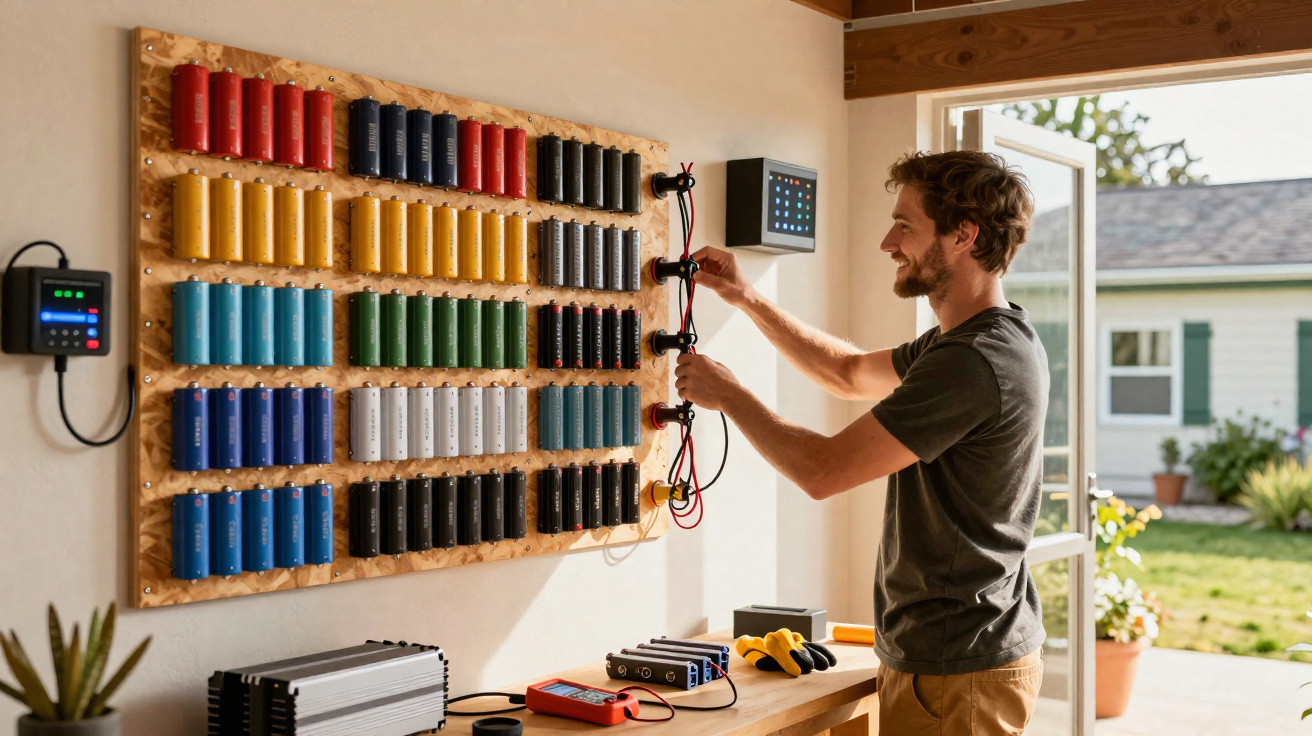
For most people, they are simply electronic waste; for him, they keep the lights, fridge and computer running. For around ten years, an energy-minded DIY enthusiast has been drawing on the remaining capacity of laptop batteries, becoming largely independent of the conventional electricity grid in the process.
How an unusual hobby became a personal electricity supply
The story started in the middle of the 2010s. A technology enthusiast with an interest in self-sufficiency, he had already installed his first solar panels on his property. Initially, the electricity was stored in an old forklift battery – heavy, cumbersome and limited.
At the same time, he noticed how many notebook batteries were thrown away despite being only partly worn out. Many battery packs contain several lithium cells. When one cell fails, the entire battery is usually replaced, even though the remaining cells are often still perfectly usable.
Rather than buying expensive storage systems, he dismantles old laptop batteries and turns them into his own power bank for the entire house.
In November 2016, he began his major project: a self-built energy system in an outbuilding, powered by solar electricity and assembled from hundreds of recovered battery cells.
A hangar behind the house serves as the battery hub
The heart of the installation is not inside the home itself but in a simple hangar roughly 50 metres away. Shelves there are packed with carefully sorted and interconnected cells. From the outside, it looks more like a DIY garage, but inside is the result of years of work.
The principle is straightforward: solar panels on the roof and nearby convert sunlight into direct current. Charge controllers route this electricity into several large battery packs made from reused laptop cells. An inverter then converts it into 230-volt electricity, the same type supplied by a standard mains socket.
To make this possible, he opened batteries from old laptops, tested each individual cell and retained only the sound ones. He then used those cells to build modules with comparable capacity and voltage.
650 laptop batteries at the outset – now more than 1,000
At the beginning, he worked with around 650 used laptop batteries. From these, he created large storage blocks, each with approximately 100 ampere-hours of capacity. Over time, he collected more discarded batteries from a range of sources, sorted and tested them, then combined them into new configurations. His system now contains more than 1,000 such batteries, many wired together in packs.
- Starting point: around 650 used laptop batteries
- Today: more than 1,000 batteries in use within the system
- Storage blocks: approximately 100 Ah capacity each
- Location: a separate hangar about 50 metres from the house
The entire setup is connected with substantial copper cabling. This keeps resistance low and reduces power losses – an important consideration when numerous cells are connected in series and parallel.
Safety: no fires and no swollen batteries
Lithium batteries are widely regarded as sensitive, particularly when non-professionals work on them. Videos of burning e-bike batteries and exploding power banks regularly circulate. The DIY enthusiast, however, stresses that his system has operated for almost a decade without a serious incident.
He reports:
- not a single fire in the battery storage system
- no swollen or ruptured packs during operation
- only isolated cells that he removed as a precaution
One reason is that the installation is housed in its own building rather than in the living room. It is separated from the residential area, benefits from better ventilation, and any damage would be contained in an emergency. He also uses relatively moderate currents, monitors voltage and temperature, and consistently replaces any cells that show signs of concern.
The most important safeguard is probably this: he treats every battery as a potentially risky component – and designs his system conservatively as a result.
How much electricity old laptop batteries can provide
The amount of energy actually available naturally depends on the condition of each cell. Laptop batteries lose some capacity with every charging cycle in everyday use. At a certain point they are too weak for computer use, yet they can still be entirely suitable for stationary storage systems with substantial reserves.
The experimenter combines hundreds of these cells. Even if every one retains only part of its original capacity, together they create a considerable amount of storage. On sunny days, the electricity can cover large parts of the household's demand:
- base loads such as the router, lighting and entertainment electronics
- the fridge and smaller kitchen appliances
- workshop equipment in the hangar, depending on consumption
The extent to which he needs to supplement the system with grid electricity varies with the season and weather. On some days, the house runs almost entirely from the homemade storage system; on dull winter days, the installation is more of a supporting supply.
Why someone would go to all this effort
The idea of one person spending years testing, sorting, soldering and wiring hundreds of batteries may seem mad at first. Yet the appeal is based on several factors:
- Independence: He does not want to depend on tariffs or grid outages.
- Recycling principle: He saves valuable cells from disposal.
- Cost control: Used batteries often cost little or nothing.
- Fascination with technology: He simply enjoys building and refining the system.
The story illustrates the amount of unused potential in what appears to be electronic waste. Every laptop battery consists of several lithium cells that, considered individually, may continue working for years. What is deemed unreliable in an office can become a valuable buffer in a cellar or hangar.
What anyone attempting this must consider
As inspiring as the project may be, one point is equally clear: replicating it requires expertise, patience and an understanding of the risks. Lithium cells are sensitive to overcharging, deep discharge and short circuits. Carelessness can lead to fires.
Anyone intrigued by the approach should first become familiar with the basics:
- differences between lithium-ion and lithium iron phosphate cells
- the role of battery management systems (BMS)
- selecting suitable cable cross-sections and fuses
- clear separation between living areas and battery storage
Many countries also apply strict rules once systems reach certain sizes. Open, self-built installations cannot necessarily be formally approved with ease. The DIY enthusiast therefore operates more in a grey area, where all responsibility rests with him.
Why laptop batteries are so interesting for home energy storage
This case reflects a trend that is also attracting researchers: second-life batteries. Batteries from laptops, e-bikes or electric cars lose range in mobile use, but may still buffer electricity for years in stationary applications. This can extend the useful life of the cells considerably.
Advantages of this approach include:
- Raw materials such as lithium, cobalt and nickel remain in use for longer.
- The environmental balance of battery production improves.
- Home energy storage could potentially be delivered at a lower cost.
At the same time, it raises new questions: who can guarantee the safety of old cells? How can their condition be assessed reliably? And how can such a patchwork of many different batteries be integrated into homes in line with standards?
What can be learned from the project
Although this DIY enthusiast's installation is more an extreme example than a standard solution, it offers valuable inspiration. It shows how much energy can remain in rejected pieces of technology, and how far creativity and persistence can take someone.
For ordinary households, ready-made home energy storage systems from manufacturers offer a much simpler and safer route. Even so, this story highlights a central question in the energy transition: how sensibly do we use the resources already available before producing new ones? The answer will help determine how sustainable our electricity consumption truly becomes in the future.





Comments
No comments yet. Be the first to comment!
Leave a Comment